


.png)

Which BIM Companies Are Hiring Most Actively in 2026?
For those seeking BIM jobs, the best way to navigate the market is to identify which companies are offering the most favourable prospects for growth, learning, and career advancement. Here is a list of the top BIM companies actively hiring in India:
1. AECOM
As one of the world's largest infrastructure consulting firms, AECOM delivers projects across transportation, water, energy, and urban development sectors. Its strong focus on digital project delivery makes it an attractive destination for BIM professionals.
2. L&T Construction
It has delivered some of India's most significant infrastructure and building projects. Its adoption of BIM across project workflows offers professionals exposure to large and technically complex developments.
3. CP Kukreja Architects
Known for its work across healthcare, education, hospitality, and urban planning projects, CP Kukreja Architects has been among the early adopters of BIM in India. The firm offers opportunities in integrated design and project coordination.
4. WSP India
Part of the global WSP network, the company delivers engineering and consulting services across buildings, transportation, and infrastructure sectors. BIM professionals often gain exposure to multidisciplinary projects across international markets.
5. Gammon India
Gammon India has contributed to the development of major infrastructure projects across the country. BIM professionals support the coordination and management of complex project information.
6. DLF
As one of India's leading real estate developers, DLF has delivered numerous residential, commercial, and mixed-use developments. BIM supports coordination and project management across its large project portfolio.
7. Shapoorji Pallonji
Renowned for landmark buildings and infrastructure projects, Shapoorji Pallonji is one of India’s leading BIM companies. They integrate BIM into their project planning and delivery processes. This creates opportunities to work on large-scale and technically demanding developments.
8. Prestige Group
Prestige Group is one of South India's leading real estate developers with projects spanning residential, commercial, retail, and hospitality sectors. BIM helps improve coordination and delivery across its diverse developments.
9. Godrej Properties
Known for its focus on innovation and quality, Godrej Properties has adopted BIM to support project planning and execution. Professionals can gain experience across a wide range of real estate developments.
10. Tata Consulting Engineers
As one of India’s leading BIM companies, Tata Consulting Engineers serves infrastructure, energy, manufacturing, and industrial sectors through its engineering expertise.
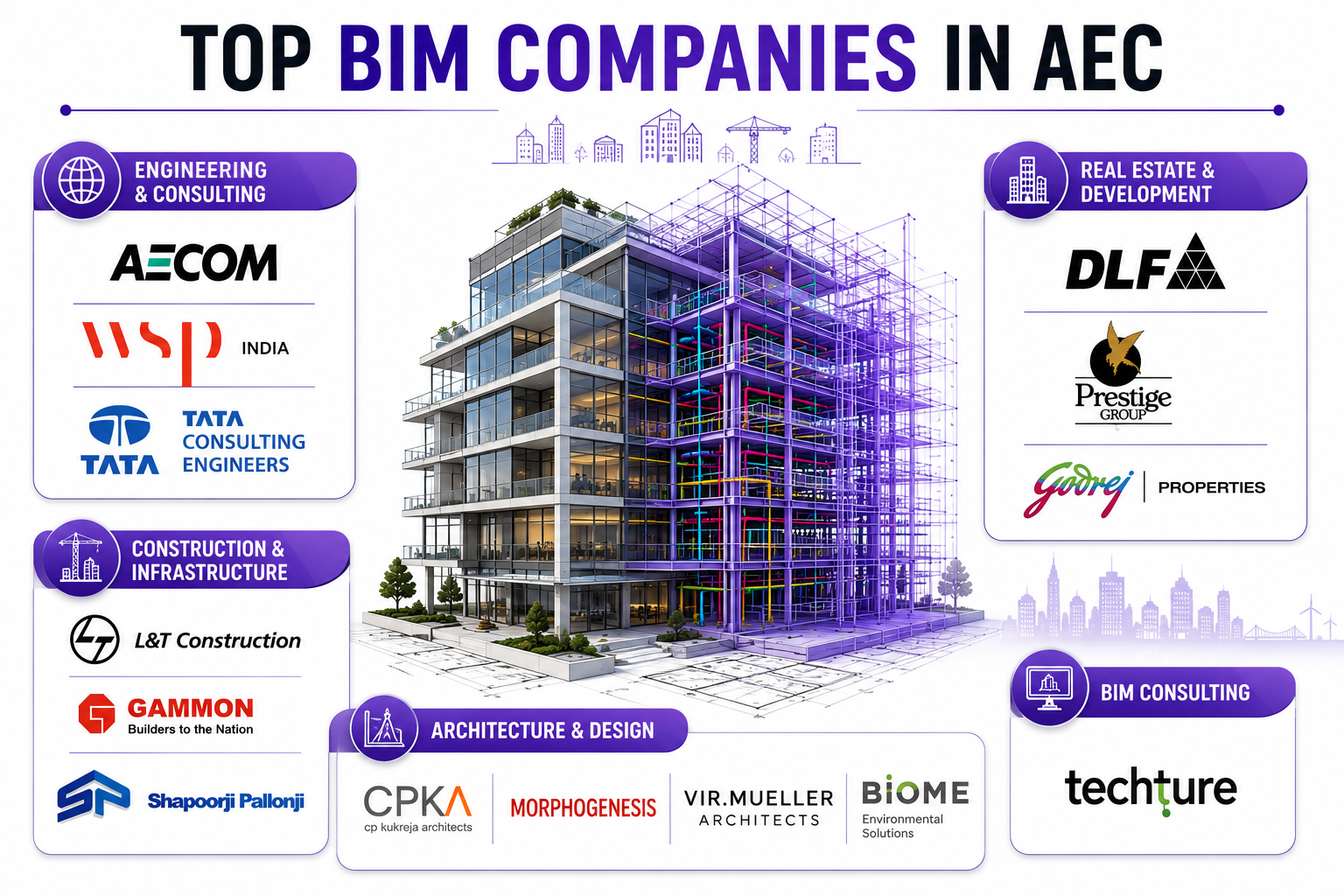
11. Biome Environmental Solutions
Led by architect Chitra Vishwanath, Biome Environmental Solutions is known for its sustainable and environmentally responsive design approach. BIM supports the firm's efforts to integrate ecological performance with project delivery.
12. Morphogenesis
Morphogenesis is recognised for its climate-responsive and sustainable design approach across commercial and institutional projects. BIM forms an important part of its collaborative design process.
13. VIR.MUELLER Architects
Known for its contemporary design language, VIR.MUELLER Architects delivers projects across residential, commercial, and hospitality sectors. The firm's technology-driven workflows create opportunities for BIM-enabled project delivery.
14. Techture
This firm specialises in BIM consulting, implementation, and digital transformation services. It is an ideal destination for individuals looking to build expertise in BIM technologies and workflows.
What Roles Are AEC Companies Looking to Fill in BIM Teams?
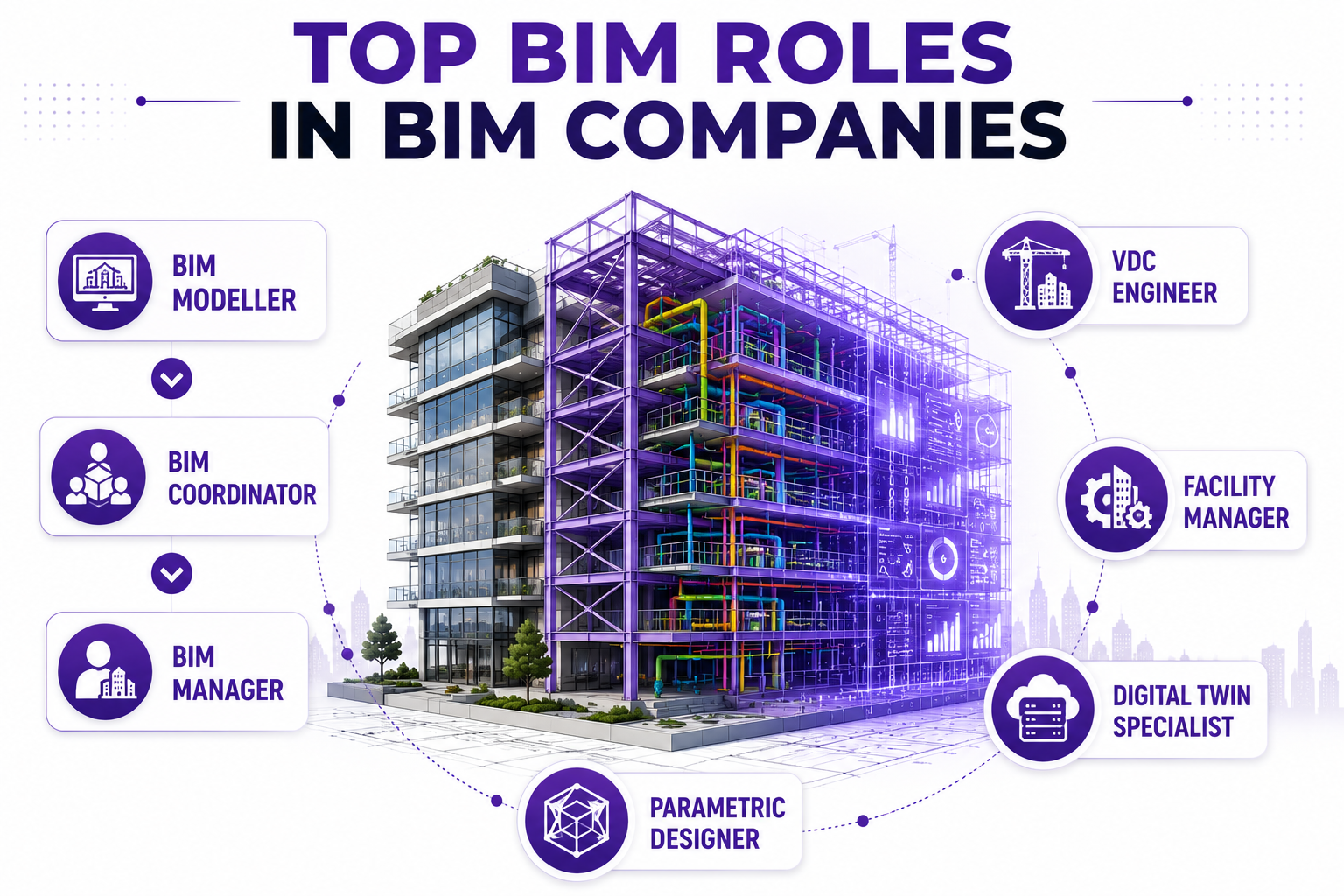
BIM careers have a trajectory. Freshers typically start with roles such as BIM modellers or BIM engineers, climbing their way up the ladder. Let’s have a look at the key roles that companies are hiring for:
1. BIM Modeller
BIM Modellers are responsible for creating and maintaining accurate 3D models based on design and construction information. They work closely with architects and engineers to ensure project data is properly represented within the BIM environment.
2. BIM Coordinator
BIM Coordinators belong to the mid-seniority cadre in BIM companies and manage the exchange of information between different disciplines, and help identify clashes or inconsistencies within project models. Their role is crucial in ensuring seamless collaboration across teams.
3. BIM Manager
They develop BIM standards, workflows, and implementation strategies within an organisation. Their job is to oversee project delivery from a BIM perspective while ensuring teams adhere to established processes and best practices.
4. VDC Engineer
Virtual Design and Construction (VDC) Engineers use BIM models to support construction planning, sequencing, and site coordination. They bridge the gap between design intent and on-site execution.
5. Facility Manager
In BIM companies, facility managers leverage BIM software to analyse and support building operations, maintenance, asset tracking, and lifecycle management.
6. Digital Twin Specialist
These professionals create and manage digital replicas of a physical structure by combining BIM models with real-time operational data. These digital environments help monitor performance and optimise building operations.
7. Parametric Designer
For design experts, this role seems like an extension of architecture jobs where professionals use computational design tools for developing data-driven design solutions. They create, iterate, and analyse 3D models that can respond to changing project requirements while improving design efficiency and innovation.
Which Skills Help Candidates Stand Out in BIM Hiring?
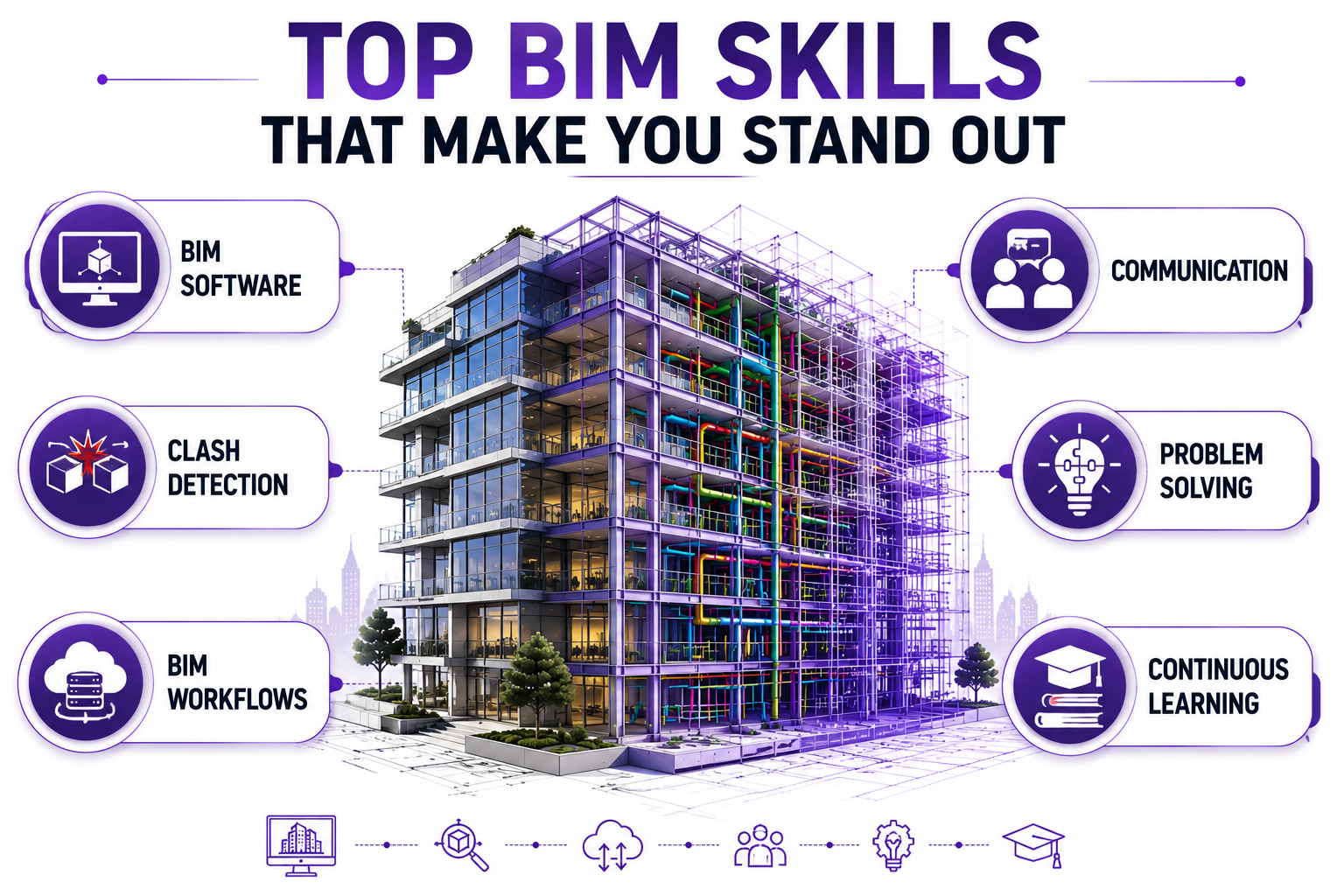
Understanding BIM is not just about mastering a software or two. It’s about learning new tools, processes, and workflows that require a blend of digital as well as interpersonal aptitudes. To secure a job, individuals need to have the following BIM skills:
1. BIM Software Skills
Employers expect candidates to be experts in industry-standard BIM tools such as Revit, Navisworks, Civil 3D, AutoCAD Cloud Construction, Archicad, or similar platforms relevant to their discipline.
2. Clash Detection
BIM projects involve multiple disciplines working simultaneously. The ability to identify clashes, resolve conflicts, and coordinate information across teams is highly valued by BIM companies.
3. Awareness of BIM Workflows
Beyond software, candidates should understand concepts such as Common Data Environments (CDEs), model coordination, information exchange, and project delivery workflows.
4. Communication
BIM is inherently collaborative. So, professionals are often in sync with architects, engineers, contractors, clients, and facility managers to provide real-time feedback and ensure seamless execution.
5. Problem-Solving
Whether it is resolving design conflicts or optimising project workflows, BIM companies frequently encounter challenges that require critical thinking and a solution-oriented mindset.
6. Continuous Learning
BIM technologies continue to evolve with advancements in automation, AI, digital twins, and cloud collaboration. Employers often prefer candidates who demonstrate a willingness to learn and adapt to new technologies.
Why Is Demand for BIM Professionals Growing Across India?
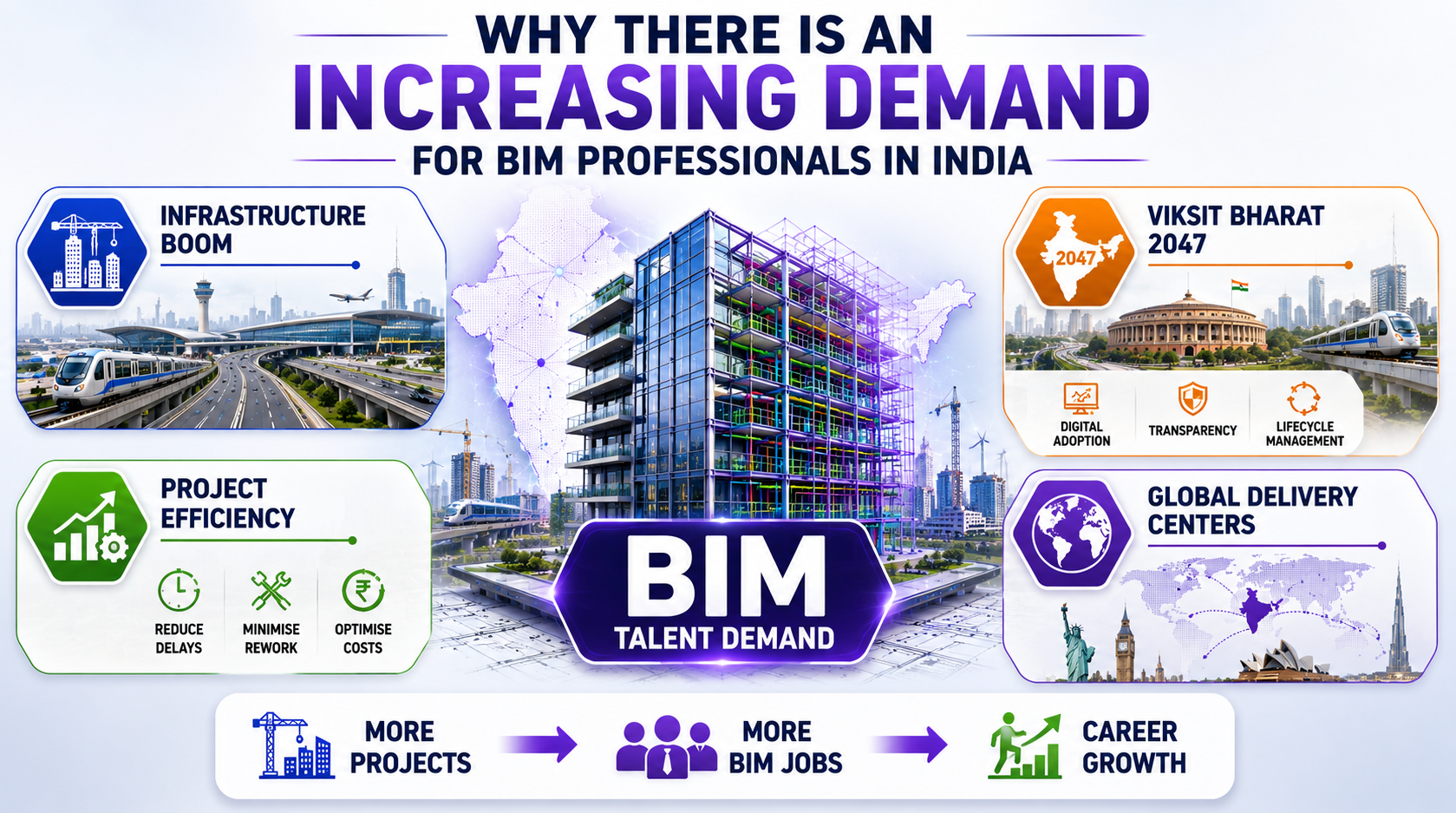
In the past decade, BIM has made a significant impact on global projects of significance. These projects have demonstrated how BIM can improve project coordination and construction quality across India’s rapidly growing AEC industry.
1. Growing Infrastructure Development
As one of the fastest-growing global economies, India is witnessing large-scale investments in airports, metro networks, highways, industrial facilities, and smart cities. The complexity of these projects has increased the need for skilled individuals in infrastructure jobs who can improve coordination across multiple stakeholders.
2. The “Viksit Bharat 2047” Agenda
Public sector organisations are increasingly encouraging the adoption of digital technologies to improve project efficiency, transparency, and lifecycle management. This has created new opportunities for BIM professionals across infrastructure and public works projects.
3. Rising Demand for Project Efficiency
Developers, consultants, and contractors are under constant pressure to reduce project delays, minimise rework, and optimise costs. BIM helps achieve these goals by enabling better planning, coordination, and information management.
4. Expansion of Global Delivery Centres
Many international AEC firms operate design and engineering centres in India to support projects across North America, Europe, Australia, and the Middle East. These BIM companies actively seek professionals who can contribute to their globally delivered projects.
What Types of Companies Hire BIM Professionals Beyond Architecture Firms?
The demand for BIM professionals is not just limited to architecture firms. They also find a place in companies dealing with digital construction, project management, infrastructure development, and construction technology. Here’s the list of industries hiring BIM-skilled candidates:
1. Engineering Consultancies
These firms use BIM to coordinate structural, civil, and MEP systems across projects. BIM professionals help improve collaboration, reduce design conflicts, and ensure smooth information exchange between disciplines.
2. Construction and Contracting Companies
Contractors leverage BIM for construction jobs such as planning, clash detection, quantity take-offs, and site coordination. This helps improve project efficiency while minimising delays and rework.
3. Infrastructure Development Firm
Companies involved in airports, metro systems, highways, and utility projects use BIM to manage large volumes of project information. BIM enables better coordination across multiple stakeholders and disciplines.
4. Project Management Consultancies (PMCs)
PMCs use BIM tools to track project progress, improve communication, and support decision-making throughout the project lifecycle. BIM professionals help maintain accurate and up-to-date project information.
5. Real Estate Developers
Developers adopt BIM to improve their design coordination, optimise costs, and reduce project risks. The technology also helps them make more informed decisions during project planning and execution.
6. Facility Management Companies
BIM models provide valuable data for building operations and maintenance after project completion. Facility managers use this information to improve asset management and lifecycle planning.
7. Construction Technology Companies
ConTech firms develop digital tools that support BIM workflows, collaboration, and project delivery. They often hire BIM professionals to support product development, implementation, and client engagement.
8. Industrial Organisations
Industrial facilities such as factories, warehouses, pharmaceutical plants, and data centres use BIM to coordinate complex systems and improve project execution. This has created a growing demand for BIM expertise within the sector.
How Can Freshers and Working Professionals Prepare for BIM Hiring?
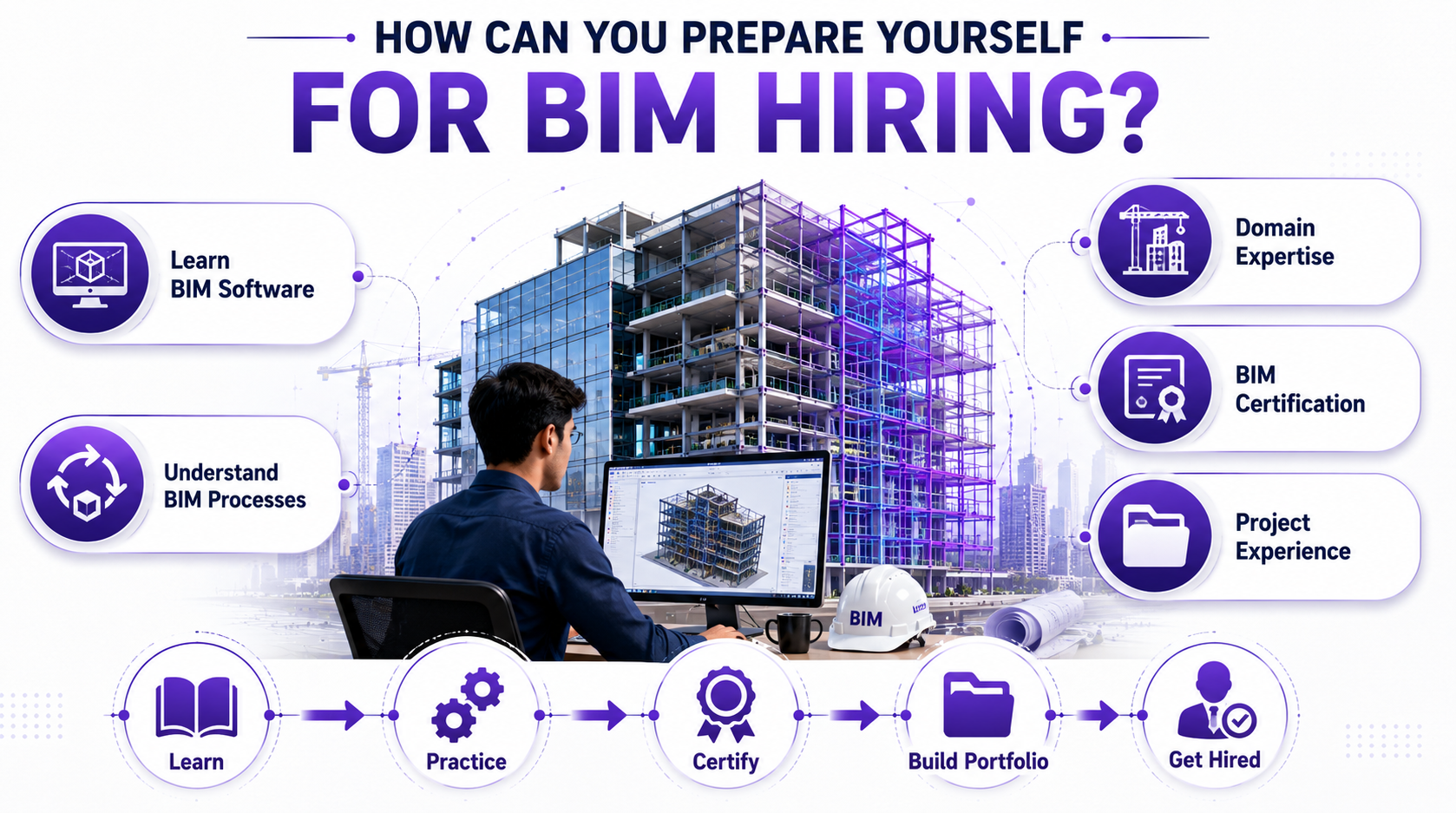
Individuals seeking career growth through BIM should focus on building skills that align with the industry's evolving digital workflows. Let’s explore the path to employment in BIM companies.
1. Learn BIM Software
Familiarity with tools such as Revit, Navisworks, and Tekla Structures is often a prerequisite for many BIM roles. Candidates should focus on understanding not just the software interface, but also how these tools support project delivery.
2. Understand BIM Processes
BIM companies also require candidates to have knowledge of concepts such as model coordination, clash detection, Common Data Environments (CDEs), and BIM execution plans, which can help candidates stand out.
3. Develop Discipline-Specific Expertise
BIM professionals with a strong acumen of structure, architecture, construction, or MEP systems are typically more valuable to companies. Domain knowledge helps candidates apply BIM effectively within real-world project scenarios.
4. Pursue Industry-Relevant BIM Certifications
Certifications such as the one provided in Novatr’s BIM Professional Program can validate technical competence and display a commitment to professional development. They also help candidates showcase their expertise when applying for BIM-focused roles.
5. Gain Practical Project Experience
Working on live projects, internships, or project portfolio exercises allows candidates to apply their skills in a practical setting. BIM companies value hands-on experience as much as formal training.