



Overview of Atal Setu Project
Atal Setu is the longest sea bridge in India popularly known as Mumbai Trans Harbour Link. It runs from Sewri to Nhava Sheva in Mumbai and Navi Mumbai. The bridge spans about 22 kilometers, of which a significant part is floating above the Arabian Sea.
This project aimed to provide a shortcut between Mumbai and Navi Mumbai, which could cut down the journey time from almost 2 hours to around 20 minutes. It also helps to alleviate traffic congestion and promotes economic development in the region.
This is no simple task to construct a sea bridge of this magnitude. It includes the marine environment, long spans and several teams collaborating. That's where digital solutions, such as BIM in infrastructure, can come into play to deal with planning, design and execution.
What is BIM in Construction?
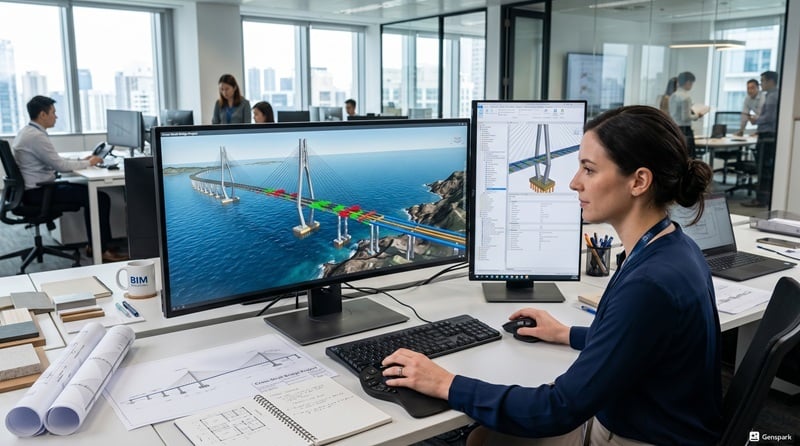
Building Information Modeling system functions as a digital process for construction projects, which enables users to create and manage 3D models and their associated design details, material specifications and project timelines.
BIM integrates all the elements into a single system, rather than using individual drawings.
The BIM in construction is quite the opposite, and in simple terms, BIM helps construction teams:
- Plan the project before constructing it
- See changes as they happen (real-time tracking)
- Control the data of cost, time and material
- Enhance team working relationships
It's not all about software. It's the thing of planning and executing projects with data.
In BIM in design, BIM is readily employed in bridge and building design, and various infrastructure projects today to enhance accuracy and minimise re-work.
How BIM helped in Atal Setu's Planning and Design?
BIM technology for design work provided multiple benefits to the planning and design processes.
- Development of the 3D models of the Bridge: In 3D, engineers produced detailed models of the bridge structure, including all pillars, spans, and the roadway.
- Testing of the Structure Under Real Conditions: The design team simulated the wind, waves and traffic load on the structure in the testing process.
- Conflict detection: Pre-construction, conflicts between various systems were identified using BIM.
- Structural Workflow: Road team and utility team adopted the same model for design coordination to minimize confusion.
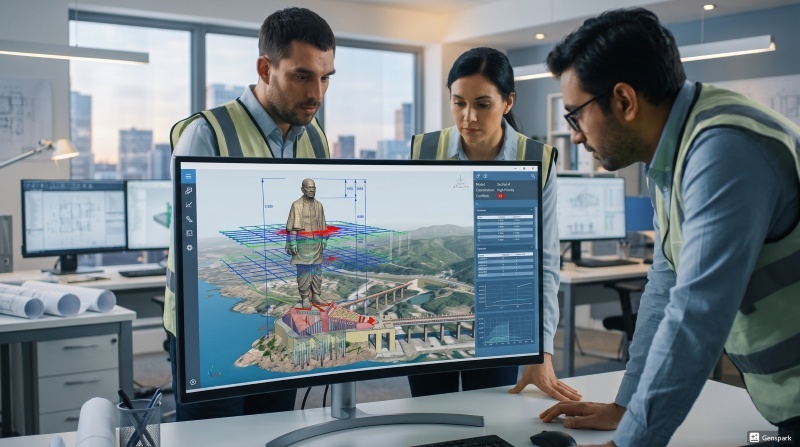
- 3D visualization: 3D views might give stakeholders a better understanding of the project, which would be more effective than 2D drawings.
Role of BIM in Construction and Coordination
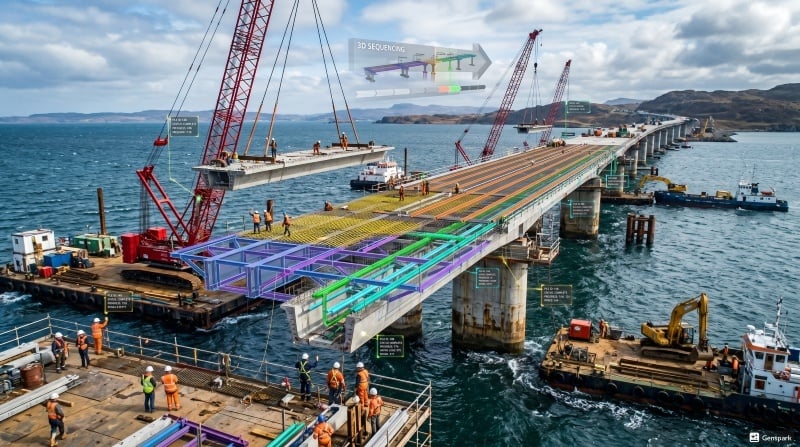
In a sea bridge project, coordination is even more important due to the limited space available to work and the deadlines.
An important aspect of using BIM was the management of this complexity:
- Centralized data management: Project data were stored within one system, and this data was more readily available and easy to update.
- Real-time updates: When team members updated the same content, they would see this as soon as the other team did.
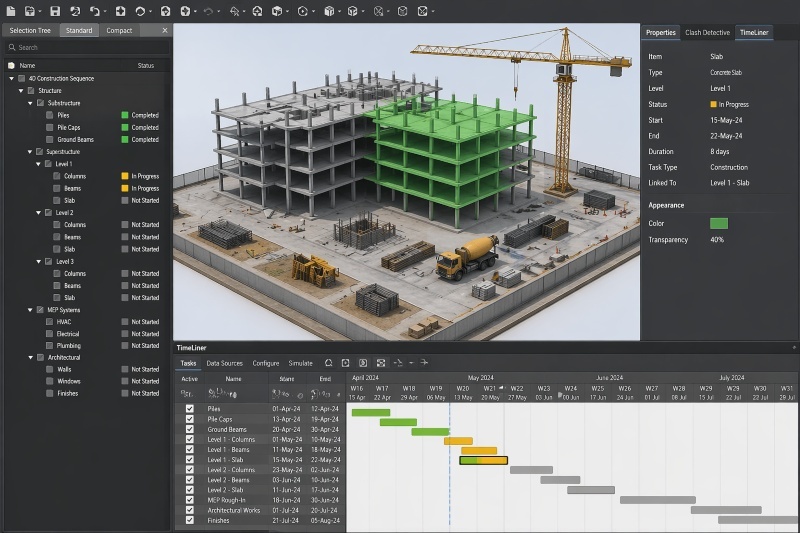
- Construction sequencing (4D BIM): The sequence of construction activities was planned to avoid delays.
- Material tracking: BIM has enabled the tracking of materials and timely delivery to the site.
- Coordination amongst teams: There could be coordination between structural, marine and road teams without conflicts.
- Progress monitoring: Engineers monitored progress in relation to the planned schedule.
Benefits of Using BIM in Bridge Projects
The following advantages illustrate how BIM in infrastructure is becoming an integral part of large projects.
|
Benefit |
Explanation |
|
Better planning |
Assists with the visualisation of the project before construction work starts |
|
Reduced errors |
Finds conflicts and problems with design early on |
|
Time savings |
Improves scheduling and avoids delays |
|
Cost control |
Minimises rework and material waste |
|
Improved coordination |
Provides all teams with a single platform to connect with each other |
|
Data management |
Stores all project data in one place |
|
Safety improvement |
Involved in optimizing safe construction practices |
Challenges in Sea Bridge Construction
Some of the following problems were encountered on construction:
- Marine sensitive environment: High wind, waves and salt water affecting construction activities.
- Challenge of foundation complexity: Deep foundations are needed in water, challenging to do.
- Logistics and transport: Transportation of materials and equipment by water is difficult.
- Lack of working space: Workers and machines work in confined spaces.
- Weather sensitivity: Construction is very sensitive to weather conditions.
- Expensive projects: Any project that is delayed or has an error will add to the overall cost.
- Coordination problems: There can be multiple teams working together and confusion can occur if systems are not in place.
How to Learn BIM for Infrastructure Projects
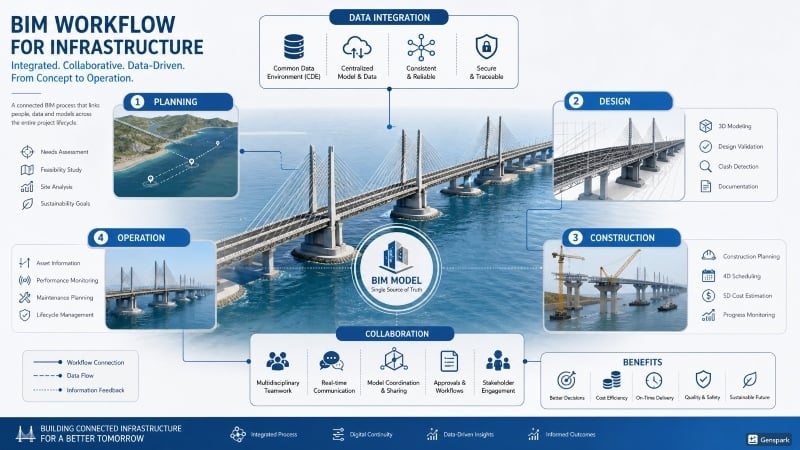
Developing BIM ability hinges heavily on learning construction methodologies, tools and coordination procedures. These skills need to be used effectively by professionals in a real setting related to infrastructure projects.
Take your civil engineering career to the next level with Novatr’s BIM Professional Course for Civil Engineers, a project-based program that prepares you to plan, design, and manage construction projects using 12+ industry software and essential BIM plugins.
Learn how to work with Autodesk Revit, Navisworks, construction cloud and key plugins like DiRoots.One, pyRevit, EF-Tools, ProSheets, Issue and Model Checker for Revit to improve automation, accuracy, and project efficiency.
Here’s what you’ll gain:
- End-to-end understanding of BIM workflows — modeling, estimation, coordination, sequencing, and documentation.
- Hands-on training aligned with ISO 19650 standards and real residential + commercial projects.
- Globally recognized certifications:
- Novatr Course Certificate
- Autodesk User Certification
- NSDC Skill Certificate
- Novatr Specialization Certificate, if opted
After completing the core modules, learners can also choose 2 additional specializations, including:
- Visual Programming with Dynamo – for automation and parametric workflows
- 4D, 5D & 6D with BIM – for time, cost, and facility integration
- Tekla for RCC Modeling – for detailed steel and concrete modeling
- Civil 3D for Infrastructure – for roadways, railways, and utilities
- Project Strategy & Optimization with Plannerly - Plan, structure, and audit BIM execution plans.
This structured approach enables professionals to build solid and effective BIM skills applicable to real projects.