---
title: What’s the Difference Between Generative, Parametric, and Algorithmic Design? (From an Expert’s Lens)
description: Understand the real differences between generative, parametric, and algorithmic design through an expert lens and practical project insights.
image: https://blog.novatr.com/hubfs/What%E2%80%99s%20the%20Difference%20Between%20Generative%2c%20Parametric%2c%20and%20Algorithmic%20Design_.jpg
---
[Blogs](https://www.novatr.com/learning-hub)
- [Architecture & Construction](https://www.novatr.com/learning-hub?category=Architecture+%26+Construction)
- [BIM](https://www.novatr.com/learning-hub?category=BIM)
- [Computational Design](https://www.novatr.com/learning-hub?category=Computational+Design)
- [Company News](https://www.novatr.com/learning-hub?category=Company+News)
- [Expert Talks](https://www.novatr.com/learning-hub?category=Expert+Talks)
Explore Courses
[Just Launched  BIM Professional Program v.2026 Take your career to the next level by mastering the real-world application of BIM. Know More](https://www.novatr.com/courses/bim-professional-program)
[ Master Computational Design Course Break into an advanced career by learning to apply the power of computation to the art of design. Know More](https://www.novatr.com/courses/computational-design)
[Blogs](https://www.novatr.com/learning-hub)
Explore Blogs
- [Architecture & Construction](https://www.novatr.com/learning-hub?category=Architecture+%26+Construction)
- [BIM](https://www.novatr.com/learning-hub?category=BIM)
- [Computational Design](https://www.novatr.com/learning-hub?category=Computational+Design)
- [Company News](https://www.novatr.com/learning-hub?category=Company+News)
- [Expert Talks](https://www.novatr.com/learning-hub?category=Expert+Talks)
Courses
- [BIM Professional Program v.2026](https://www.novatr.com/courses/bim-professional-program)
- [Master Computational Design](https://www.novatr.com/courses/computational-design)
- [BIM/](https://www.novatr.com/learning-hub?category=BIM) [BIM/](https://www.novatr.com/learning-hub?category=BIM)
Featured Article
# What’s the Difference Between Generative, Parametric, and Algorithmic Design? (From an Expert’s Lens)

Kanwaljeet Singh
February 16, 2026
7 min read


computational design has moved from experimental studios into everyday architectural practice. It now supports facade engineering, infrastructure planning, sustainability modelling, and large-scale coordination across multidisciplinary teams.
Data in the industry indicates this change. According to the [UK Office of National Statistics](https://www.ons.gov.uk/businessindustryandtrade/constructionindustry/articles/constructionstatistics/2023?) total new construction work in Great Britain reached £139.0 billion in 2023 which is the highest value on record. The larger the project and the more complicated the regulations, the harder it is to maintain the manual coordination.
Alongside this growth, conceptual confusion has intensified. Terms such as parametric, algorithmic, and generative design are frequently used interchangeably. In many offices, they are treated as software features rather than distinct ways of structuring design thinking. They are not interchangeable.
These approaches represent different layers of computational reasoning. They define how architects structure problems, encode relationships, and produce outcomes. Without understanding these layers, designers risk learning tools without learning the systems that make those tools effective.
Understanding their differences requires returning to fundamentals: how architectural systems are constructed and how design decisions are organised.
Unlock High-Paying Careers With BIM
Master BIM workflows, software and skills on real projects.
Apply Now
\*Limited seats available
## **From Drawings to Systems**
Traditional architectural drawing is fundamentally additive. Designers add marks, erase marks, and overlay independent lines to build up complexity. Relationships exist, but they remain implicit maintained mentally by the designer rather than embedded in the medium itself.
As Robert Woodbury explains in Elements of Parametric Design, the archetypal design medium is pencil, eraser, and paper. The pencil adds. The eraser subtracts. Even when precision tools are introduced, the logic remains unchanged: designers accumulate independent elements and personally manage their consistency.
When CAD software emerged, the medium changed, but the underlying logic did not. Lines became digital, layers replaced tracing paper, and drafting became faster. However, the computer largely remained a representational device. This phase, often described as computerization, digitised preconceived ideas rather than enabling design reasoning.
Kostas Terzidis, in Algorithmic Architecture, draws a clear distinction. Computerization is the act of entering, processing, and storing information. It is extremely powerful for documentation and repetition, but it does not reason, deduce, or explore.
Computerization works effectively for deterministic problems such as drafting, documentation, visualisation, and modification. However, contemporary architectural challenges increasingly involve uncertainty, interdependence, performance feedback, and emergent behaviour, conditions that cannot be resolved through representation alone.
## **Computerization vs Computation**
Computation is not simply the use of computers. It is the use of logical and procedural systems to derive outcomes from relationships and rules.
Terzidis defines computation as determining something through mathematical or logical methods. More importantly, he emphasises that computation is exploratory. It addresses ill-defined problems and extends human reasoning by enabling systems to evaluate, deduce, and generate outcomes.
Achim Menges similarly describes computation as increasing the specificity of information from abstraction. Rather than manually resolving every consequence, computational systems deduce results from initial values and relationships.
This shift is not merely technical. It is methodological. Design moves from drawing representations to constructing systems capable of reasoning.
Parametric, algorithmic, and generative design all emerge from this transformation and represent different ways of approaching architecture computationally.
## **What Is Parametric Design — At Its Core?**
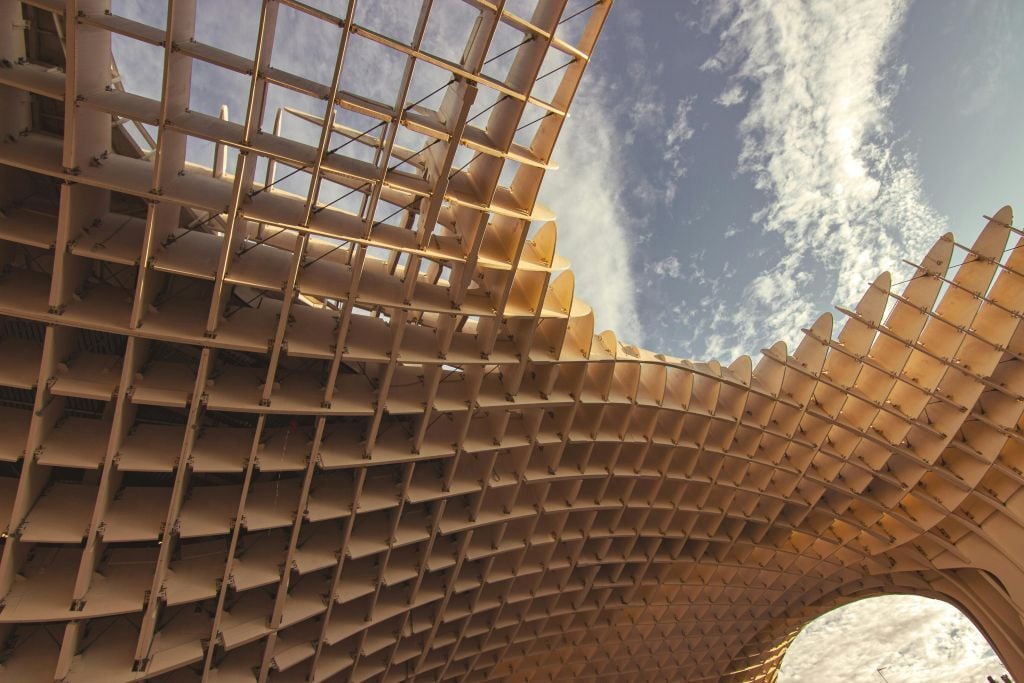
Parametric design begins when an architect stops designing isolated objects and starts designing relationships.
At its core, [parametric design](https://www.novatr.com/blog/understanding-parametric-design-in-architecture-the-complete-guide) is not about visual complexity. It is about explicitly defining how elements depend on one another. Walls, floors, facades, structural members, and services become parts of a connected system.
In traditional drawing, designers manage consistency mentally. In parametric systems, consistency is embedded. Relationships are defined in advance, allowing coordinated change.
The designer moves from controlling individual elements to constructing frameworks of dependency.
As Robert Woodbury explains in [Elements of Parametric Design](https://www.researchgate.net/publication/272148176_Elements_of_Parametric_Design), traditional design operates through adding and erasing independent elements. Parametric design introduces a shift: designers add, erase, relate, and repair. When one part changes, dependent parts are reorganised through relationships rather than manually redrawn.
### **Parameters and Constraints**
Every parametric system rests on two foundations. Parameters define what can vary, including dimensions, quantities, densities, and performance values. Constraints define how elements relate, including alignment, proportionality, containment, and continuity.
Together, they transform drawings into coordinated systems. When one value changes, the system reorganises itself according to predefined rules.
This is why parametric design is often described as associative geometry. Branko Kolarevic describes parametric design in [Architecture in the Digital Age](https://books.google.co.in/books?id=iv95AgAAQBAJ&printsec=copyright#v=onepage&q&f=false) as associative geometry, geometry whose behaviour is defined by relationships that can be revisited and revised throughout the design process. Geometry becomes responsive rather than static.
### **Typical Architectural Use Cases**
Parametric design becomes essential wherever coordination is unavoidable.
#### **In Facades**
Facades operate as dependency networks. Panels relate to grids. Openings relate to daylight. Geometry relates to fabrication. Density relates to performance.
Contemporary facade systems must respond to environmental data, material constraints, structural logic, and construction workflows. Parametric systems allow these requirements to remain coherent.
Here, parametric design functions as organisational infrastructure.
#### **In Towers**
Tall buildings intensify interdependence. Floor plates depend on cores. Facades depend on stacking logic. Structural systems depend on spans. Zoning depends on regulatory envelopes.
Manual coordination becomes unreliable at this scale. Parametric systems allow global changes to propagate systematically.
In high-rise projects, parametric design becomes a mechanism for managing complexity.
To get more insights on the application of computational design in architecture, read our [detailed blog](https://www.novatr.com/blog/computational-design-in-architecture).
## **What Makes Algorithmic Design Fundamentally Different?**
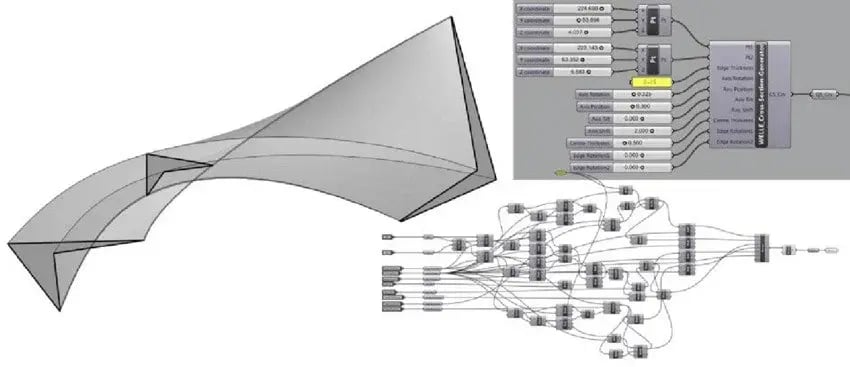
A parametric model becomes algorithmic when geometry is no longer the starting point and logic becomes primary.
Algorithmic design begins with a procedure. It focuses on defining step-by-step reasoning that structures how decisions are made. Instead of shaping outcomes directly, the designer organises processes that generate outcomes.
An algorithm is a finite sequence of instructions that performs a task or solves a problem. Arturo Tedeschi defines algorithms as finite, well-defined instructions that return a solution or perform a task, emphasising that algorithms are not inherently digital but reflect structured human reasoning broken into executable steps. These instructions may exist in code, diagrams, or written logic.
### **Logic-First vs Geometry-First Thinking**
Parametric design often starts with geometry and makes it responsive. Algorithmic design starts with logic and allows geometry to emerge. This represents a shift from composing forms to designing decision systems. Buildings become the result of encoded reasoning.
### **Conditional Logic, Loops, and Rule-Based Systems**
Algorithmic design introduces conditional statements, iterative loops, hierarchies, and evaluation structures.
These mechanisms allow systems to filter options, sequence operations, resolve conflicts, and prioritise outcomes. Instead of reacting passively, systems actively reason through scenarios.
As Kostas Terzidis clarifies in Algorithmic Architecture, computation differs from mere computerisation. Computerisation processes and stores information; computation determines outcomes through logical and mathematical methods. It reasons, evaluates, and deduces.
### **Deterministic Outcomes**
Most architectural algorithms are deterministic. Given the same inputs and rules, they produce the same outputs. Terzidis notes that algorithms formalise design reasoning into repeatable logical structures; they do not replace the designer, but operationalise structured thinking. They formalise design thinking and make it scalable.
### **Examples in Practice**
Algorithmic thinking appears wherever architecture becomes procedural. In space planning, algorithms structure adjacency and circulation. In code-compliant layouts, they formalise regulatory and safety requirements. In optimisation workflows, they enable systematic testing and refinement. In these contexts, form is computed rather than composed.
## **What Exactly Is Generative Design?**
Generative design is a strategic use of computational systems to explore multiple solutions. Generative systems produce many outcomes from the same goals and constraints. Designers define objectives, limitations, and evaluation criteria. The system searches the solution space.
Generative design becomes possible because computation is exploratory. [Terzidis](https://www.academia.edu/6994087/Algorithmic_Architecture)emphasises that computational systems can address indeterminate problems by evaluating and deducing outcomes rather than simply representing predefined ideas.
In practice, generative design appears in two dominant modes. The first is optioneering. Systems generate diverse configurations for early-stage exploration.
The second is optimization. Systems iteratively refine solutions toward performance targets. Achim Menges describes computation as increasing the specificity of information from abstraction, allowing results to be deduced from initial parameters rather than manually resolved step by step. Generative systems extend this principle into multi-solution exploration.
Despite its visibility in software marketing, generative design is less common in daily practice. It is usually confined to research teams, competitions, and specialised technical groups.
Most firms embed generative moments within broader parametric and algorithmic workflows. Without stable relationships and clear logic, generative systems produce variation without direction.
## **How These Approaches Combine in Real Projects**
In real projects, parametric, algorithmic, and generative design function as layers. Algorithmic structures define decision logic. Parametric systems embody those decisions in coordinated geometry. Generative strategies allow exploration and refinement.
A project may use algorithms for zoning, parametric systems for building components, and generative solvers for performance testing.
What is often labelled “generative design” is typically a mature parametric and algorithmic framework with targeted exploration. Generative methods amplify structured thinking.
## **Which One Should Architects Learn First — And Why?**
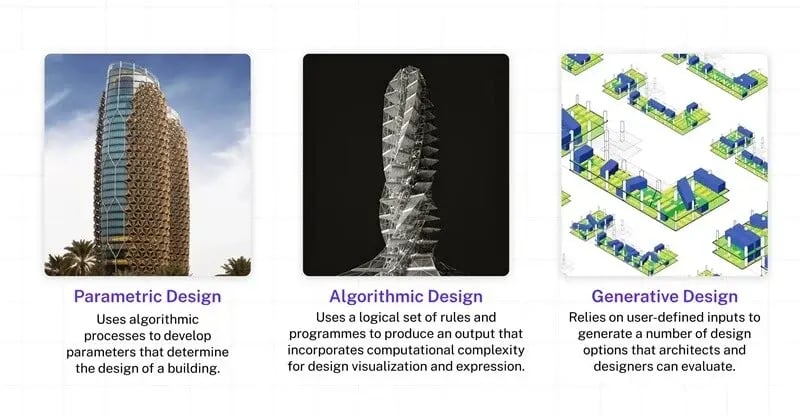
For architects with limited time, the learning sequence matters.Parametric thinking should come first. It builds sensitivity to relationships and coordinated change.Algorithmic thinking should follow. It develops procedural reasoning and abstraction.
Generative thinking belongs later. It functions effectively only when systems are stable.
### **1. Skill Maturity vs Project Complexity**
As project complexity increases, architectural work shifts from form-making to system management. Larger teams and higher performance demands require stronger computational frameworks. Computational maturity must grow alongside responsibility.
### **2. Common Beginner Mistakes**
Common mistakes include jumping directly into generative tools, confusing variation with intelligence, building unstable parametric models, and optimising poorly defined problems.
These practices produce visual complexity without structural clarity. Computational design is about constructing better systems.
## **How To Get Started?**
Most architectural education still prioritises additive workflows. Far fewer programmes train designers to build systems, formalise relationships, and encode logic.
Yet contemporary practice increasingly demands coordinated change management, performance-driven workflows, and data-informed decision structures.
Developing computational literacy requires progression from parametric foundations to algorithmic reasoning and finally to generative exploration. Programmes such as Novatr’s [Master Computational Design Course](https://www.novatr.com/courses/computational-design) are structured around this progression and grounded in architectural application.
Master BIM and Get Hired Faster
Join a community of 8500+ Architects and Engineers.
Explore Now
\*Limited seats available
## Conclusion
Parametric design teaches control over relationships. Algorithmic design teaches how to encode reasoning. Generative design teaches how to explore solution spaces. They are layers of computational maturity.
As Woodbury, Kolarevic, Terzidis, Tedeschi, and Menges collectively frame it, the shift in computational design is not stylistic but methodological — from composing geometry to constructing systems capable of reasoning, reorganising, and deducing outcomes.
Architectural practice is increasingly shaped by those who can design clear systems, robust logic, and adaptable workflows. As projects grow in scale and interdependence, computational thinking becomes central to professional competence.
Computational design is no longer a visual style. It is becoming the operating system of architecture.
For architects seeking structured development in this direction, the [Master Computational Design](https://www.novatr.com/courses/computational-design) Course offered by [Novatr](https://www.novatr.com/) provides a pathway grounded in practice-based learning and systemic thinking. Visit our [resource page](https://www.novatr.com/learning-hub) to explore learning materials, case studies, and detailed programme information that support long-term computational growth.
Was this content helpful to you
Like Yes
Dislike No

TABLE OF CONTENTS
BIM Is The New Standard. Are You Certified?
Get Certified in BIM
SHARE ON YOUR SOCIALS
Link Copied Successfully
Related articles
[ MCD D5 Render For Architects: Here's What You Should Know 12 November 2025 4 min read](https://blog.novatr.com/blog/d5-render-for-architects-heres-what-you-should-know) [ MCD 10 Modern Pavilion Architecture Examples Around the World } 26 July 2023 8 min read](https://blog.novatr.com/blog/10-impressive-parametric-pavilions) [ MCD Impressive Engineering of the World's Largest Masonry Dome by Filippo Brunelleschi | 2026 Updated 17 July 2023 8 min read](https://blog.novatr.com/blog/worlds-biggest-dome-by-filippo-brunelleschi) [ MCD How did Computational Design Benefit the Construction of ZCB Bamboo Pavilion? 26 July 2023 6 min read](https://blog.novatr.com/blog/zcb-bamboo-pavilion-case-study)
Download Syllabus
## BIM Professional Program
Next Cohort
June 2026
Program Duration
7 Months
Premium Program benefits
8 Credentials from Autodesk, NSDC, Novatr
1 program. 10 career paths. Infinite Growth.
40+ ISO 19650 & RIBA real-world projects to practice
1-on-1 guidance. Access 400+ industry experts.
Access the biggest AEC-Tech community on the planet. 8500+ and counting
Curated for you by 100+ global BIM leaders.
Lifelong access to course content
Enter your details to download the program syllabus.
##### BIM Professional Program
June 2026, 7 Months
Your Name Invalid name.
Phone Number Enter a valid phone number
Email Please enter a valid email address.
Select years of experience\* Currently studying 0-1 years 1-2 years 2-4 years 4-8 years 8-10 years 10-12 years 12+ years Invalid selection.
Specialisation Select your background\* Architecture Civil Engineering Mechanical Engineering Electrical Engineering Invalid selection.
Are you professionally trained in interior design?
Yes
No
I agree to the [Terms of Use](https://www.novatr.com/terms-and-conditions) and [Privacy Policy](https://www.novatr.com/privacy-policy), and consent to be contacted by Email, Call, WhatsApp, or SMS.
Submit
Ready to skyrocket your career?
Begin your next chapter in AEC
with Novatr!
We are here to help you take the industry by storm with advanced, tech-first skills.
[Explore Courses](https://www.novatr.com/#courses)
Join our newsletter
Submit
Thank you for signing up.
We’ll send you a nice letter once per week. No spam.

Dare to Disrupt.
Join thousands of people who organise
work and life with Novatr.
Company
- [About Us](https://www.novatr.com/about)
- [BIM Professional Program v.2026](https://www.novatr.com/courses/bim-professional-program)
- [Masters Computational Design](https://www.novatr.com/courses/computational-design)
- [Become a Mentor](https://www.novatr.com/apply-as-mentor)
- [Hiring from Us](https://www.novatr.com/hire-from-us)
- [Careers at Novatr](https://www.novatr.com/career)
Resources
- [Blog](https://www.novatr.com/learning-hub)
- [Media Room](https://www.novatr.com/media-room-home-page)
- [Career Builder](https://www.novatr.com/career-navigator)
- [Events & Webinars](https://www.novatr.com/webinars)
- [FAQs & Support Center](https://www.novatr.com/contact-us)
- [Contact Us](https://www.novatr.com/contact-us)
- [Privacy Policy](https://www.novatr.com/privacy-policy)
- [Terms of Use](https://www.novatr.com/terms-and-conditions)
©2023 Oneistox Network Pvt. Ltd.
All Rights Reserved
```json
{
"@context" : "https://schema.org",
"@type" : "BlogPosting",
"author" : {
"@type" : "Person",
"name" : "Kanwaljeet Singh",
"url" : "https://blog.novatr.com/blog/author/kanwaljeet-singh"
},
"dateModified" : "2026-02-16T08:14:44.617Z",
"datePublished" : "2026-02-16T07:29:47.000Z",
"headline" : "What’s the Difference Between Generative, Parametric, and Algorithmic Design? (From an Expert’s Lens)",
"image" : [ "https://blog.novatr.com/hubfs/What%E2%80%99s%20the%20Difference%20Between%20Generative%2c%20Parametric%2c%20and%20Algorithmic%20Design_.jpg" ],
"mainEntityOfPage" : {
"@id" : "https://blog.novatr.com/blog/generative-vs-parametric-vs-algorithmic-design-an-expert-perspective-for-architects",
"@type" : "WebPage"
},
"publisher" : {
"@type" : "Organization",
"logo" : {
"@type" : "ImageObject",
"url" : "https://blog.novatr.com/hubfs/Novatr%20Prev%20OX-2.svg"
}
}
}
```