




Overview: Artificial Intelligence in Civil Engineering
Wondering what is artificial intelligence in civil engineering? It is the integration of AI technologies to revolutionise traditional construction practices. AI enhances accuracy in planning, design, and execution by automating complex tasks and enabling data-driven decision-making. In civil engineering, AI is crucial for optimising workflows, predicting structural behaviors, and managing resources efficiently.
Through Building Information Modelling, AI fosters seamless collaboration, enabling professionals to visualise projects, detect potential issues, and streamline processes. This synergy is reshaping the industry, making projects more efficient, sustainable, and cost-effective.
AI in civil engineering uses data-driven insights to help teams make faster, more accurate decisions across all project phases, from concept to maintenance.

Application of Artificial Intelligence in Civil Engineering
By integrating AI technologies, engineers can enhance precision, efficiency, and sustainability across various domains. Here is a look at the diverse ways AI is being utilised in civil engineering, along with the artificial intelligence methods and their applications in civil engineering.
-
Structural Health Monitoring
AI-powered sensors and systems continuously assess the condition of infrastructure. These solutions detect stress, deformation, or damage in buildings, bridges, and tunnels, enabling engineers to take proactive maintenance measures. The application of artificial intelligence in civil engineering ensures infrastructure safety and minimises repair costs by identifying potential issues before they escalate. For instance, AI-based SHM systems in smart bridges now analyze vibration data to predict potential faults weeks before they occur, reducing costly repairs and improving public safety.
-
Design and Modeling with Generative AI
Generative design tools utilise AI to create innovative and efficient building designs. Engineers input specific constraints, and AI generates optimised design options, considering factors like cost-effectiveness, energy efficiency, and functionality. Companies like Autodesk and Bentley are already using generative AI to design lighter, safer bridges and energy-efficient structures. This application boosts creativity while adhering to project requirements.
-
Geotechnical Risk Assessment
It predicts soil behavior and geological risks, such as landslides or ground instability, by analysing vast datasets. These artificial intelligence methods and their applications in civil engineering help improve site selection and ensure safer construction practices in challenging terrains. Machine learning models have been used in metro tunnel projects to map underground stability, minimizing excavation risks and project delays.
-
Smart Traffic Management
AI improves urban planning by analysing traffic patterns and congestion hotspots. It helps design better road networks, optimise traffic signals, and predict future traffic conditions, enhancing commuter experience and reducing transportation inefficiencies. For example, AI-based smart city programs in Hyderabad and Singapore have improved signal coordination, cutting commute times by up to 20%.
-
Sustainable Construction Practices
AI recommends sustainable materials and evaluates a project’s environmental impact through lifecycle analysis. It ensures compliance with green building standards and improves energy efficiency.
-
Automation in Construction
AI-powered autonomous machinery, such as drones and robotics, is transforming construction sites. Drones conduct site surveys, while AI-driven machines perform tasks like excavation and concrete pouring with precision, reducing human error and boosting productivity.
This reduces manual labor risks and accelerates project timelines while ensuring consistency in quality.

Role of Artificial Intelligence in Civil Engineering
The use of AI in civil engineering has brought transformative changes to the way projects are planned, executed, and maintained. AI-powered tools and technologies have enhanced precision, efficiency, and decision-making across various facets of the industry. Here are some key roles that AI plays in civil engineering:
-
Design Optimisation
AI enables advanced modeling and simulation, helping engineers design structures that are both efficient and sustainable. By analysing large datasets and real-world scenarios, AI assists in creating optimised layouts for bridges, buildings, and other infrastructure.
-
Risk Assessment and Management
The use of AI in civil engineering allows for real-time risk analysis. AI identifies potential hazards, such as structural weaknesses or environmental impacts, enabling engineers to mitigate risks effectively during the planning and execution stages.
-
Predictive Maintenance
AI algorithms analyse sensor data from infrastructure to predict when maintenance is needed. This proactive approach helps prevent unexpected failures, saving costs and ensuring the safety of structures like dams, roads, and bridges.
-
Smart Material Selection
It also assists in selecting materials based on factors such as cost, durability, and environmental impact. Engineers use AI-driven tools to predict material behavior under various conditions, ensuring better project outcomes.
-
Construction Automation
Artificial intelligence powered robots and autonomous machinery are transforming construction sites. Tasks like excavation, material handling, and quality inspection are increasingly automated, improving efficiency and safety while reducing human labor dependency.
-
Resource and Cost Management
It streamlines project budgeting and resource allocation. By analysing past projects and real-time data, it provides accurate cost estimations and ensures optimal resource utilisation, preventing delays and wastage.
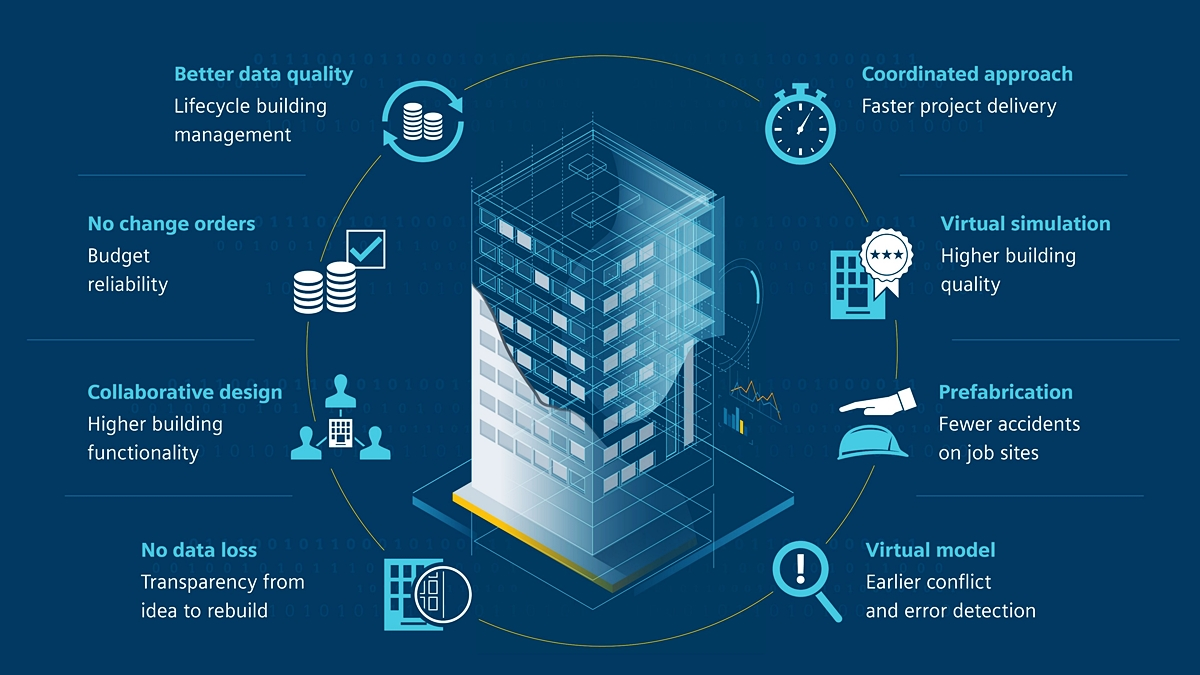
Benefits of Integrating Artificial Intelligence in BIM for Civil Engineers
The integration of artificial intelligence in civil engineering through Building Information Modeling is transforming how projects are conceptualised and executed. This powerful combination enables enhanced accuracy, efficiency, and innovation. Here are some key advantages of AI in BIM in civil engineering and its impact on BIM-driven workflows.
-
Enhanced Design Optimisation
AI algorithms analyse vast datasets to suggest design optimisations in real-time. From material selection to structural load distribution, AI improves designs by predicting performance under various conditions. Civil engineers benefit from automated simulations, which refine construction plans and reduce potential errors before execution.
-
Improved Risk Mitigation
AI enhances risk assessment by analysing project data and identifying potential hazards or delays. In combination with BIM, engineers can visualise these risks within the project model, enabling proactive measures. Whether it's structural vulnerabilities or budget overruns, AI-powered insights help mitigate risks effectively.
-
Efficient Resource Management
One of the key advantages of AI in civil engineering is its ability to streamline resource allocation. AI tools in BIM predict material requirements and labor needs, minimising waste and ensuring optimal resource utilisation. This leads to significant cost savings and environmentally sustainable practices in construction projects.
-
Enhanced Collaboration and Communication
AI-powered tools integrated with BIM facilitate better communication among project stakeholders. From architects to contractors, everyone accesses a unified project model enriched by AI insights. This improves coordination, reduces misunderstandings, and fosters collaborative problem-solving.
-
Streamlined Construction Processes
Integrating AI into BIM automates repetitive tasks like clash detection, scheduling, and coordination. AI reduces the time spent on manual corrections, ensuring seamless workflows. Civil engineers can focus on strategic decisions while AI handles operational complexities, improving overall project efficiency.


-1.png)
