



What Are the Biggest Infrastructure Announcements?

The infrastructure budget focuses on improving connectivity, reducing logistics costs, and modernizing urban systems. These developments are aligned with national growth priorities and create a structured pipeline of projects for the coming years.
To better understand the scope, the key announcements can be grouped into the following areas:
1. Roads, Highways, and Urban Infrastructure
The railway and highway budget 2026 emphasizes road expansion and urban infrastructure upgrades to support economic activity. Several initiatives stand out:
- Expansion of national highway networks to connect industrial regions
- Development of urban transport systems such as metro rail and bus corridors
- Investment in smart city infrastructure, including drainage, water supply, and housing
- Focus on sustainable construction practices for urban resilience
For example, expanding highway corridors reduces travel time for goods transportation, improving supply chain efficiency. Similarly, metro rail projects in growing cities help reduce congestion and support urban mobility.
2. Railway Infrastructure Expansion
Railway development remains a core focus within the union budget of India, with continued investments in modernization and capacity building. Key developments include:
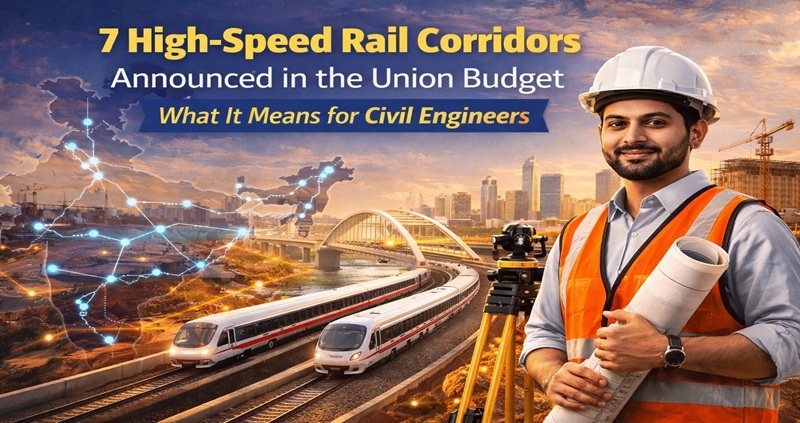
- Expansion of high-speed rail and semi-high-speed corridors
- Redevelopment of railway stations into integrated transport hubs
- Electrification of railway tracks to improve efficiency and reduce emissions
- Strengthening of freight corridors for faster cargo movement
The railway and highway budget 2026 also supports better integration between railways, ports, and highways. This creates a seamless logistics network that benefits industries and reduces operational delays.
For civil engineers, these projects involve complex design, structural planning, and coordination, increasing the need for advanced engineering solutions.
These announcements highlight how the budget of India 2026 is shaping infrastructure development through both scale and innovation.
Major Transport Projects Announced

The infrastructure budget highlights include several large-scale transport projects that aim to improve connectivity across regions. These projects are designed to support economic growth and reduce inefficiencies in logistics.
The major initiatives include:
- Development of new expressways connecting key economic corridors
- Expansion of dedicated freight corridors for faster goods movement
- Construction of multimodal logistics parks to integrate transport systems
- Port connectivity projects to improve trade efficiency
- Smart transport systems linking urban and regional networks
For instance, multimodal logistics parks allow goods to move seamlessly between road, rail, and ports. This reduces handling time and improves overall efficiency.
These projects reflect how the union budget 2026 highlights for civil engineers' focus on integrated infrastructure planning. Engineers working on such projects must coordinate across multiple disciplines, making digital tools essential.
The infrastructure budget also encourages private sector participation, which increases project diversity and creates new opportunities for engineers.
Impact on the Civil Engineering Industry
The union budget 2026 highlights for civil engineers directly influencing the demand for skilled professionals. As infrastructure spending increases, the complexity of projects also rises, requiring specialized expertise.
Some of the key impacts include:
- Increased demand for BIM Engineers and BIM Managers
- Growth in roles related to infrastructure design and planning
- Expansion of opportunities in project management and coordination
- Rising need for professionals skilled in digital construction tools
For example, a large railway station redevelopment project requires coordination between multiple teams, including architects, structural engineers, and contractors. BIM enables this coordination by creating a shared digital model.
The career opportunities for civil engineers are expanding beyond traditional roles. Engineers are now expected to manage data, use advanced software, and collaborate across disciplines.
Additionally, the infrastructure budget highlights encourage innovation in construction practices, including automation and prefabrication. This further increases the need for skilled professionals who can adapt to new technologies.
The union budget of India is also driving growth in public-private partnership projects, which offer diverse roles and exposure to large-scale infrastructure development.
How Can Civil Engineers Be Future Ready?

To align with the infrastructure budget highlights, civil engineers need to develop skills that match modern project requirements. The focus is shifting toward digital tools, integrated workflows, and efficient project delivery.
Key areas to focus on include:
- Software Skills: Learning tools such as Autodesk Revit, Navisworks, and Civil 3D helps engineers create accurate models and simulations. These tools improve design precision and reduce errors during execution.
- BIM Workflows: Understanding BIM processes such as modeling, coordination, and documentation is essential for managing complex projects. BIM also supports cost estimation and scheduling.
- Project Management Skills: Engineers need to manage timelines, budgets, and teams effectively, especially in large infrastructure projects.
- Sustainability Practices: Knowledge of eco-friendly construction methods is becoming increasingly important in urban and infrastructure projects.
For example, using BIM in a highway project allows engineers to visualize the design, identify potential conflicts, and optimize construction processes.
To build these skills, structured training programs play an important role.
Take your civil engineering career to the next level with Novatr’s BIM Professional Course for Civil Engineers, a project-based program that prepares you to plan, design, and manage construction projects using 12+ industry software and essential BIM plugins.
Learn how to work with Autodesk Revit, Navisworks, construction cloud and key plugins like DiRoots.One, pyRevit, EF-Tools, ProSheets, Issue and Model Checker for Revit to improve automation, accuracy, and project efficiency.
Here’s what you’ll get:
- End-to-end understanding of BIM workflows — modeling, estimation, coordination, sequencing, and documentation.
- Hands-on training aligned with ISO 19650 standards and real residential and commercial projects.
Globally recognized certifications:
- Novatr Course Certificate
- Autodesk User Certification
- NSDC Skill Certificate
- Novatr Specialization Certificate, if opted
After completing the core modules, learners can also choose two additional specializations, including:
- Visual Programming with Dynamo – for automation and parametric workflows
- 4D, 5D and 6D with BIM – for time, cost, and facility integration
- Tekla for RCC Modeling – for detailed steel and concrete modeling
- Civil 3D for Infrastructure – for roadways, railways, and utilities
- Project Strategy and Optimization with Plannerly
These skills align closely with the evolving career opportunities for civil engineers, ensuring professionals remain competitive in a changing industry.