

.png)

The Digital Twin Revolution: What is BIM, Anyway?
Before we dive into these megaprojects, let's understand BIM. Think of Building Information Modeling as creating a digital replica of a building or infrastructure project, a "digital twin" that contains every conceivable detail about what's being built. It's not just a fancy 3D model; it's an intelligent database that tracks everything from the thickness of concrete barriers to the placement of every electrical conduit, all while helping different teams coordinate their work in real-time.
BIM integrates structured, multi-disciplinary data to produce a digital representation of an asset across its lifecycle, from planning and design to construction and operations. In simpler terms? It's like having X-ray vision combined with time travel. You can see inside your building before it's built and predict problems before they happen.
Qiddiya Speed Park: Where Desert Dreams Meet Digital Precision
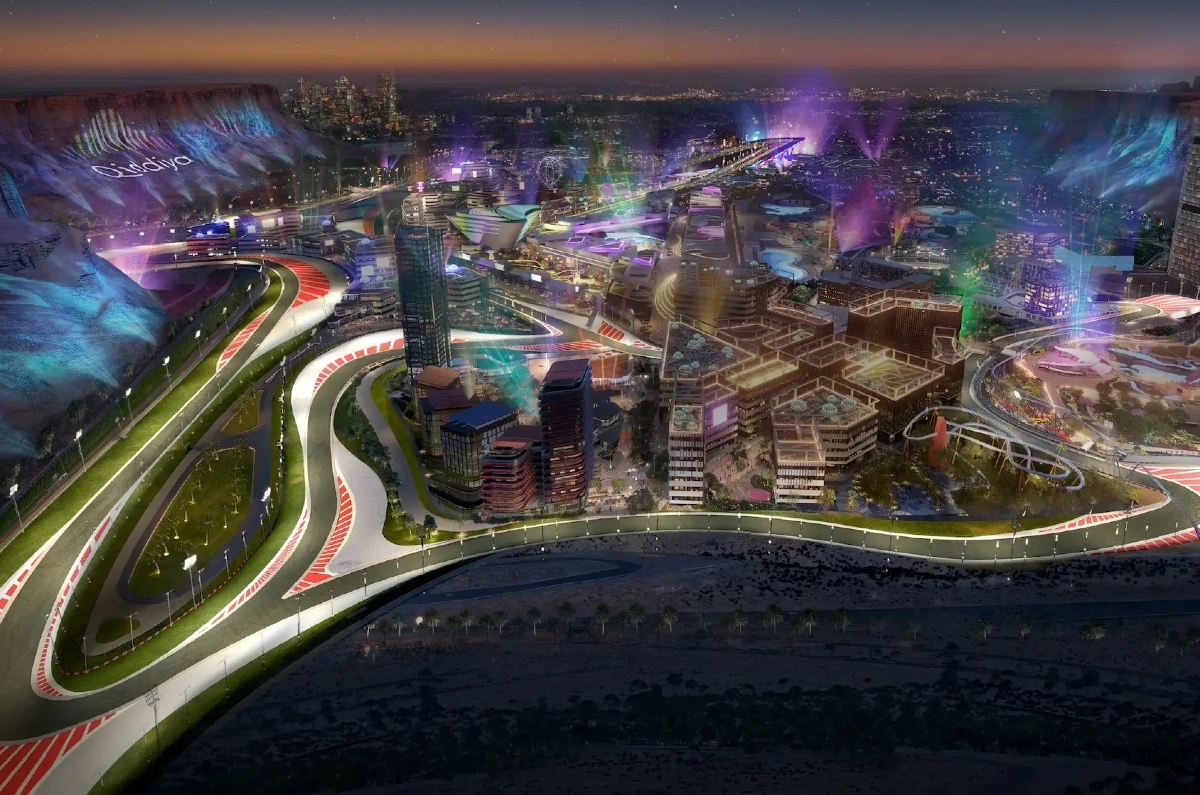
Let's talk about ambition. Saudi Arabia's Qiddiya Speed Park isn't just building a race track; they're creating an entire motorsport universe. The circuit features 21 corners and achieves elevation gains of more than 108 meters per lap, with a design by Formula 1 driver Alex Wurz and circuit designer Hermann Tilke. But here's where it gets truly mind-bending: the first turn, called "The Blade," climbs some 70 meters into the air, roughly equivalent to a 20-story building, with plans for a concert venue underneath.
Now imagine coordinating that without BIM. Spoiler alert: you couldn't.
The project is being developed using LOD 400 (fabrication and assembly) and LOD 500(as-built) BIM modeling, which represent construction and as-built documentation levels of detail. These "Levels of Development" (LOD) are industry standards that define how much information is packed into the digital model. LOD 400 means the model includes everything needed for fabrication and assembly, precise dimensions, materials, and installation details. LOD 500 takes it even further, representing the actual as-built conditions for facility management.
What makes this approach revolutionary for Qiddiya Circuit?
The project has leveraged advanced construction technologies, including Building Information Modeling and modular construction techniques, to streamline operations and mitigate delays. When you're building a track section that literally defies gravity and engineering convention, being able to simulate, test, and coordinate every element digitally before pouring a single cubic meter of concrete isn't just helpful, it's essential.
The scope is staggering: a plot area of 895,500 square meters with a track length of 6.6 kilometres. BIM allows the massive team to coordinate infrastructure, including electrical networks, storm drainage systems, water and sewer networks, landscape works, and all the underground and above-ground structures simultaneously. Without this digital coordination, different teams would inevitably clash (literally) with pipes running through structural beams or electrical conduits blocking drainage systems.
Madrid's F1 IFEMA Circuit: BIM from Blueprint to Burnout
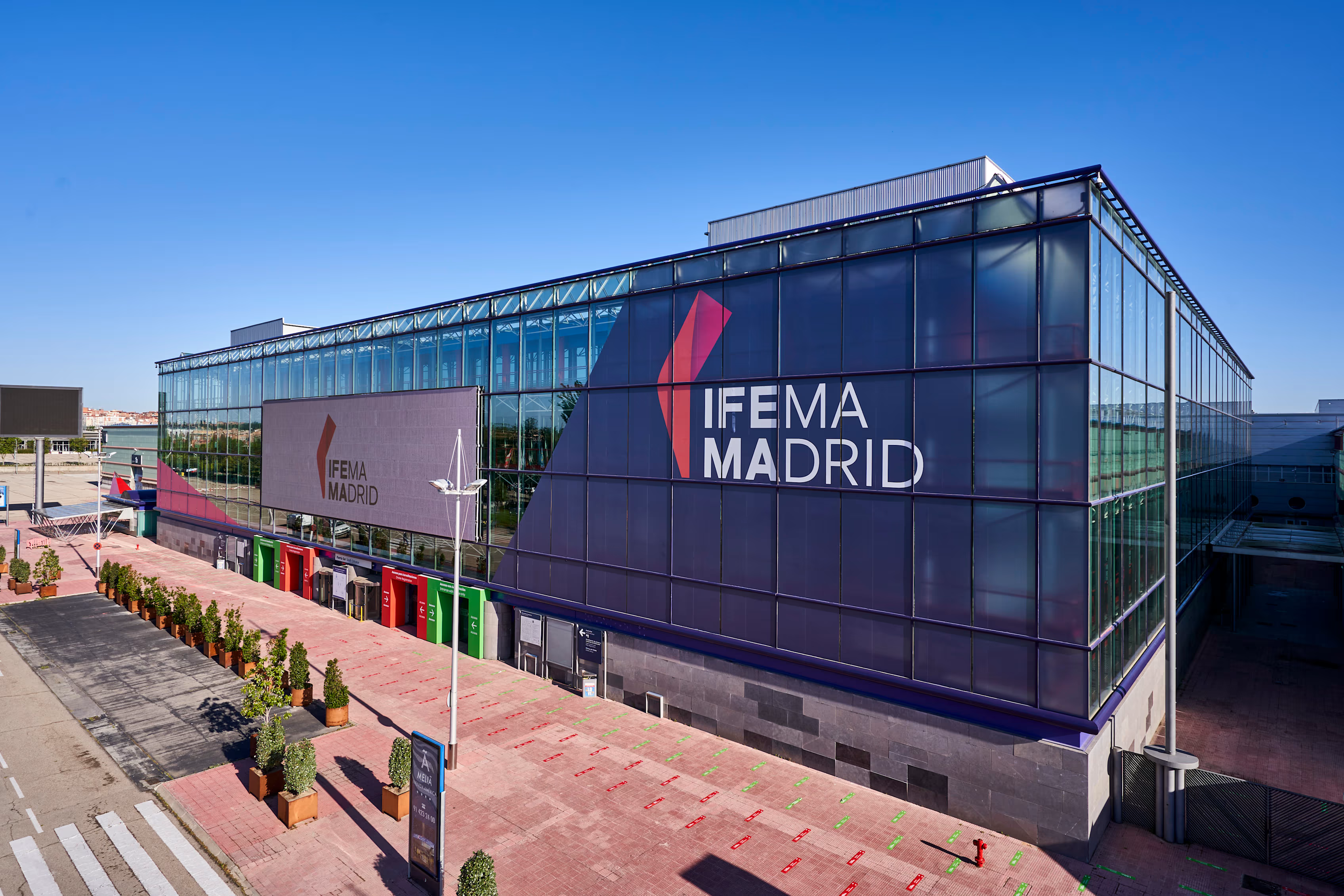
While Qiddiya circuit is building from scratch in the desert, Madrid's challenge is different but equally complex: constructing a street circuit using both public roads and non-public land around the IFEMA exhibition centre, with a planned capacity of 110,000 spectators.
The Madrid F1 circuit project explicitly includes in its bidding requirements "coordination, control, and supervision of the entire project using the BIM methodology." This isn't BIM as an afterthought; it's baked into the project's DNA from day one.
Here's where BIM truly shines for the Madrid F1 circuit. The methodology enables several game-changing capabilities: coordinating different teams of architects, engineers, and builders within a shared digital model; detecting clashes between different disciplines early in the project; simulating various race scenarios and spectator flow; controlling costs and timelines with unprecedented precision; and promoting sustainability through more informed decision-making. Platforms such as Autodesk Revit, Graphisoft ArchiCAD, or Bentley AECOsim Building Designer facilitate this collaboration.
The Madrid project faces unique coordination challenges. Construction by contractors Acciona and Eiffage is budgeted at €83.2 million, with the circuit expected to be ready by May 2026. That's an incredibly tight timeline for such a complex project, which is precisely why BIM is non-negotiable. The technology enables the team to work on different aspects of the project simultaneously without overlapping each other's work.
Think about it: you need to design grandstands, coordinate utilities, plan traffic flow, integrate temporary structures, ensure FIA safety compliance, and manage the interface with existing IFEMA facilities, all at once. BIM creates a single source of truth where everyone can see how their work affects everyone else's in real-time.
Did You Know?
Modern F1 circuits use BIM to achieve millimeter-level accuracy in track geometry, drainage slopes, and safety zones, critical for both race performance and FIA compliance.
Also Read: 5 Effective Tips To Create An Impressive BIM Portfolio That Will Help You Land A Great Job
The Technical Magic: How BIM Actually Works in These Projects
So what does BIM actually look like in practice for these circuits? Let's get into the technical details.
Clash Detection: Imagine discovering that your drainage pipe is trying to occupy the same physical space as a structural beam, but finding out about it while both are still digital, not after construction crews are standing around scratching their heads. BIM software automatically identifies these conflicts before they become expensive jobsite disasters.
4D and 5D Modeling: The "4D" adds time as a dimension, allowing project managers to visualize the construction sequence and optimize scheduling. "5D" adds cost, enabling real-time budget tracking and what-if scenarios. For Qiddiya's LOD 500 scope, this means tracking every change's impact on both timeline and budget instantly.
Simulation and Analysis: Want to know if spectators can evacuate safely in an emergency? How will sunlight hit the track at 3 PM in July? Can your drainage system handle a desert downpour? BIM can simulate all of this before breaking ground. For Madrid, BIM can simulate various race scenarios, analyse spectator flow, and optimise the circuit design, including improving overtaking opportunities and driver safety.
Multi-Disciplinary Coordination: When your electrical engineers are in one office, structural engineers in another, and MEP (mechanical, electrical, plumbing) contractors in a third location, all need to work together. BIM provides the collaborative platform that makes it possible. Everyone works on the same model, seeing updates in real-time.
The Sustainability Angle: Building Green at 300 km/h
Here's something that doesn't get enough attention: BIM isn't just about building faster and cheaper, it's about building smarter and more sustainably. Both circuits are leveraging this advantage.
Qiddiya's design prioritises energy efficiency, water conservation, and the integration of renewable energy sources, with green building practices, extensive parklands, walking trails, and eco-friendly transport solutions being implemented. BIM makes this possible by allowing teams to analyse and optimise energy performance, water usage, and material efficiency before construction begins.
For Madrid, BIM enables more informed decision-making, supporting the proposal for a carbon-neutral event in alignment with F1's sustainability, diversity, and inclusion policies. When you can model and analyse every material choice's environmental impact digitally, you can make greener decisions without compromising performance or safety.
The Human Element: Why BIM Matters Beyond the Tech
At the end of the day, BIM isn't really about software; it's about enabling human creativity and collaboration at unprecedented scales. When Qiddiya faced challenges from supply chain disruptions to adapting construction schedules, BIM helped streamline operations and mitigate delays.
These aren't just construction projects; they're exercises in coordinating thousands of people across dozens of disciplines, cultures, and time zones. The digital model becomes the universal language that allows a Saudi contractor, a German engineer, and a Spanish architect to work together seamlessly.
The Checkered Flag: What This Means for the Future
The use of BIM in circuits like Qiddiya and Madrid represents a broader transformation in how we approach infrastructure. These Giga Projects rely heavily on advanced digital technologies like Building Information Modelling and Geographic Information Systems, which are critical for managing the complex planning, design, and construction processes that such large-scale developments demand.
As these circuits race toward completion, Qiddiya targeting around 2027 or later, Madrid aiming for May 2026, they're not just building places for cars to go fast. They're pioneering construction methodologies that will influence how we build everything from airports to stadiums to entire smart cities.
The next time you watch an F1 race and marvel at these stunning venues, remember: behind every perfectly banked corner and soaring grandstand is a digital twin, meticulously coordinated by teams using BIM to turn impossible visions into concrete (and asphalt) reality. The real race isn't just on the track, it's in the digital realm where buildings are born.
Welcome to the future of construction. It's going to be one hell of a ride.