



What the Transition Actually Demands That No Software Vendor Will Tell You Upfront.
What is surprising about the introduction of BIM technology is the realization that the difficult aspects do not lie in the technology itself, which most firms can handle; rather, the challenge lies in the organizational changes required to accomplish these tasks.
During the first year of BIM adoption, several problems arise that pertain to coordination, communication, and responsibility. Activities that could have been performed independently using CAD must be carried out collectively by all parties involved.
Here are some observations based on the experience of making the transition:
-
The main issue lies in team coordination and getting them to work on shared models rather than individual drawings.
-
Existing workflows lack the framework to support such an approach.
-
The management may fail to recognize the effort required to modify these processes.
-
Such an approach reveals weaknesses in documentation systems, data management, and coordination processes.
-
It may be difficult for team members to assign themselves roles due to potential task overlap in the BIM context.
Organizations could better prepare if they were aware of these challenges at the outset.
Why CAD Habits Are the Hardest Thing to Leave Behind and the Most Damaging to Carry Over?
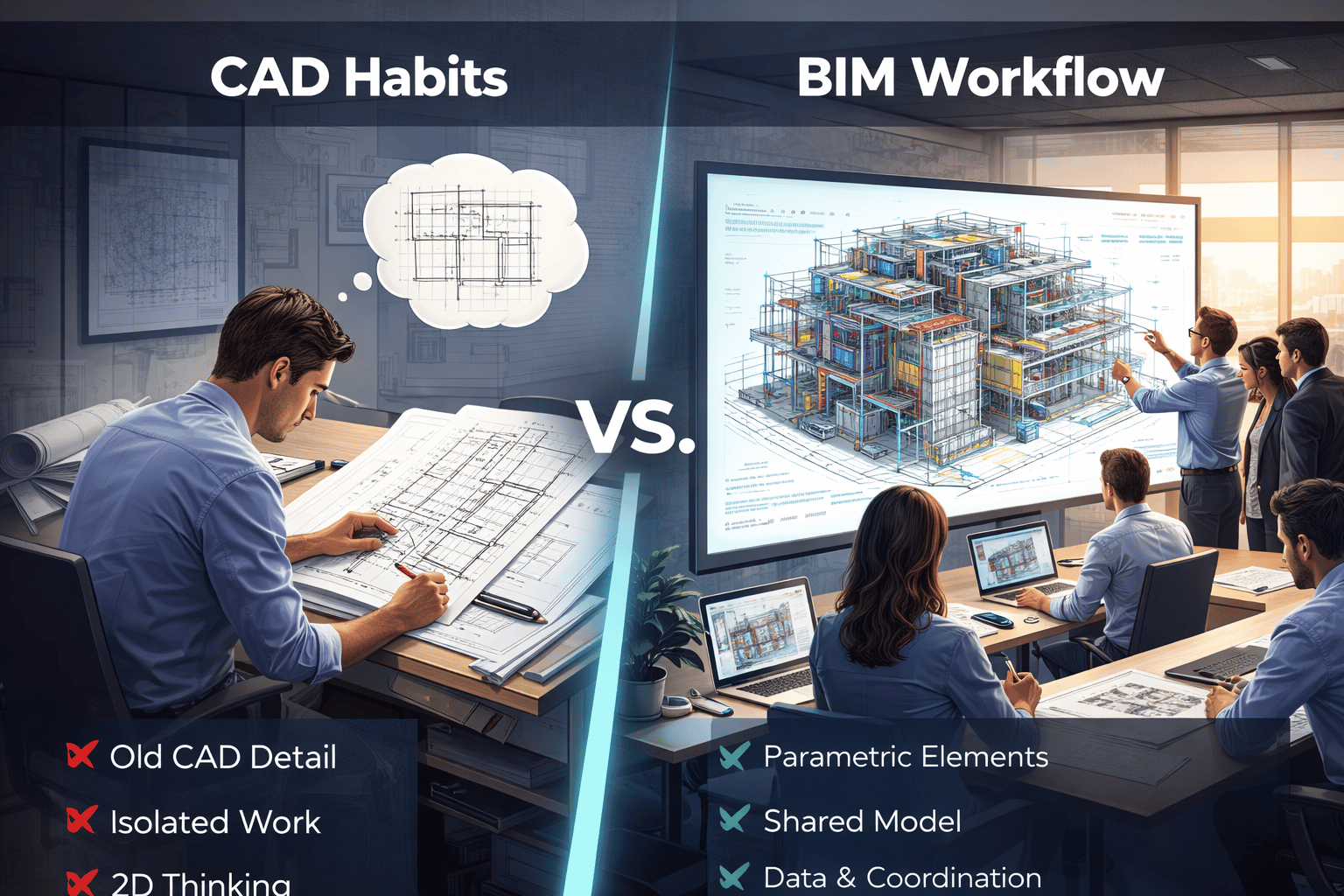
Among the biggest problems with BIM use is giving up old CAD behaviors. This problem exists because such behaviors become embedded, particularly with veteran users who are very good at working in 2D.
In CAD, the task is to create drawings. With BIM, the task shifts to creating a rich model that generates the drawings. Using a CAD mindset when working with BIM usually leads to poor practices.
Some examples of practices inherited from the era of CADs that make it hard to implement BIM are:
-
The use of modeling in BIM as a replacement for drawing.
-
High utilization of 2D drawings rather than the creation of parametric components.
-
Failing to collaborate but instead working independently of shared BIM models.
-
Refusing to standardize and sticking to individual drawing methods.
-
Emphasizing visualization over data accuracy.
Retraining experienced workers is about changing their thinking about design and documentation, not just teaching them to use the software. Such a change may prove difficult given the pressure to work quickly to meet project deadlines.
A CAD mentality contradicts the fundamental principles of BIM. Models that lack data and relationships cannot support coordination, analysis, and life-cycle management.
How Project Delivery Changes and Breaks Before It Gets Better.
The transition period may involve some instability in project delivery because systems that have worked well with CAD may no longer be applicable, and new processes have not yet been established.
The process may significantly impact the stages of design development and documentation. There may be delays as we adapt to new modeling and coordination systems. There may be a dip in output quality during the transition to new software systems.
Some of the important observations made during the early use of BIM include:
-
Project schedules can be extended during the initial few BIM uses.
-
There could be difficulty in maintaining consistency in the model and drawing standards.
-
Coordination problems will occur initially before BIM adoption improves.
-
It becomes difficult to communicate effectively across disciplines during the initial transition phase.
-
Doubts may arise regarding responsibilities and deliverables at various stages.
As teams gain experience with BIM and the process becomes more streamlined, they will manage these difficulties. It occurs once the team begins to see improved results through increased efficiency and better coordination.
It is when BIM works for the team.
What Leadership and Management Get Wrong About Supporting a Cad-To-Bim Transition.
The importance of leadership in the successful BIM implementation cannot be overstated. However, many organizations overlook the level of commitment needed for this process.
The gap between expectations and reality is one such problem. The leadership expects to achieve productive results instantly, whereas this period requires more time.
These include some of the most important problems associated with management and leadership in this context:
-
Companies tend to underinvest in training and skills improvement efforts.
-
There are no specific positions, for example, BIM managers or BIM coordinators.
-
Learning and experimentation processes are not accounted for within the schedule.
-
BIM adoption should be achieved without changing current timeframes.
-
Standardized work processes have not received sufficient attention.
For effective management, the transition must be viewed as a structured change process. It would entail setting appropriate expectations and resource allocation. An efficient transition ensures that existing projects are not affected and teams develop their BIM capability incrementally.
What a Successful Transition Actually Looks Like Once the Dust Settles.
The introduction of BIM is not limited to software use. It also manifests itself through efficient communication, data management, and project coordination.
Successful implementation of BIM creates a workflow in which design, coordination, and documentation are combined into a single activity. It means the organization moves from just using BIM software to fully implementing the BIM approach.
Indicators of successful transition include:
-
Collaboration within a unified modeling system with clear responsibilities.
-
Consistency of data and reliability of the model for all specialists.
-
Problems in coordination are revealed and resolved at an early stage in the design process.
-
Project planning becomes more effective and faster.
-
Manual work is reduced in future phases.
However, the benefits of complete BIM integration can be enjoyed not only during the projects but also after they are completed, since it fosters collaboration and improves decision-making.
Most architects realize these benefits only after they have fully integrated into the BIM modeling process.

.png)

.png)
