


Why are BIM Jobs in High Demand in the UK?
The UK's construction industry is becoming more complex, with large infrastructure, healthcare and commercial projects involving multiple teams and disciplines. This has increased the need for professionals who can manage project information, coordinate models and support efficient delivery. As BIM adoption continues to grow, employers are looking for professionals who can combine technical knowledge with practical project understanding.
-
BIM professionals help teams coordinate design information and identify issues before construction begins.
-
Knowledge of digital construction helps professionals work with modern BIM software and tools, cloud collaboration and data-driven workflows.
-
Understanding BIM management and ISO 19650 can help professionals contribute to structured information workflows.
-
Growing use of construction technology is creating opportunities across infrastructure, architecture and engineering projects.
-
Strong BIM skills can help graduates and experienced professionals access wider career opportunities in the UK.
What Are the Top BIM Job Roles in the UK?
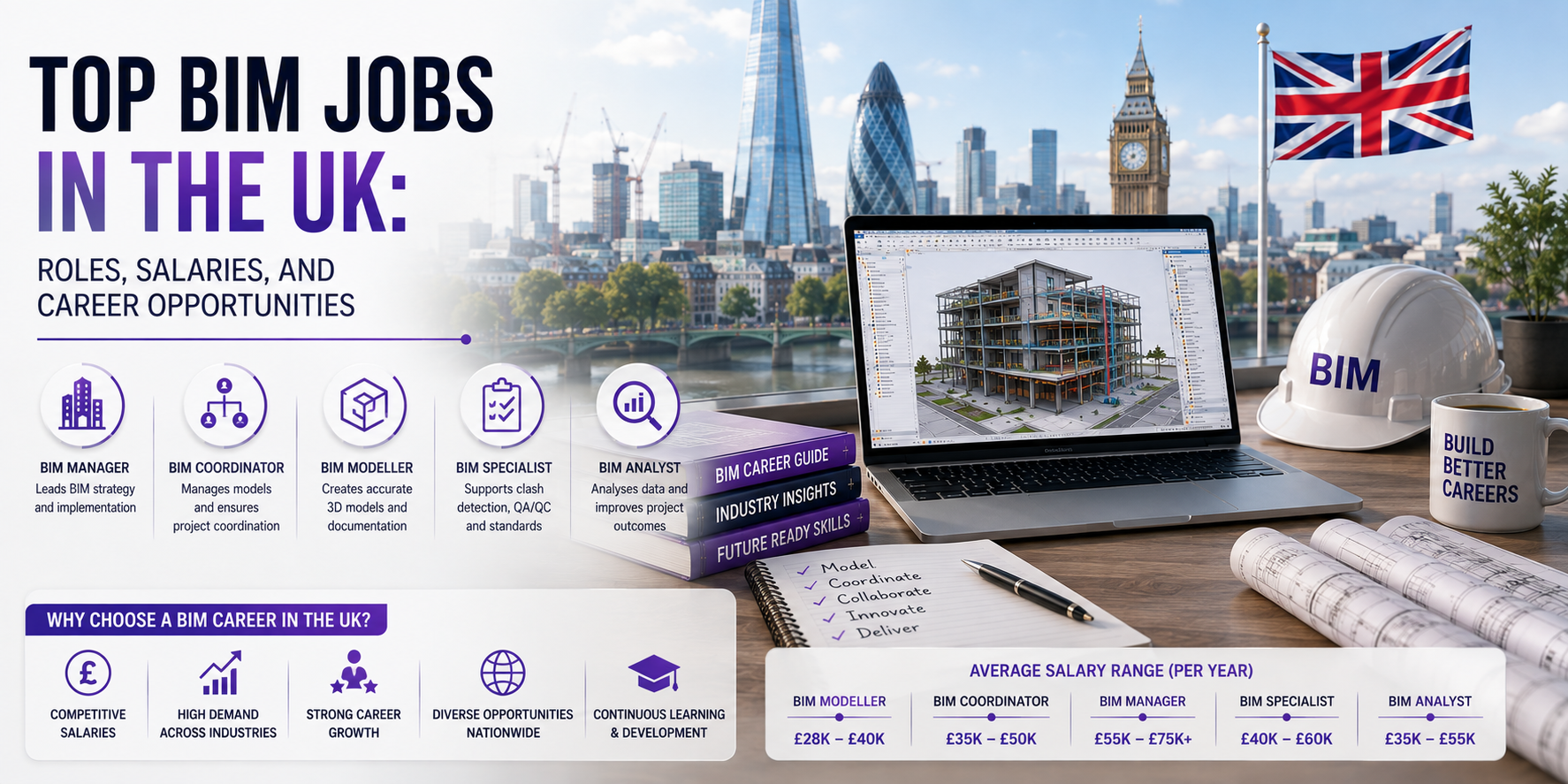
BIM careers cover a range of roles, from technical modelling and coordination to information management and digital delivery. Responsibilities and salaries can vary depending on experience, location, discipline, employer and project complexity.
According to Architecture Social, here is the salary breakdown of BIM professionals in the UK:
|
Job Role |
Key Responsibilities |
Required Skills |
Indicative Salary Range |
|
BIM Technician |
Produces and maintains technical models and project documentation. |
Revit, discipline knowledge, drawing production, BIM standards |
£32,000 - £45,000 |
|
BIM Modeller |
Creates and updates discipline-specific models, drawings and project information. |
Revit, modelling standards, technical drawing, attention to detail |
£28,000 - £40,000 |
|
BIM Coordinator |
Coordinates models across disciplines, manages clashes and supports model reviews. |
Revit, Navisworks, BIM coordination, communication, problem-solving |
£38,000 - £54,000 |
|
BIM Manager |
Establishes BIM processes, standards and project requirements across teams. |
BIM management, ISO 19650, leadership, CDEs, coordination |
£60,000 - £80,000+ |
|
BIM Consultant |
Advises clients and project teams on BIM implementation, standards, workflows and information management |
BIM consulting, ISO 19650, information management, CDEs, communication |
£42,000 - £58,000+ |
|
BIM Lead |
Leads BIM delivery across projects, coordinates teams and drives digital workflows, standards and technology adoption |
BIM management, digital workflows, leadership, coordination, technology strategy |
£65,000 - £90,000+ |
What Skills Do Employers Look for in BIM Professionals?

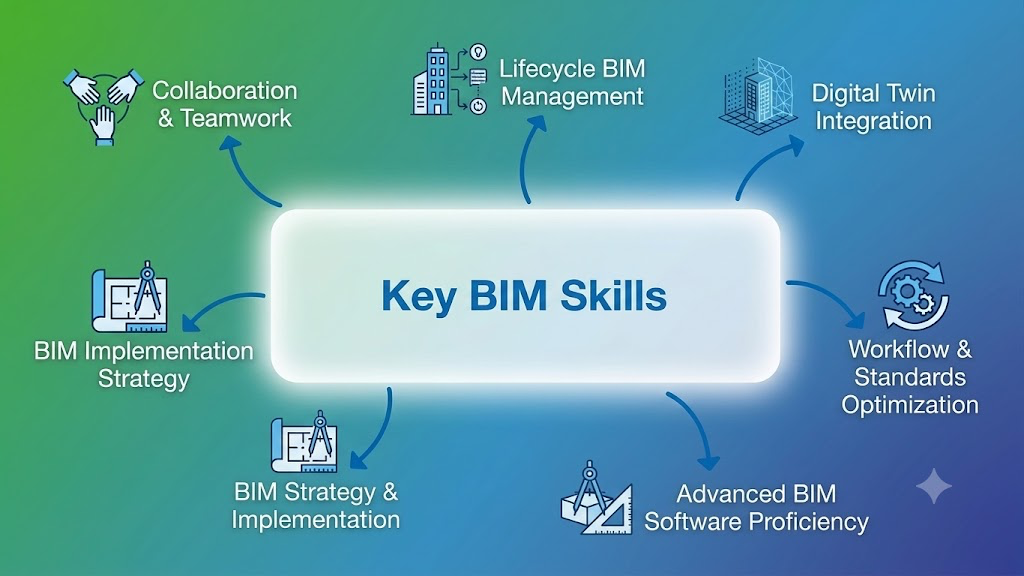
Knowing a software package is useful, but it is rarely enough to build a strong career. Employers increasingly look for a combination of technical knowledge, project understanding and interpersonal skills.
-
BIM Software Proficiency
Tools such as Revit and Navisworks are widely used across BIM workflows. Depending on the role, professionals may also encounter Autodesk Construction Cloud, model-checking platforms, authoring tools and other collaboration systems. The goal should not be to memorise commands. You should understand why a tool is being used and how your output affects the wider project.
-
Coordination and Communication
BIM is inherently collaborative. A coordinator may need to communicate an issue identified in a model to architects, structural engineers, MEP teams and contractors. Clear communication can therefore be just as important as technical accuracy.
-
Information Management
Professionals working with structured information need to understand naming conventions, revisions, approvals, information exchanges and common data environments. Knowledge of BIM standards such as ISO 19650 can help professionals understand how information should be organised throughout a project.
-
Problem-Solving
Clash detection is only useful when someone can interpret the issue and help the team decide what should happen next. Employers value people who can investigate problems, understand design intent and suggest practical solutions.
-
Adaptability
Construction technology continues to evolve. Automation, artificial intelligence, reality capture and digital twins are changing how project teams work. Professionals who remain curious and willing to learn are better positioned to adapt as workflows change.
Which Industries Offer the Best BIM Career Opportunities?
One of the advantages of BIM is that it is relevant across multiple parts of the built environment.
-
Infrastructure
Major rail, road, airport and public infrastructure projects involve numerous disciplines and large volumes of information. This makes coordinated digital workflows particularly valuable. Professionals may work on model coordination, information management, asset information or digital delivery.
-
Commercial Construction
Office buildings, retail developments, mixed-use schemes and large residential projects can involve architects, engineers, contractors and specialist suppliers working simultaneously. BIM helps these teams coordinate their work and manage design information throughout the project lifecycle.
-
Healthcare
Hospitals and healthcare facilities are particularly complex because of their architectural, structural, mechanical, electrical and operational requirements. BIM can support coordination while helping teams manage detailed building information.
-
Engineering and Industrial Projects
Industrial facilities, manufacturing plants and engineering-led projects often require highly coordinated models and detailed technical information. This creates opportunities for professionals with strong discipline knowledge and BIM capabilities.
-
Architecture and Design
For architects, BIM can extend beyond documentation into design development, visualisation, analysis and multidisciplinary coordination. This makes it relevant to both architecture careers and broader digital project roles.
How Can You Start a BIM Career in the UK?
An architecture, engineering, construction or related educational background can provide useful industry knowledge, but professionals from other backgrounds can also develop relevant capabilities through structured learning. A process to build a BIM career can look like this:
Step 1: Build your AEC foundation
Understand drawings, construction processes, materials, building systems and how different disciplines interact.
Step 2: Learn relevant software
Start with tools aligned with your target role. For many entry-level positions, Revit is a useful starting point, while coordination-focused roles may also require tools such as Navisworks.
Step 3: Understand BIM workflows
Learn how models are created, shared, reviewed and coordinated rather than focusing solely on software commands.
Step 4: Develop a project portfolio
Show what you can actually do. A portfolio could include a coordinated model, drawing set, clash detection exercise, family creation or a documented project workflow.
Step 5: Add recognised learning
A relevant BIM certification course can demonstrate structured knowledge and help fill gaps in your practical understanding.
Step 6: Apply for suitable roles
Look beyond job titles containing only "BIM". Search for roles such as BIM Technician, BIM Modeller, Digital Design Technician, BIM Coordinator and Information Management positions.
How Can a BIM Course Improve Your Employability?
Learning BIM software is only the starting point. Employers also look for professionals who can apply that knowledge to real project requirements, coordinate with different disciplines and understand how information moves through a project.
Novatr’s BIM Professional Program is designed to bridge this gap by taking learners beyond software training. The programme covers practical BIM workflows, multidisciplinary coordination, project-based modelling and industry-relevant tools, helping learners understand how BIM is used across actual AEC projects. This practical approach can help students build a stronger portfolio and demonstrate job-ready skills during interviews.
For architects, engineers and construction professionals, the programme can also provide a structured path to move towards roles in BIM modelling, coordination and management. By developing both technical and project-based capabilities, learners can build a more relevant skill set for today's digital construction environment and make more informed decisions about their long-term career direction.