
.png)

What Should You Look for in an Advanced Online BIM Course?
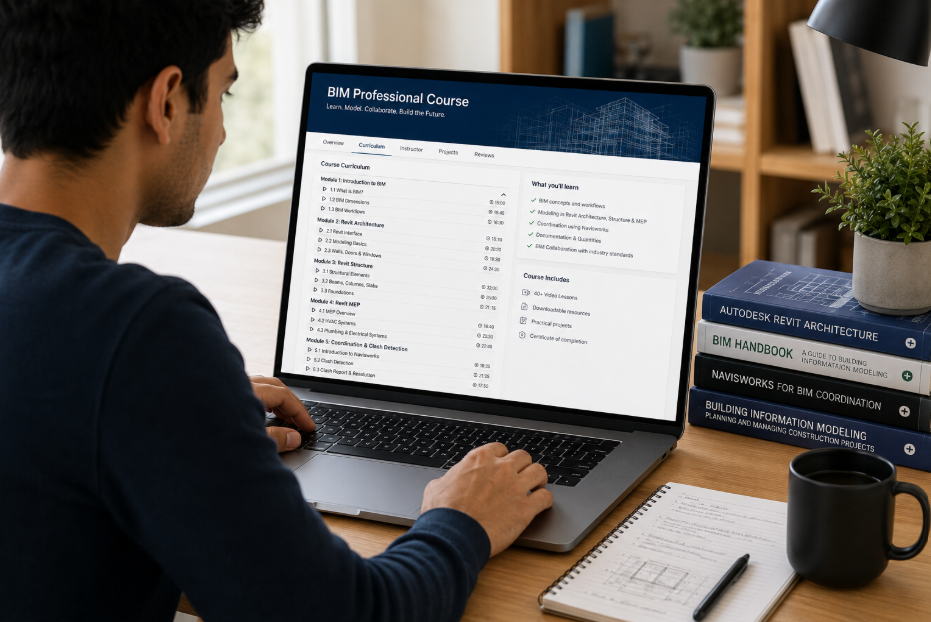
There is more to picking a course than software tutorials. These are 10 factors to consider when looking at options:
-
Extensive design, coordination and documentation.
-
Realistic assignments that are representative of project conditions.
-
Experience in mentoring opportunities.
-
Multiple contact with disciplines.
-
Industry recognised BIM certification programs.
-
Experiences of programmed portfolio development.
-
Introduction to existing BIM standards and best practice.
-
Part time programs for working people.
-
Work support, networking.
-
Regular curriculum updates in line with industry requirements.
Many learners researching what factors matter when selecting BIM course options often focus only on software. But organizations are looking for more and more collaborative, coordinating and project delivery experts.
Novatr focuses on learning experiences where technical concepts are linked to real project execution, enabling learners to develop skills to work in their jobs, not just software skills.
A careful review process can be used to make sure that the program being selected is for the long-term benefit of career advancement and not just software competence.
How Important Are Real Projects, Mentorship, and Industry Workflows?
BIM learning outcomes are greatly enhanced through hands-on experience. Theory is a foundation and project-based learning is how one becomes a problem solver in the real world.
Real projects enable students to learn:
-
Model coordination
-
Documentation workflows
-
Interdisciplinary collaboration
-
Construction sequencing
The studies conducted in BIM adoption in India indicate that there are still issues with skills/expertise that continues to be a challenge, thus, hands-on training becomes more valuable.
Learners gain insight into the way BIM works through real project life cycles with the assistance of experienced professionals. Learners receive a view of project challenges and client expectations and a knowledge of working in a team, not just from recorded lessons.
For professionals pursuing BIM learning for engineers, Mentorship can enable engineers to connect the dots between engineering knowledge and the requirements of digital delivery of projects.
Novatr's mentoring program brings industry content to the learning environment, and provides students with feedback that mirrors industry expectations.
Industry workflows also matter as employers take the concept of software skills into consideration. They are looking for candidates who are aware of the benefits of BIM for design coordination, construction planning and information management throughout the life cycle of a project.
Which Software, Tools, and Specializations Should an Advanced BIM Course Cover?
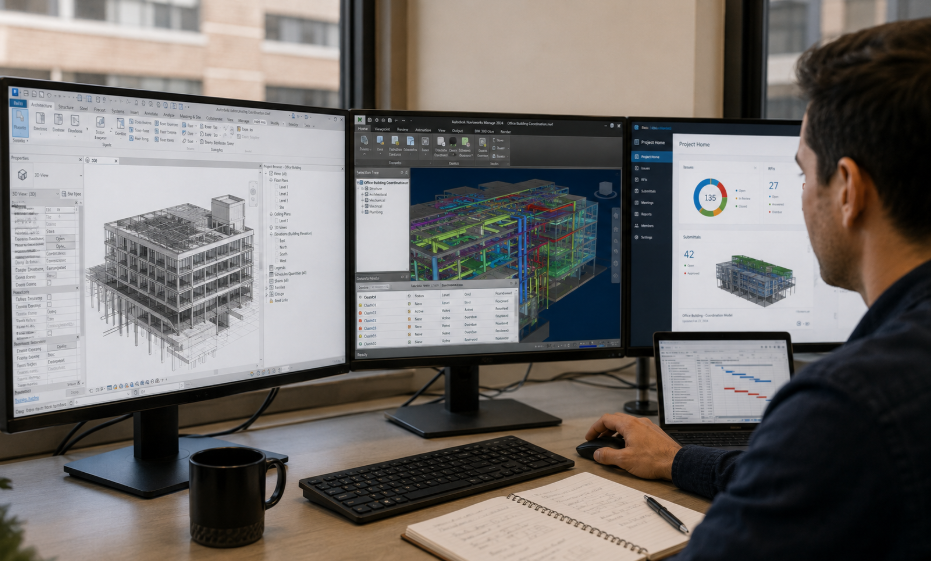
The ideal programs offer exposure to various platforms and not just one application.
|
Category |
Key Software and Tools |
Why It Matters |
|
Architectural Modeling |
Autodesk Revit |
Core BIM authoring and documentation |
|
Coordination |
Navisworks |
Clash detection and model review |
|
Structural Modeling |
Revit Structure |
Structural design integration |
|
MEP Design |
Revit MEP |
Building systems coordination |
|
Visualization |
Enscape, Twinmotion |
Design communication and presentations |
|
Project Planning |
Primavera, MS Project |
Scheduling and construction management |
|
Documentation |
AutoCAD |
Supporting technical drawings |
|
Collaboration |
BIM 360, Autodesk Construction Cloud |
Cloud-based project coordination |
|
Quantity Takeoff |
Revit Schedules, Cost Tools |
Estimation and procurement support |
|
Data Management |
Common Data Environment Platforms |
Information sharing and version control |
Many advanced learners are also interested in specialized tracks in advanced BIM training.
These may include:
-
Architecture BIM
-
Structural BIM
-
MEP BIM
-
Construction management
-
Digital project delivery
-
Infrastructure BIM
Novatr's curriculum strategy emphasizes a software development approach that blends software skills with the practical use of software in project applications, so that one understands how software tools are utilized in the larger context of project processes.
How Do Course Structure and Learning Support Impact Skill Development?
The course structure has a direct impact on the effectiveness of learning. Quality online courses contain:
-
Live sessions
-
Mentor feedback
-
Peer interaction
-
Defined milestones
-
Learner support
These attributes enable learners to build up BIM skills progressively without putting their work commitments at risk.
While many professionals look at the curriculum when making their choice of design courses, a support system is a significant factor in achieving success.
Mentorship and structured learning pathways are integrated into Novatr to support learners to hold their pace during the program.
What Makes One Online BIM Course More Industry-Relevant Than Another?

A strong BIM course should include lessons on collaboration, coordination and digital delivery workflows as well as lessons on the software.
The following are some of the signs that the course is relevant:
-
Industry-led mentorship
-
Real project simulations
-
Portfolio development
-
Career guidance
-
Updated workflows
Project exposure and the outcomes of alumni might give a better understanding for learners assessing BIM classes.
Novatr centers on practical applications, guidance and learning experiences that are connected with industry needs.
Relevance is always a selection factor when looking for BIM certification or when considering a career change.
.png)
.png)