

.png)

What Is Smart Facade Integration and Why Is It Redefining Modern Architecture?
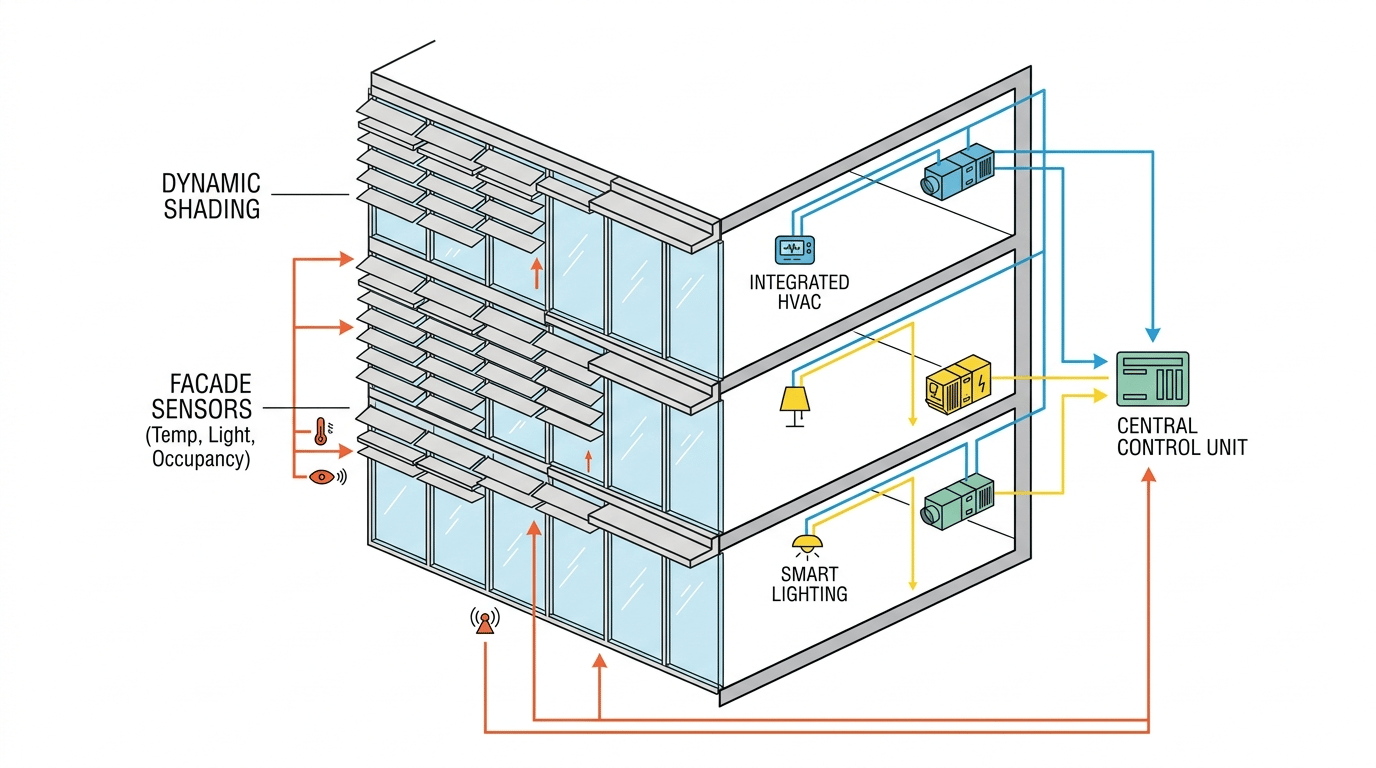
If we simplify it, smart facade integration is about removing the old boundary between architecture and building services. Earlier, the facade was designed visually first, and everything else followed later. That sequence is slowly breaking.
So when we ask what is smart facade integration in architecture and MEP, it basically refers to designing the building facade in coordination with mechanical, electrical, and environmental systems from the beginning itself.
In practice, this shows up in a few important ways:
-
Facade design changes depending on HVAC load calculations
-
Shading devices are planned along with daylight studies
-
Sensors are embedded into facade components instead of being added later
-
Facade engineering decisions depend on energy performance targets
-
The entire approach supports sustainable design, not just aesthetics
What is interesting is that smart building facade technologies are not limited to high-end projects anymore. Even mid-sized commercial buildings are slowly adopting at least partial automation or performance-based glazing systems.
How Does MEP Engineering Influence Facade Design Decisions in 2026?
MEP and facade design are now deeply connected, even if the coordination is not always smooth in practice. In most projects, MEP design shapes key decisions about the building envelope.
To understand how does MEP impact facade design in modern architecture, you have to look at actual constraints rather than theory.
Some common influences include:
-
HVAC load requirements deciding glazing percentage and type
-
Duct routing affecting facade depth and structural detailing
-
Electrical layouts enabling or limiting facade-integrated lighting
-
Plumbing and drainage influencing panel breaks and joints
-
Fire safety rules controlling openings and material selection
Because of this, facade design with MEP systems is rarely linear. The design goes through revisions as simulations and coordination drawings evolve. This is where building facade engineering and design focus on a performance-driven approach rather than just design.
Also Read: Top 50 MEP Interview Questions & Answers
What Are the Most Common Smart Facade Systems Used in High-Performance Buildings?
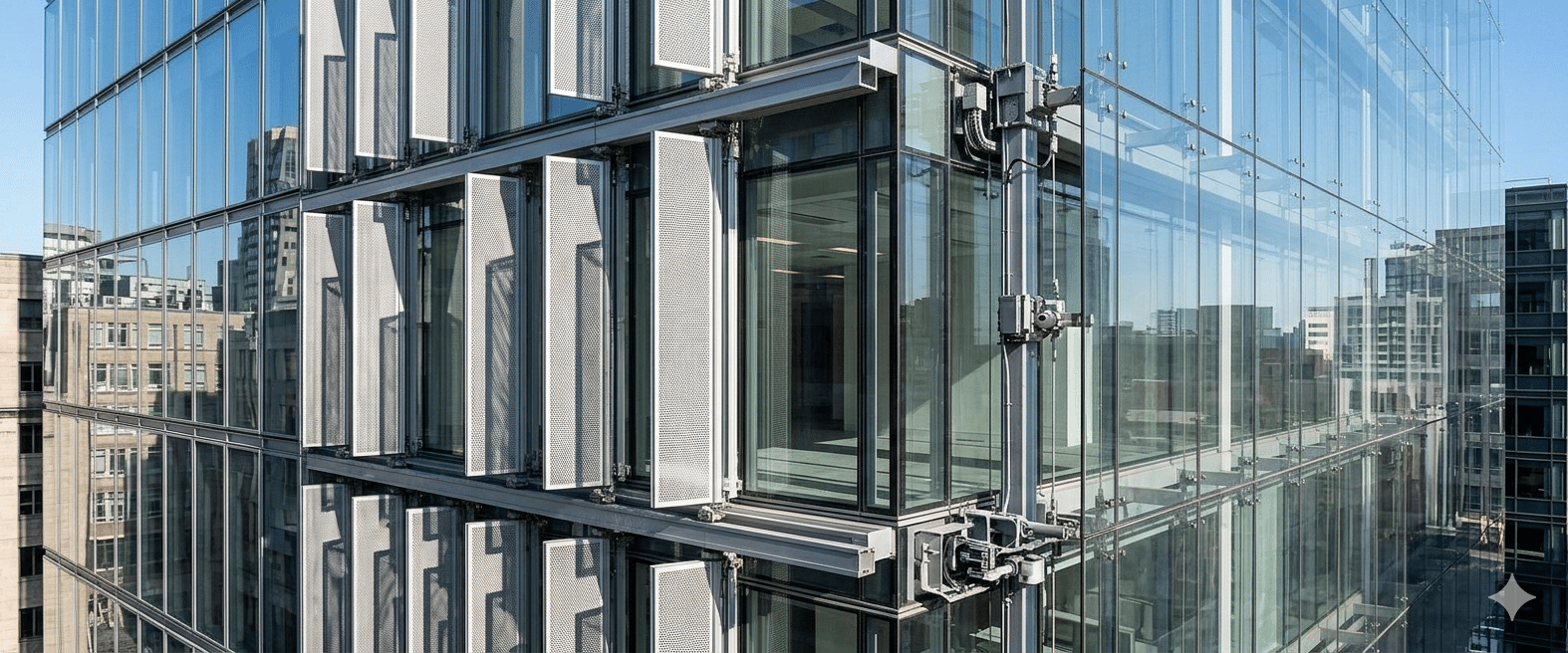
In real construction practice, smart facade systems are usually introduced with a simple goal: to reduce heat gain and improve comfort without increasing mechanical load too much.
Some commonly used systems include:
-
Double-skin facades are often used in commercial towers because they create a buffer between exterior and interior conditions. It helps reduce cooling demand quite significantly, particularly in hot climates.
-
Electrochromic glass is also gaining more use in recent projects. It adjusts its tint based on sunlight, though cost remains a limiting factor in India.
-
Automated shading systems are now more common in offices and institutional buildings. They adjust with the sun and cut glare, so manual changes aren't needed.
-
In warmer regions, ventilated facades are widely used to allow air to pass behind the cladding, reducing heat buildup.
-
Kinetic facades are most commonly seen in landmark-type projects, where both the building's appearance and its performance matter equally.
All these fall under smart building facade technologies, and what connects them is not complexity but intent. They reduce energy demand and improve occupant comfort.
It is also closely linked to "What are smart facade systems in sustainable buildings?" since their main purpose is energy reduction.
How Do Architects and MEP Engineers Collaborate on Facade Integration Projects?
In theory, collaboration sounds structured. In reality, it depends heavily on project workflow and timing. The idea of integrated building systems architecture only works when both disciplines start discussions early. If coordination starts late, facade design becomes reactive instead of planned.
In most real projects, collaboration looks like this:
Architects define the overall form, spatial quality, and facade intent. MEP engineers evaluate whether those decisions are actually viable from an energy and system perspective.
What works better in practice is:
-
Early alignment on energy and daylight goals
-
Continuous feedback between facade geometry and HVAC performance
-
Adjustments based on simulation results instead of assumptions
-
Open discussion on cost-performance trade-offs
In the long term, the practice of facade engineering and design becomes collaborative and not a handover across disciplines.
What Role Does BIM Play in Coordinating Smart Facade and MEP Systems?
BIM is now the most practical answer to coordination problems in facade and MEP integration. It basically shows how facades integrate with MEP systems in buildings, since everything is brought into one shared model. Instead of separate drawings, teams end up working in the same setup.
In practice, BIM is used for:
-
Aligning facade geometry with MEP routing in 3D
-
Spotting clashes early, before site work
-
Checking energy and daylight performance
-
Making design changes quicker
-
Planning for maintenance later
In facade design with MEP systems, BIM helps reduce guesswork and catch issues earlier. It can affect how projects are delivered, especially in high-rise buildings where coordination is tighter.
Also Read: Top 10 MEP Engineering Courses in India
What Are the Biggest Challenges in Integrating MEP Systems Into Facade Design?
Even with better tools, integration is still not easy. The majority of obstacles are operational as opposed to technical.
Other common issues are:
-
Smart facade systems are costly and value engineering tends to decrease the scope.
-
Coordination timing is another issue. Late entries of teams make it more difficult to solve design conflicts.
-
Maintenance is often underestimated as well.
-
India has its own set of challenges. Climate varies widely, so a system that works in one city may not perform the same way in another.
-
There remains a learning gap in understanding performance-based facade design among all project teams.
It is where "why is facade design important for building performance" becomes clear, especially when issues such as overheating, high energy bills, or occupant discomfort arise.