


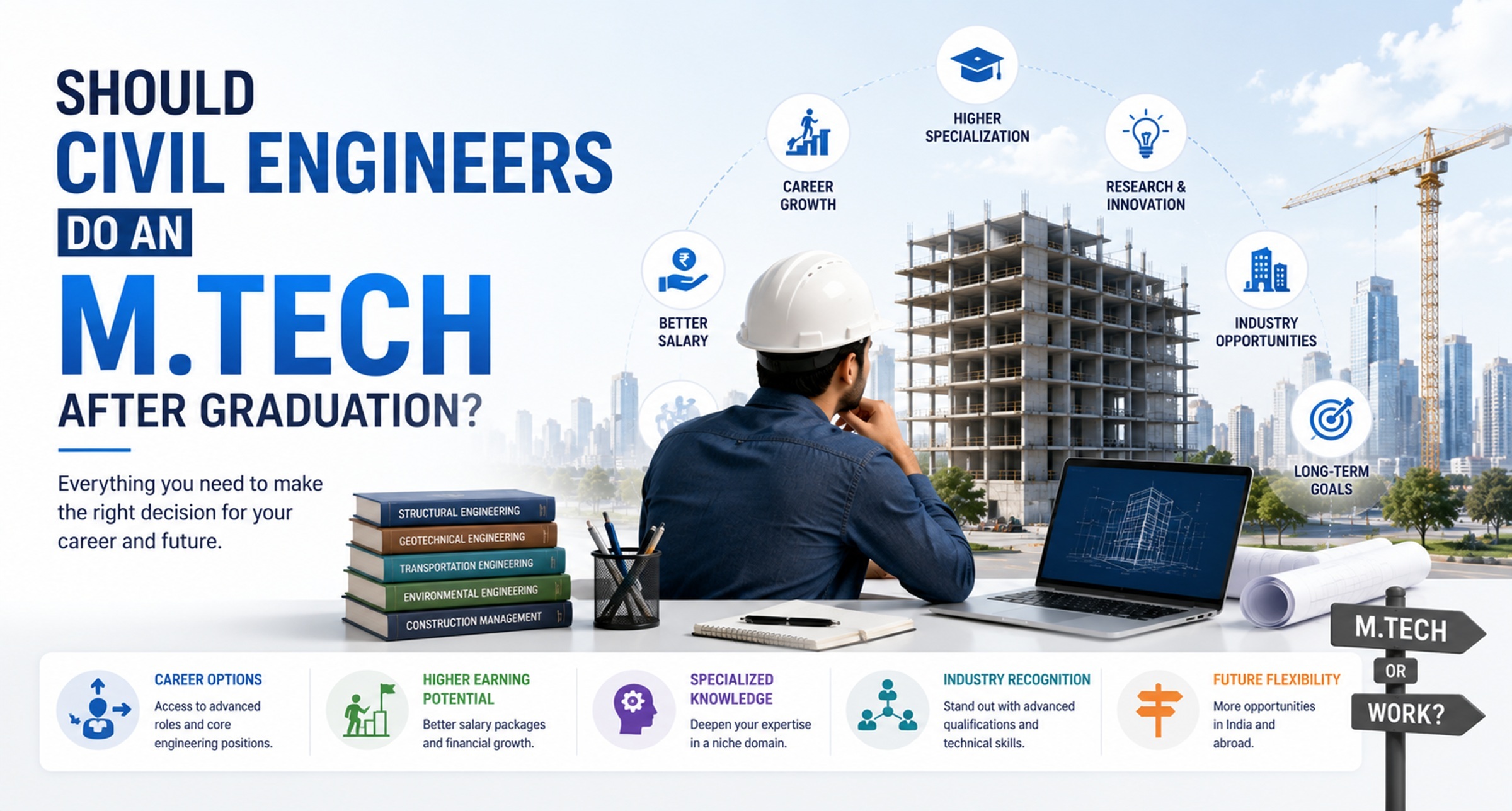

What is M.Tech in Civil Engineering?
An M.Tech after civil engineering is a postgraduate degree that trains engineers to develop advanced knowledge in a specific area of the discipline. This degree typically spans two years and combines theoretical concepts, research, and practical applications to prepare students for specialised roles in the AEC industry.
Some of the most sought-after specialisations include Structural Engineering, Transportation Engineering, Geotechnical Engineering, Environmental Engineering, and Construction Management. However, the decision of selecting the best specialisation in M.Tech for civil engineering depends on your interests and long-term career goals. The degree is also a popular choice for professionals interested in research opportunities or in qualifying for advanced engineering and academic roles. It can also help engineers stand out in competitive job markets and create new opportunities for a stronger career after M.Tech Civil Engineering.
What Are the Benefits and Limitations of M.Tech?

Pursuing an M.Tech after Civil Engineering offers several advantages for civil engineers looking to specialise in a particular domain. It can open opportunities in specialised fields such as design, consulting, infrastructure development, and academia, and strengthen prospects for a long-term career after M.Tech Civil Engineering.
However, an M.Tech also comes with certain limitations. It requires an additional investment of time and a considerable amount of tuition fees, and the career benefits often depend on the chosen specialisation and industry demand. In many cases, employers also value practical skills and project experience alongside academic qualifications. Without further ado, let’s get into Mtech vs. BIM career aspects.
|
Benefits |
Limitations |
|
Develops specialised technical expertise |
Requires 2 additional years of study |
|
Can improve eligibility for advanced roles |
High cost and time investment |
|
Useful for research and academic careers |
Does not guarantee higher salaries |
|
Builds subject-matter knowledge |
May still require separate training for industry-relevant skills |
The decision should ultimately depend on your career goals and the type of opportunities you want to pursue.
Also Read: Is a Master’s in Science a Good Option for Civil Engineers? Know Alternative Careers!
What Skills Are Companies Looking for Today?
While academic knowledge remains important, employers are increasingly looking for professionals who can contribute from day one on the job for digital construction careers. In addition to academic qualifications, leading AEC companies increasingly value practical skills that improve project efficiency, collaboration, and decision-making.
This is why the skills required for civil engineers today include digital construction workflows, Building Information Modelling (BIM) coordination, project planning, quantity estimation, data-driven decision-making, and multidisciplinary collaboration. Soft skills such as strong communication, problem-solving, and stakeholder management skills are also becoming essential for collaborating effectively with architects, MEP engineers, and multidisciplinary project teams.
As a result, many engineers are now exploring alternatives to B.Tech Civil Engineering, such as industry-recognised courses that help them gain job-ready skills alongside or instead of higher education. The growing adoption of BIM has also created new opportunities in BIM careers for civil engineers, where professionals are expected to combine technical expertise with digital project delivery capabilities.
In today's job market, practical skills and industry relevance can be just as important as academic credentials.
M.Tech vs Industry-Focused Skill Programs: What’s the Difference?
Both an M.Tech in Civil Engineering and industry-focused programs can help advance your career, but they are designed for different outcomes.
The following are the key differences:
|
M.Tech |
Industry-Focused Skill Programs |
|
Academic and research-oriented |
Industry and application-oriented |
|
Typically 2 years |
Typically completed within a few months |
|
Focuses on specialization |
Focuses on practical skills |
|
Suitable for research and higher studies |
Suitable for immediate industry roles |
|
Theoretical foundation |
Strong project-based learning |
How Do BIM Certifications Help Civil Engineers Become Job-Ready Faster?
The construction industry is undergoing rapid digital transformation, and employers are looking for engineers who can work with modern project delivery workflows from the inception of the design stage. This is where BIM certifications and programs can offer a practical advantage.
Unlike traditional degrees, BIM training focuses on real-world applications such as model coordination, clash detection, construction documentation, quantity take-offs, and multidisciplinary collaboration. These are skills that companies actively seek when hiring for digital construction roles.
For professionals exploring BIM careers for civil engineers, certification programs can provide direct exposure to industry tools, workflows, and project-based learning. This helps bridge the gap between academic learning and workplace requirements.
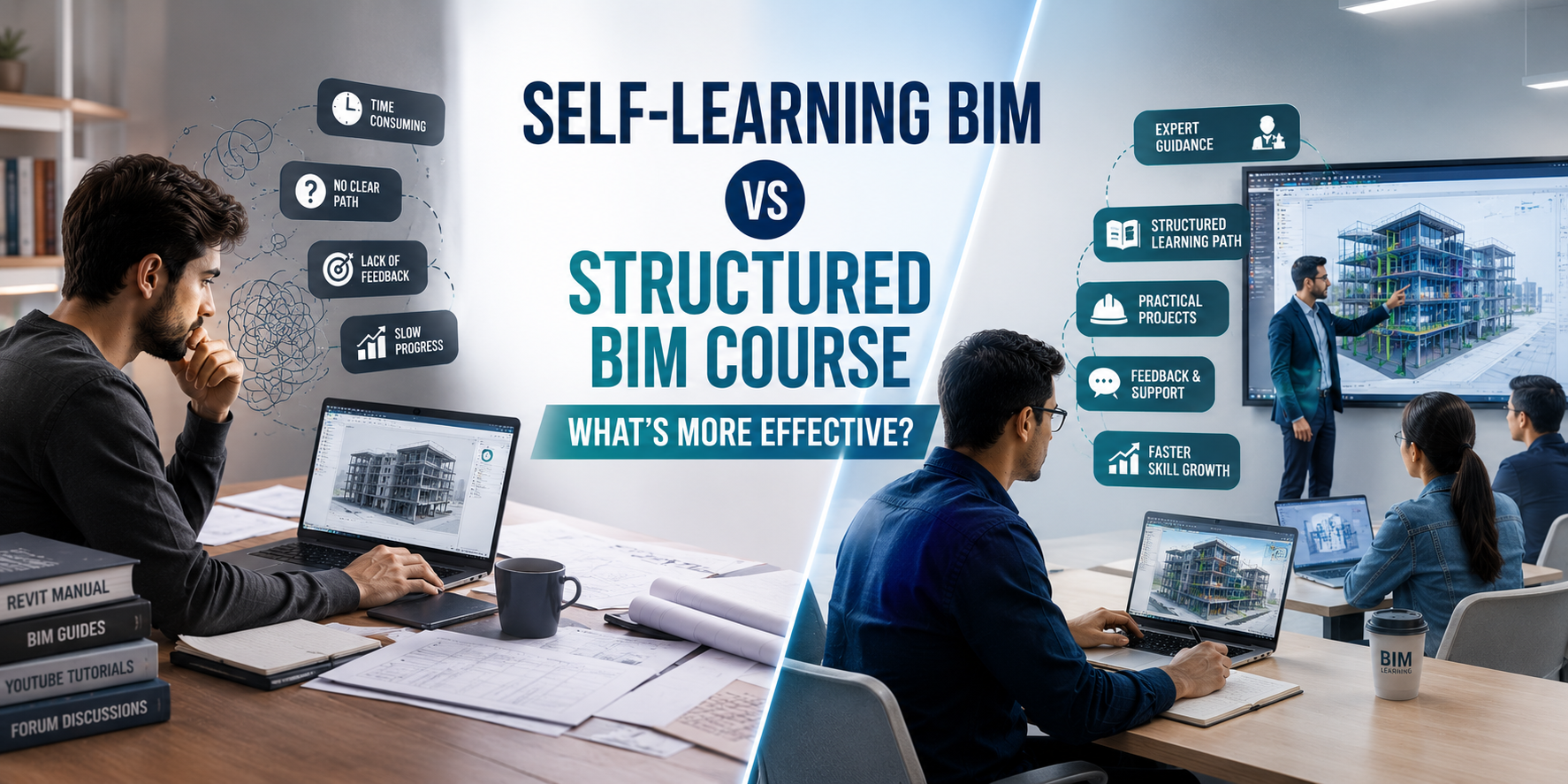
Programs such as Novatr's BIM Professional course are designed around real project scenarios, helping engineers build technical expertise, develop industry-relevant portfolios, and gain practical experience that can support faster entry into high-growth roles across the AEC industry.


.png)
