


What Made the Bengaluru Airport Project Complex to Build?
The construction of an airport is not an easy task and in this regard the scope of work for Kempegowda International Airport has been even more difficult to manage. The issues involved ranged from dealing with the fast-growing number of passengers to integrating specialised systems. The project demanded the next level of coordination that traditional workflows often struggle to manage, making it a dominant case for adopting BIM in airport construction.
Here are some key factors:
- Scale and Future-Ready Capacity: Not only were the needs of today taken into consideration during construction, but also the need to be prepared for future capacity expansion without disrupting operations at the airport.
- Multi-Stakeholder Coordination: With architects, engineers, contractors, and global consultants involved, aligning everyone on a single vision was complex. Miscommunication at any stage could lead to costly delays or rework.
- Complex MEP Integration: Airports rely on dense networks of mechanical, electrical, and plumbing systems. Coordinating these without clashes, especially in tight spaces, required a high level of precision.
- Phased Construction Constraints: Construction had to progress alongside live airport operations. This added pressure on scheduling, sequencing, and safety management.
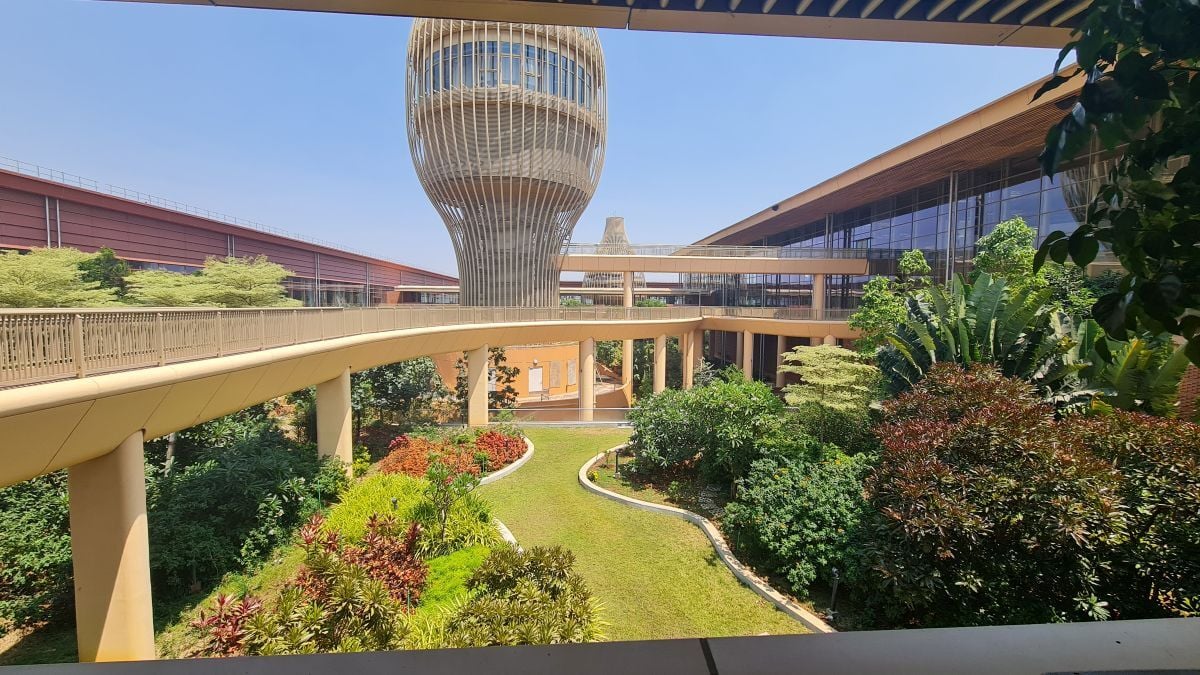
- Sustainability and Design Ambitions: Incorporating eco-friendly design and sustainable strategies introduced additional layers of technical and design complexity.
- Strict Compliance and Safety Standards: Meeting global aviation regulations required continuous validation, monitoring, and coordination across all project stages.
How did BIM Support Planning and Project Workflows?
BIM played a critical role in streamlining planning, coordination, and execution by creating a connected and data-driven BIM workflow across all project stages.
- Centralised project data using BIM software tools to ensure a single source of truth
- Improved cross-disciplinary coordination, reducing design conflicts and rework
- Enabled 3D, 4D, and 5D planning for better project visibility
- Supported real-time collaboration across distributed teams and stakeholders
- Integrated scheduling tools to align construction sequencing with design intent
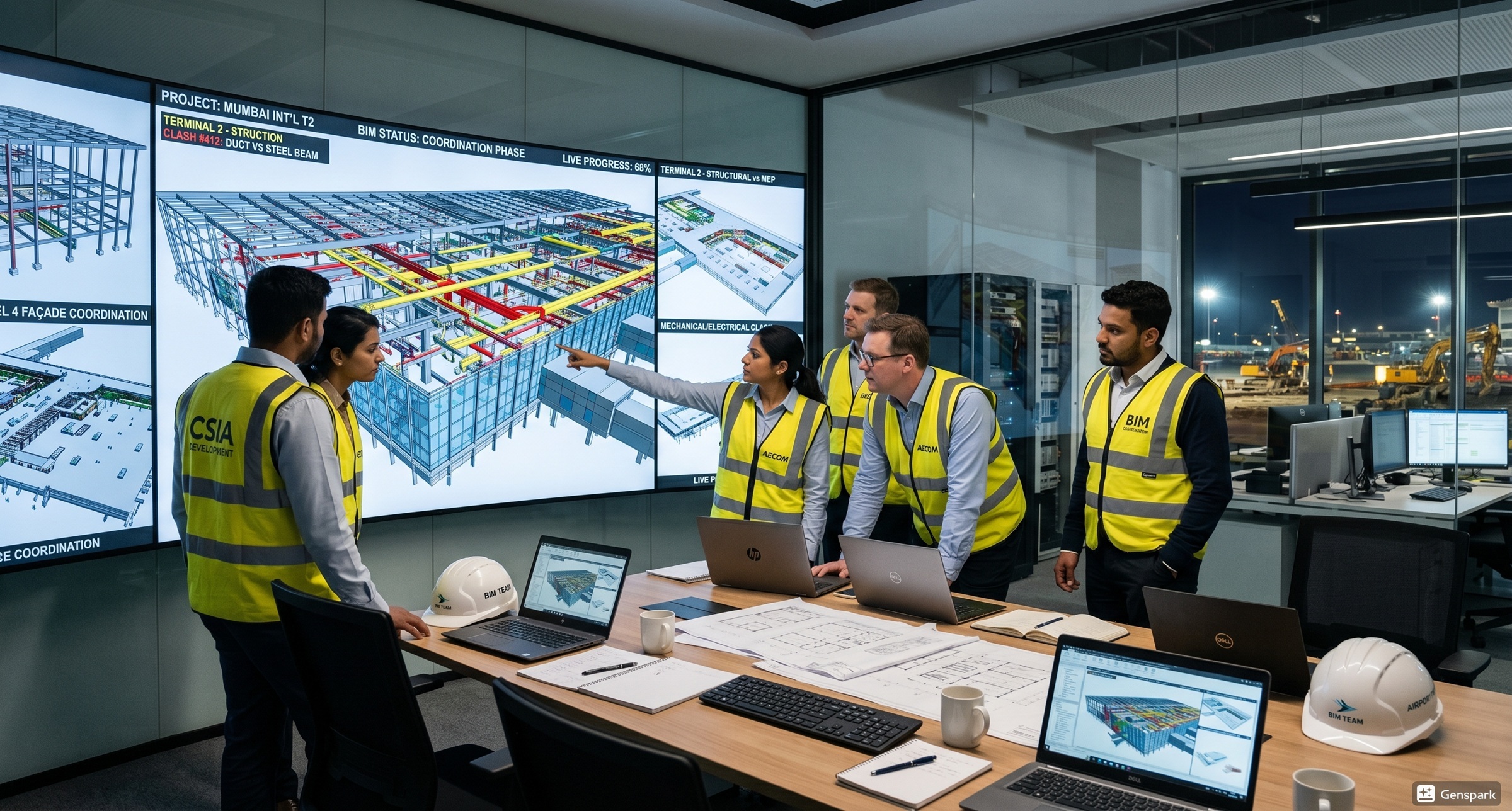
- Facilitated clash detection and early issue resolution within the BIM in construction process
- Enabled quantity take-offs and cost estimation directly from the model
- Supported simulation of construction scenarios to improve planning accuracy
- Improved site logistics planning, including material flow and space utilisation
- Allowed better coordination of MEP systems within complex building designs
- Enabled integration with procurement and supply chain management systems
- Leveraged the use of AI in construction for predictive insights and risk identification
Which New Technologies can Work Alongside BIM in Large Projects?
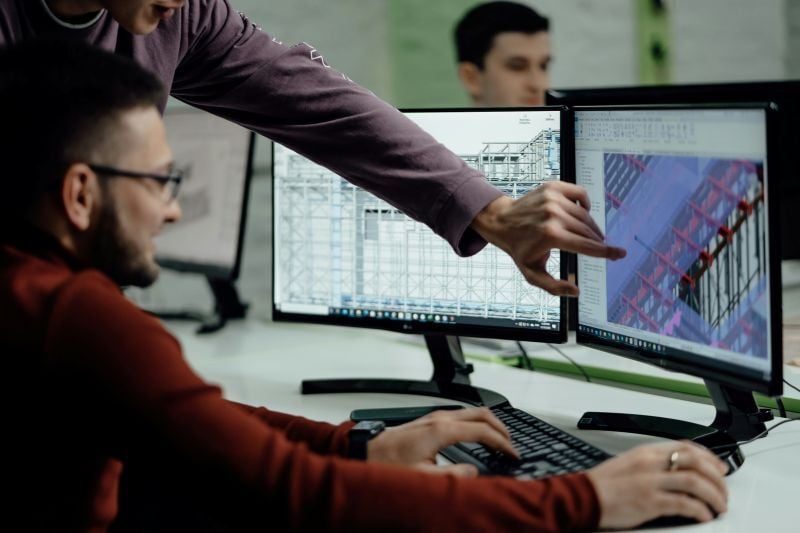
In 2026, BIM in construction is evolving into a central data layer that connects multiple advanced technologies, each solving a specific gap in large-scale project delivery. Here are some of those:
- Digital Twins for Lifecycle Intelligence: Whereas BIM is more concerned with design and construction, digital twins add value to construction through monitoring and optimising performance throughout its lifecycle.
- AI for Risk and Decision Support: Using AI techniques to study BIM data helps identify clashes in the design process, foresee delays, and determine an optimal workflow. It also enables continuous optimisation by learning from past project data to improve accuracy and efficiency over time.
- IoT for On-Site Data Integration: IoT devices capture real-time information, such as usage of machinery on site, environment conditions or other situations.
- Cloud Platforms for Distributed Workflows: In contrast to fragmented file transfers, the cloud provides a unified view that guarantees everyone is working on the most updated version of the model.
- AR/VR for Execution Clarity: Immersive technologies help teams visualise complex assemblies before construction, improving accuracy during installation and reducing dependency on 2D drawings.
- Generative Design for Early-Stage Optimisation: Testing various designs under certain constraints ensures quick and efficient decision-making based on the performance of each concept.
What can Aspiring Architects and Engineers Learn from this Project?
Projects like Bengaluru Airport highlight how the future of AEC is being shaped in real time. Here are some key takeaways for aspiring professionals:
-
Understanding Infrastructure as an Integrated System
Modern projects are no longer designed in isolation. Airports, in particular, function as highly interconnected ecosystems where architecture, engineering systems, and operations must work seamlessly together. Exposure to smart infrastructure thinking helps professionals design with performance, efficiency, and user experience in mind.
-
Learning BIM as a Collaborative Process
The value of BIM in airport construction lies not just in modelling, but in enabling collaboration. It brings multiple stakeholders onto a single platform, allowing for better coordination, real-time updates, and fewer errors. For students, this means focusing on workflows and coordination, not just software proficiency.
-
Adapting to Multi-Disciplinary Work Environments
Large-scale infrastructure projects involve diverse teams across geographies. Being able to communicate effectively, interpret shared data, and collaborate across disciplines is becoming a core skill in the AEC industry.
-
Embracing Data-Driven Decision Making
With the rise of airport construction technology, decisions are increasingly backed by simulations, analytics, and real-time data. Professionals who can interpret and act on this data will have a clear advantage in delivering efficient and resilient projects.
-
Prioritising Continuous Learning and Adaptability
The industry is evolving rapidly, driven by AEC software and digital solutions and emerging technologies. Staying relevant means continuously upskilling, whether it’s learning new BIM tools, understanding new strategies and concepts, or exploring automation in construction workflows.