


How Is the BIM Workforce Evolving With Changing AEC Industry Needs?
The compass of the AEC industry is shifting, and the architecture as well as construction workforce are evolving with it. Here’s how:
Modelling to Coordination: BIM professionals are moving beyond creating and updating models to coordinating inputs across architectural, structural, and MEP disciplines. Their role involves identifying clashes, resolving design conflicts, and ensuring that project information remains aligned.
Rise of BIM Management: As projects become more complex, firms need professionals who can establish BIM standards, manage workflows, coordinate teams, and ensure that project information is created and exchanged consistently. This is creating greater demand for BIM coordinators and managers.
Growing Focus on Data: BIM models are becoming more than visual representations of buildings. Professionals are increasingly expected to structure, manage, analyse, and extract project data to support cost estimation, scheduling, asset management, and informed decision-making.
Expansion of VDC Roles: Virtual Design and Construction (VDC) is bringing BIM, project planning, and construction processes closer together. This is creating opportunities for digital engineering professionals who can use digital models to plan construction sequences, improve site coordination, and optimise project delivery.
Shift Towards Digital Delivery: With AEC firms adopting connected digital workflows, BIM professionals are taking on responsibilities across the project lifecycle, from design and documentation to construction and facility management.
Which BIM Roles and Responsibilities Will See the Highest Growth Over the Next Five Years?
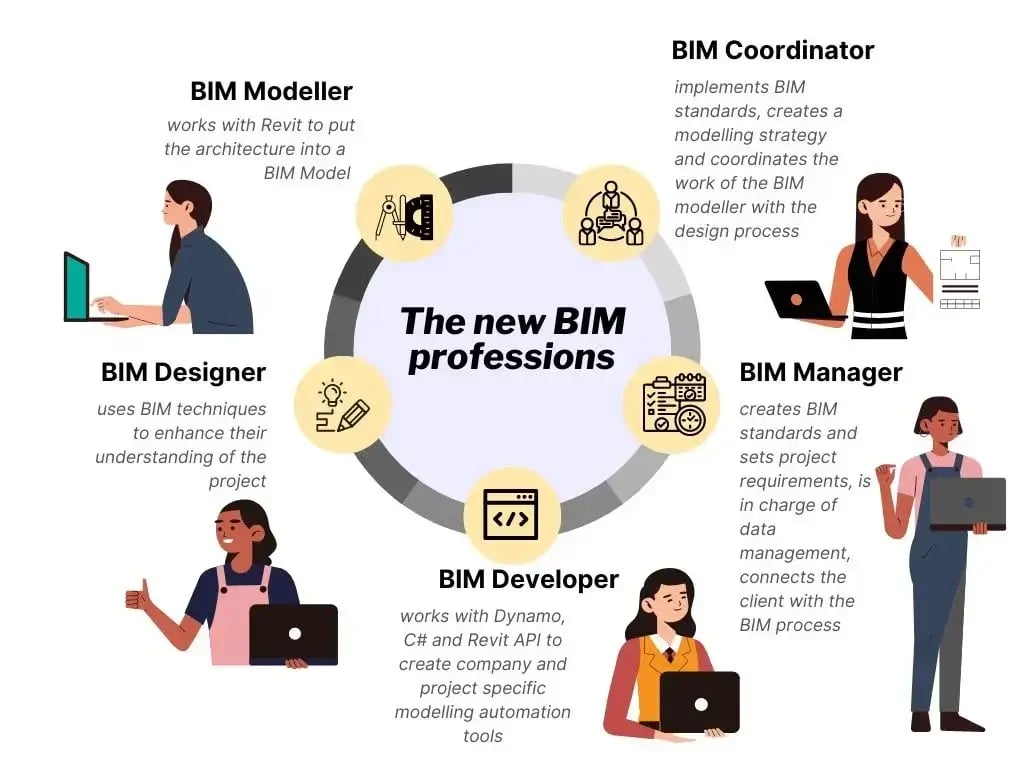
Digital transformation is introducing new roles across the AEC domain. Let’s explore the key ones:
BIM Management: BIM managers will take on a broader role in establishing project standards, defining information requirements, managing BIM execution plans, and ensuring teams follow consistent digital workflows.
VDC Professionals: These professionals connect digital 3D models with actual construction processes. They will use BIM, simulations, and project data to plan construction sequences, improve coordination, identify potential site issues, and optimise how projects are delivered.
BIM Automation: Modelling and documentation tasks are becoming supremely automated. So, professionals who can create scripts, custom tools, and automated workflows will be in greater demand. Their role will be to improve productivity while reducing manual errors across BIM processes.
Information Management: BIM professionals will steadily become responsible for maintaining the quality, structure, and accessibility of project information. This includes managing data across project stages and ensuring that the right information reaches the right stakeholders at the right time.
Digital Construction: These professionals will bring BIM closer to on-site execution by using models, field technologies, reality capture, and connected data to track progress, coordinate teams, and improve construction efficiency.
Multidisciplinary Coordination: As BIM becomes more integrated across the project lifecycle, coordination roles will involve more than clash detection. Professionals will need to align design intent, technical requirements, schedules, and construction information across multiple disciplines.
How Will AI, Automation, Data, and New Collaboration Models Shape Future BIM Careers?
New-age technologies will boost the abilities of BIM to streamline workflows across architecture careers and engineering careers. Let’s explore how:
AI-Assisted Workflows: AI will support activities such as design analysis, model checking, information extraction, and issue identification. BIM professionals will therefore spend less time on routine processes and more time reviewing outputs and making informed project decisions.
Higher Productivity: Automation will take over repetitive activities such as model updates, documentation, data entry, and quality checks. Professionals who understand how to build and manage these automated workflows will be able to handle larger volumes of work with greater consistency.
Lean BIM Teams: With digital tools becoming more capable, BIM teams may become smaller but more specialised. Instead of having larger teams to just do model creation, firms will need professionals who can manage technology, workflows, information, and project outcomes.
Cross-Functional Collaboration: BIM professionals will work alongside architects, engineers, contractors, technology experts, and project managers. This will make communication and an understanding of different project disciplines just as important as software proficiency.
New Skill Combinations: Future BIM careers will require a combination of technical knowledge and digital capabilities. Professionals who can bring together BIM, data, automation, AI, and project understanding will be better positioned to take on emerging responsibilities.
Connected Project Delivery: BIM will become more closely integrated with cloud platforms, digital twins, reality capture, and construction technologies. This will allow teams to work with continuously updated information across design, construction, and operations.
How Can AEC Professionals Prepare for the Future BIM Workforce?
BIM is a construction technology that’s moving the needle on how AEC projects are designed, coordinated, and delivered. Here’s how individuals can prepare for this change:
Build Technical Expertise: Develop a strong understanding of BIM principles, modelling standards, coordination processes, and project workflows instead of relying only on proficiency in a particular software.
Develop Digital Skills: Familiarise yourself with AI, automation, data management, computational design, and other digital tools that are becoming part of modern BIM workflows. These skills can help professionals move beyond model production into more technical roles.
Strengthen Domain Knowledge: BIM works differently across architecture, structural engineering, MEP, and construction. Combining BIM expertise with knowledge of your chosen discipline can help you understand project requirements and make better use of digital tools.
Improve Collaboration: Future BIM roles will involve working across disciplines and project stages. Building communication, coordination, and problem-solving skills can help BIM professionals contribute effectively within multi-faceted teams.
Keep Upskilling: BIM is an evolving field, with new software, technologies, standards, and workflows continually emerging. Regularly learning and applying these developments can help professionals keep their skills aligned with industry requirements.
Choose a Niche: Future BIM teams will need specialised professionals who can build deeper expertise in areas such as BIM management, VDC, automation, information management, or digital construction. A focused skill set can open pathways to more advanced BIM roles.
Build Practical Experience: Applying BIM skills to real-world projects, case studies, and interconnected workflows can help bridge the gap between learning software and understanding how BIM is used in practice.
Invest in Career-Ready Learning: For professionals looking to build these capabilities systematically, a structured BIM program can provide exposure to industry workflows, practical projects, and guidance from experienced practitioners. This can make the transition into advanced BIM roles more purposeful and career-focused.
Novatr’s BIM Professional Program is an industry-recognised certification program that prepares learners for real-world challenges.