


What is 4D BIM Scheduling?
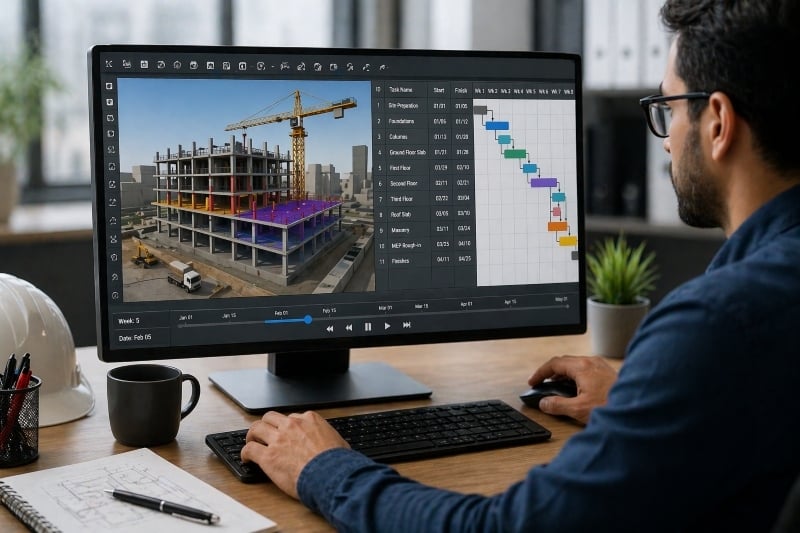
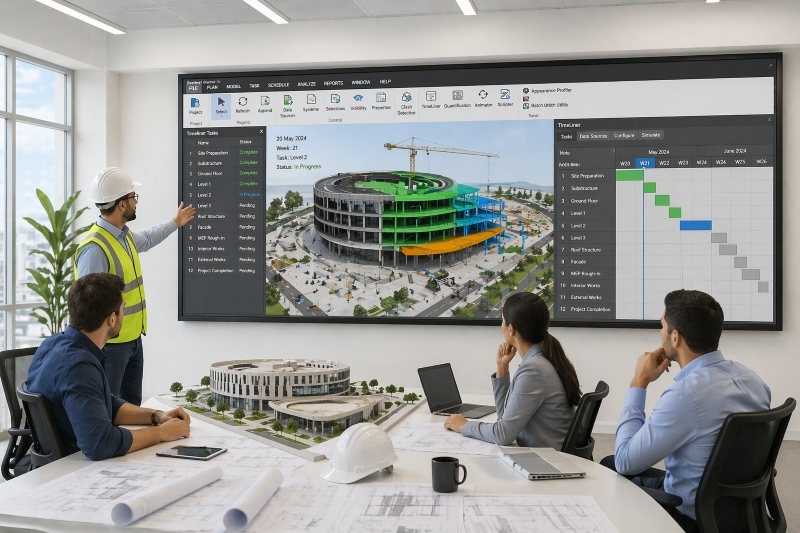
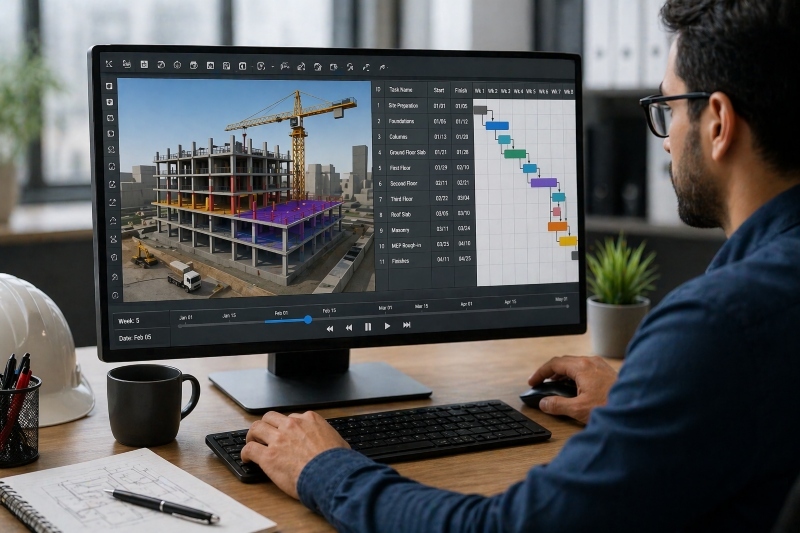
What is 4d BIM scheduling? It is an advanced planning approach where time is integrated with a 3D BIM model to simulate construction sequences. Instead of relying only on timelines, teams can visualize how a project will be built step by step.
This method is based on BIM 4d modelling, where each model element is linked to a specific task in the schedule. As a result, the project timeline becomes a visual simulation rather than a static chart.
For example, structural elements, MEP systems, and architectural components are all connected to their respective construction phases. This allows teams to see how different systems interact over time.
Using BIM 4d project management software, teams can analyze sequencing, identify delays, and optimize workflows before construction begins. This reduces uncertainty and improves coordination across disciplines.
4D BIM scheduling also supports 4d BIM planning, enabling stakeholders to make informed decisions based on visual data rather than assumptions.
Key Differences Between 4D BIM and Traditional Scheduling
Understanding how these methods differ helps clarify why modern projects are shifting toward BIM-based planning.
1. Visualization vs Static Planning
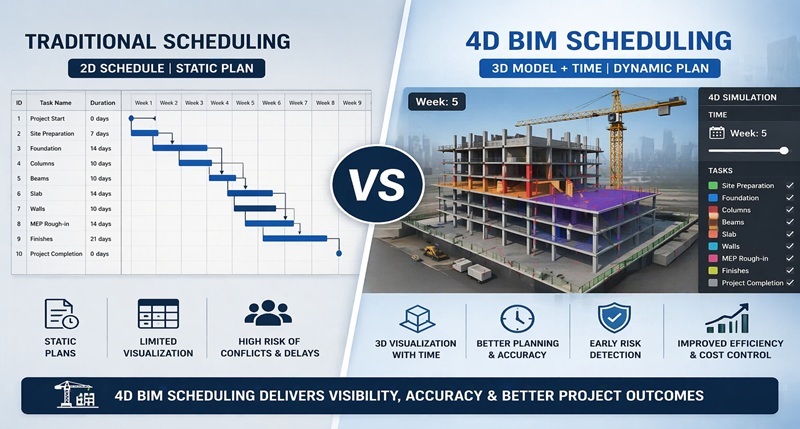
Traditional scheduling relies on charts and lists, which can be difficult to interpret. In contrast, 4D BIM provides visual simulations, making it easier to understand construction sequences.
2. Integration of Design and Time
Traditional methods separate design from scheduling. 4D BIM integrates both, ensuring alignment between models and timelines.
3. Coordination Efficiency
Traditional scheduling often leads to coordination gaps. 4D BIM improves alignment across teams through shared visual models.
4. Error Detection
With traditional methods, conflicts are often identified during construction. 4D BIM detects sequencing issues early through simulation.
5. Decision-Making
Static schedules limit decision-making. 4D BIM enables data-driven decisions using real-time simulations.
Limitations of Traditional Scheduling Methods
While traditional scheduling has been widely used, it presents several challenges that affect project performance.
- Lack of Visualization: Teams cannot easily visualize construction sequences, making it difficult to identify conflicts.
- Poor Coordination: Without integration, communication gaps between disciplines increase.
- Manual Updates: Changes require manual revisions, increasing the risk of errors.
- Limited Predictability: Static schedules cannot simulate real-world scenarios effectively.
- Higher Risk of Delays: Issues are often discovered during construction rather than planning.
Advantages of 4D BIM in Project Planning

The benefits of 4d BIM are significant, especially in complex construction environments where coordination and timing are important.
- Enhanced Visualization: Teams can see how the project evolves over time, improving clarity and understanding.
- Improved Scheduling Accuracy: 4D BIM aligns timelines with actual design elements, reducing discrepancies.
- Better Coordination: Integrated workflows improve collaboration between disciplines.
- Reduced Delays: Early detection of sequencing issues helps prevent disruptions.
- Support for Safety Planning: 4d BIM for construction safety planning allows teams to identify risks and plan safer workflows.
- Efficient Resource Management: Teams can allocate labor and materials based on accurate schedules.
Real Impact on Construction Projects
The adoption of 4D BIM has led to measurable improvements in construction outcomes. Projects that use BIM-based scheduling often experience better coordination and reduced rework.
For example, infrastructure projects benefit from visual simulations that help manage complex sequences. Commercial buildings use 4D BIM to coordinate multiple systems and ensure timely completion.
Using leading 4d BIM tools for project sequencing, teams can simulate different scenarios and choose the most efficient approach.
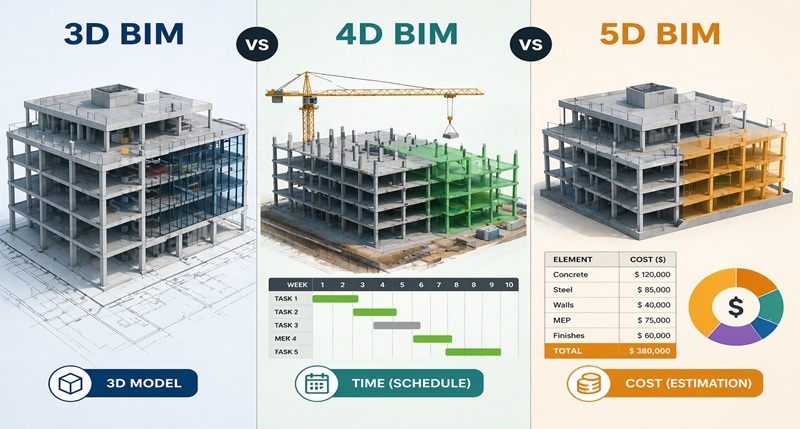
In addition, integration with 4d and 5d BIM software allows teams to connect scheduling with cost data, further improving project control.
Why the Industry is Moving Towards 4D BIM
The construction industry is increasingly adopting 4D BIM due to its ability to address modern project challenges.
Several factors are driving this shift:
- Increasing project complexity requiring better coordination
- Demand for improved efficiency and reduced delays
- Need for better collaboration across distributed teams
- Growing adoption of digital construction technologies
4D BIM provides a solution by combining design, time, and data into a single workflow. This integration improves transparency, reduces risks, and supports better decision-making.
How to Build Skills in 4D BIM
Developing expertise in 4D BIM requires understanding both modeling and scheduling workflows. Professionals must learn how to integrate design data with project timelines and use tools effectively.
Take your civil engineering career to the next level with Novatr’s BIM Professional Course for Civil Engineers, a project-based program that prepares you to plan, design, and manage construction projects using 12+ industry software and essential BIM plugins.
Learn how to work with Autodesk Revit, Navisworks, construction cloud and key plugins like DiRoots.One, pyRevit, EF-Tools, ProSheets, Issue and Model Checker for Revit to improve automation, accuracy, and project efficiency.
Here’s what you’ll gain:
- End-to-end understanding of BIM workflows, modeling, estimation, coordination, sequencing, and documentation.
- Hands-on training aligned with ISO 19650 standards and real residential + commercial projects.
- Globally recognized certifications:
o Novatr Course Certificate
o Autodesk User Certification
o NSDC Skill Certificate
o Novatr Specialization Certificate, if opted
After completing the core modules, learners can also choose 2 additional specializations, including:
- Visual Programming with Dynamo – for automation and parametric workflows
- 4D, 5D & 6D with BIM – for time, cost, and facility integration
- Tekla for RCC Modeling – for detailed steel and concrete modeling
- Civil 3D for Infrastructure – for roadways, railways, and utilities
- Project Strategy & Optimization with Plannerly - Plan, structure, and audit BIM execution plans.
Equip yourself with hands on BIM skills and become job-ready for global infrastructure and construction opportunities.