---
title: "MEP Engineer vs. HVAC Engineer: What’s the Difference? 2026"
description: Understand the difference between MEP and HVAC engineers, including responsibilities, skills, tools, salaries, and career growth paths.
image: https://blog.novatr.com/hubfs/VS.png
---
[Blogs](https://www.novatr.com/learning-hub)
- [Architecture & Construction](https://www.novatr.com/learning-hub?category=Architecture+%26+Construction)
- [BIM](https://www.novatr.com/learning-hub?category=BIM)
- [Computational Design](https://www.novatr.com/learning-hub?category=Computational+Design)
- [Company News](https://www.novatr.com/learning-hub?category=Company+News)
- [Expert Talks](https://www.novatr.com/learning-hub?category=Expert+Talks)
Explore Courses
[Just Launched  BIM Professional Program v.2026 Take your career to the next level by mastering the real-world application of BIM. Know More](https://www.novatr.com/courses/bim-professional-program)
[ Master Computational Design Course Break into an advanced career by learning to apply the power of computation to the art of design. Know More](https://www.novatr.com/courses/computational-design)
[Blogs](https://www.novatr.com/learning-hub)
Explore Blogs
- [Architecture & Construction](https://www.novatr.com/learning-hub?category=Architecture+%26+Construction)
- [BIM](https://www.novatr.com/learning-hub?category=BIM)
- [Computational Design](https://www.novatr.com/learning-hub?category=Computational+Design)
- [Company News](https://www.novatr.com/learning-hub?category=Company+News)
- [Expert Talks](https://www.novatr.com/learning-hub?category=Expert+Talks)
Courses
- [BIM Professional Program v.2026](https://www.novatr.com/courses/bim-professional-program)
- [Master Computational Design](https://www.novatr.com/courses/computational-design)
- [MEP/](https://www.novatr.com/learning-hub?category=BIM)
Featured Article
# MEP Engineer vs. HVAC Engineer: Roles, Skills, and Career Differences Explained

Neha Singh
February 11, 2026
7 min read
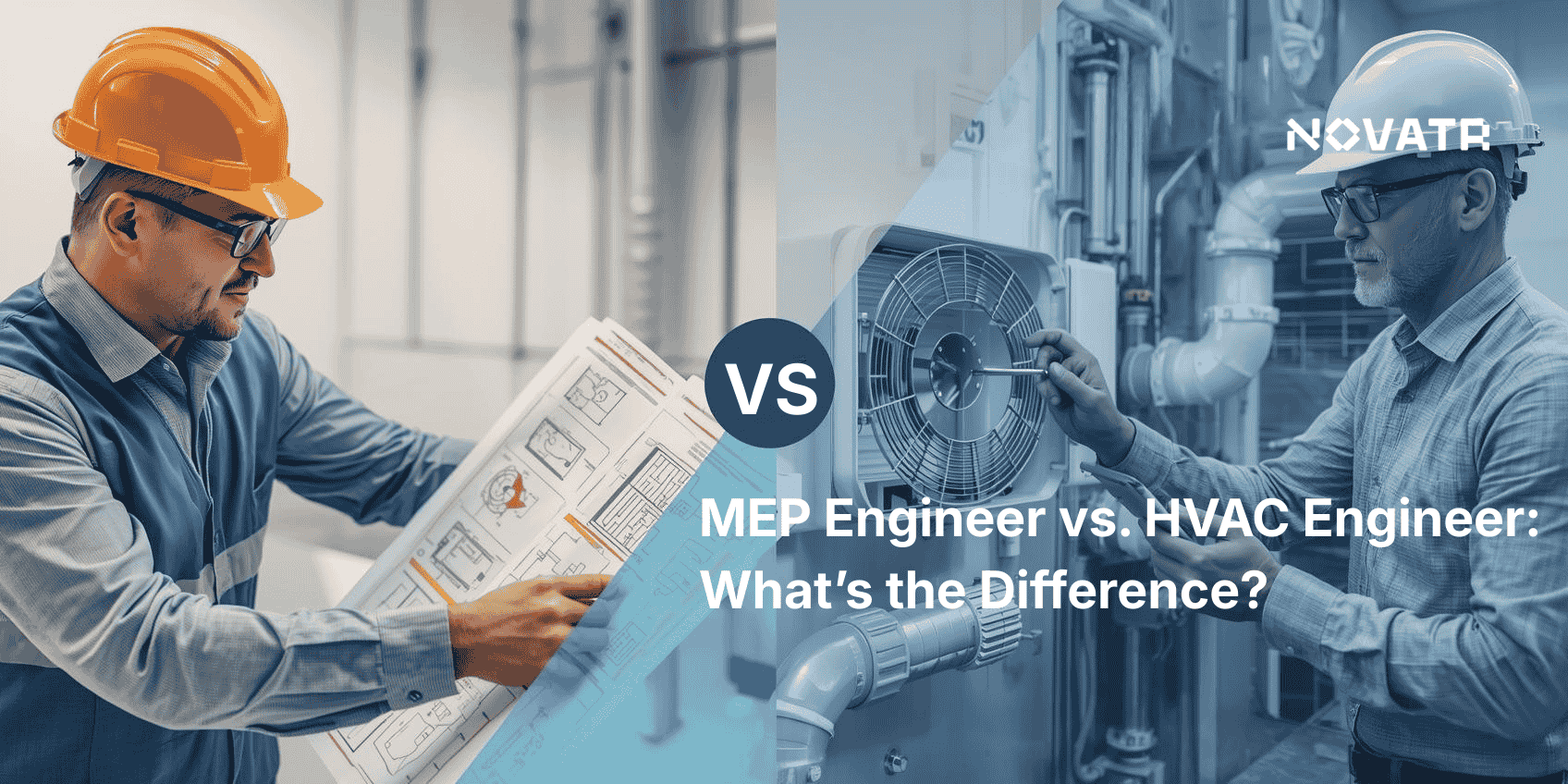

A mep engineer manages multiple building services, while an HVAC specialist focuses on heating and cooling systems. When comparing mep engineer vs hvac engineer, the main distinction lies in system scope, coordination responsibility, and technical specialization.
The [U.S. Census Bureau](https://www.census.gov/construction/c30/current/index.html) reported that non-residential construction spending in the United States exceeded $1.1 trillion in 2023, reflecting continued growth in complex building projects
As project complexity increases, organizations rely more on professionals who can manage interconnected MEP systems and work efficiently with advanced MEP software. These professionals are expected to balance technical accuracy with practical construction constraints and long-term operational needs. This article explains how MEP and HVAC engineering roles differ in scope, responsibilities, required skills, and long-term career pathways.
Unlock High-Paying Careers With BIM
Master BIM workflows, software and skills on real projects.
Apply Now
\*Limited seats available
## **Who Are MEP Engineers and What Types of Projects Do They Handle?**
****
An MEP engineer designs, coordinates, and supervises mechanical, electrical, and plumbing systems within buildings. Their role focuses on ensuring that essential services operate safely, efficiently, and in line with regulations.
Professionals working in various MEP engineering roles support commercial, industrial, and institutional developments, including hospitals, offices, data centers, and manufacturing facilities.
The main roles and responsibilities of MEP engineers in construction include:
- Mechanical system layout
- Electrical power planning
- Plumbing and drainage design
- Fire protection coordination
- Energy efficiency analysis
MEP engineers are involved from early planning through final commissioning. They review drawings, prepare coordinated layouts, and resolve system conflicts before construction begins. During installation, they also respond to site-related challenges and design adjustments.
Within building systems engineering, they often act as technical coordinators, ensuring that different services function together without disruption. This role requires consistent communication with architects, contractors, and regulatory authorities.
## **What Is the Role of HVAC Engineers in Building Design and Performance?**
An hvac engineer focuses on designing systems that control indoor temperature, airflow, and humidity. Their work directly affects occupant comfort and energy use.
Professionals working in HVAC design engineering aim to balance thermal performance with operating efficiency. They analyze environmental conditions and develop system layouts accordingly.
To explain what does an HVAC engineer do in building design, their main responsibilities include:
- Heating and cooling load calculations
- Equipment selection and sizing
- Duct and pipe layout
- Ventilation planning
- System testing and balancing
These tasks define the structure of HVAC system design.
Many HVAC engineers pursue mechanical engineering careers focused on thermodynamics and fluid behavior. They often collaborate with sustainability specialists and facility managers to improve system performance and reduce long-term operating costs.
Simulation software allows them to evaluate multiple design options before construction, helping identify potential airflow issues or capacity limitations early in the process.
Their technical depth supports consistent control of indoor environments across different seasons and usage patterns.
## **How Do Their Responsibilities Differ Across Planning, Design, and Execution Stages?**

Differences between MEP and HVAC roles become clearer when viewed across project phases.
During planning, MEP engineers evaluate infrastructure capacity and service compatibility. HVAC engineers concentrate on thermal needs and climate targets, considering both local weather conditions and building occupancy patterns.
In the design phase, MEP professionals integrate all building services, while HVAC specialists refine airflow and equipment layouts to meet comfort and efficiency goals.
During execution, both support installation and commissioning, but with different priorities.
Here is a highlight of these differences:
| **Project Stage** | **MEP Focus** | **HVAC Focus** |
| --- | --- | --- |
| Planning Stage | System Feasibility and Integration | Environmental Assessment |
| Design Stage | Multidisciplinary Coordination | Thermal Modeling |
| Execution Stage | System-Wide Verification | Performance Balancing |
This structure reflects the **difference between MEP and HVAC engineers explained** through workflow responsibilities. It also illustrates the contrast between the HVAC design workflow vs MEP coordination process, where specialization and integration follow separate paths.
Clear role allocation improves efficiency, reduces delays, and supports smoother handover to facility management teams.
## **Which Skills, Software, and Tools Are Specific to Each Profession?**
****
Both professions require strong technical foundations, but their competencies differ based on system focus.
MEP engineers develop coordination and compliance skills. HVAC engineers refine analytical and performance-related abilities.
Here's how their skills differ:
| ** MEP Engineers** | ** HVAC Engineers** |
| --- | --- |
| Cross-System Coordination | Thermal Modeling |
| Regulatory Compliance | Thermal Modeling |
| Technical Documentation | Airflow Balancing |
| Energy Analysis | System Diagnostics |
| Construction Support | Performance Testing |
These abilities reflect the skills and software tools used by MEP and HVAC professionals.
### **Software and Digital Tools**
Digital platforms support collaboration and analysis across both roles. Many teams rely on BIM for HVAC and MEP coordination.
Common tools include:
- BIM coordination platforms
- Energy simulation software
- Load calculation programs
- Equipment databases
- Cloud collaboration systems
These technologies support BIM integration for MEP and HVAC professionals and improve data consistency. Engineers who regularly update their software skills often adapt more easily to new project requirements.
## **How Do Salaries, Job Roles, and Career Growth Opportunities Compare Between the Two?**
Career progression depends on specialization, experience, and industry demand. Both roles offer stable opportunities within construction engineering jobs.
MEP engineers often advance into project management, consulting, or senior coordination roles. Their broad system knowledge supports leadership positions and cross-disciplinary responsibilities.
HVAC engineers usually progress into advanced design, commissioning, or advisory roles. Some move into energy consulting, system auditing, or equipment development.
Key factors influencing growth include:
- Project complexity
- Sector focus
- Certification levels
- Software proficiency
- Regional demand
MEP engineers benefit from wider mobility, while HVAC engineers benefit from steady demand in energy-focused projects and building retrofits.
These trends demonstrate how MEP and HVAC engineers collaborate on projects while maintaining distinct professional paths. Both professions remain stable as building performance standards rise.
Master BIM and Get Hired Faster
Join a community of 8500+ Architects and Engineers.
Explore Now
\*Limited seats available
## **Conclusion**
Understanding the difference between a mep engineer and an HVAC specialist helps professionals and employers align responsibilities more effectively. When evaluating mep engineer vs hvac engineer, the main distinction lies in system coverage, coordination scope, and technical focus.
MEP engineers oversee integrated building services, while HVAC engineers concentrate on climate control and environmental performance. Both roles support safe, efficient, and compliant facilities. As digital coordination, sustainability requirements, and performance monitoring expand, professionals in both fields benefit from continuous learning and clear specialization.
The [BIM Course for MEP Engineers](https://www.novatr.com/us/courses/bim-for-mep-engineers) offered by [Novatr](https://www.novatr.com/us) provides structured learning pathways for engineers seeking to strengthen technical knowledge and digital coordination capabilities.
Visit our [resource page](https://www.novatr.com/learning-hub) to explore detailed learning materials and receive expert guidance on advancing your career.
## **FAQs**
### **1. Does an HVAC Engineer Fall Under the Broader MEP Engineering Category?**
Yes, HVAC engineering is generally part of MEP engineering because heating and cooling systems form the mechanical component of building services. However, HVAC engineers focus only on climate control, while MEP engineers manage multiple building systems, including electrical and plumbing services.
### **2. What Type of Projects Require Both MEP and HVAC Engineers?**
Hospitals, data centers, airports, laboratories, manufacturing plants, and large commercial complexes usually require both professionals. These projects involve integrated services, strict performance standards, and continuous monitoring of environmental conditions.
### **3. How Do the Roles of MEP and HVAC Engineers Overlap in Building Design?**
Their roles overlap during mechanical layout planning, energy modeling, and commissioning. Both collaborate to ensure heating and cooling systems align with electrical, plumbing, and fire protection services for coordinated operation and long-term reliability.
Was this content helpful to you
Like Yes
Dislike No

TABLE OF CONTENTS
BIM Is The New Standard. Are You Certified?
Get Certified in BIM
SHARE ON YOUR SOCIALS
Link Copied Successfully
Related articles
[ CIVIL SCIA Engineer Vs Autodesk Robot Structural Analaysis. What Structural Engineers Should Know? 20 February 2026 8 min read](https://blog.novatr.com/blog/scia-engineer-vs-autodesk-robot-structural-analaysis.-what-structural-engineers-should-know) [ BIM Mep Engineer vs Plumbing Engineer Salary, Expertise and Skills 28 April 2025 18 min read](https://blog.novatr.com/blog/bim-mep-engineer-vs-plumbing-engineer) [.png) How MEP Engineers Collaborate with Architects and Civil Engineers 27 May 2025 7 min read](https://blog.novatr.com/blog/how-mep-engineers-work-with-architects-civil-engineers) [ BIM Mep Engineer vs Electrical Engineer Salary, Expertise & Skills 24 April 2025 20 min read](https://blog.novatr.com/blog/bim-mep-engineer-vs-electrical-engineer)
Download Syllabus
## BIM Professional Program
Next Cohort
June 2026
Program Duration
7 Months
Premium Program benefits
8 Credentials from Autodesk, NSDC, Novatr
1 program. 10 career paths. Infinite Growth.
40+ ISO 19650 & RIBA real-world projects to practice
1-on-1 guidance. Access 400+ industry experts.
Access the biggest AEC-Tech community on the planet. 8500+ and counting
Curated for you by 100+ global BIM leaders.
Lifelong access to course content
Enter your details to download the program syllabus.
##### BIM Professional Program
June 2026, 7 Months
Your Name Invalid name.
Phone Number Enter a valid phone number
Email Please enter a valid email address.
Select years of experience\* Currently studying 0-1 years 1-2 years 2-4 years 4-8 years 8-10 years 10-12 years 12+ years Invalid selection.
Specialisation Select your background\* Architecture Civil Engineering Mechanical Engineering Electrical Engineering Invalid selection.
Are you professionally trained in interior design?
Yes
No
I agree to the [Terms of Use](https://www.novatr.com/terms-and-conditions) and [Privacy Policy](https://www.novatr.com/privacy-policy), and consent to be contacted by Email, Call, WhatsApp, or SMS.
Submit
Ready to skyrocket your career?
Begin your next chapter in AEC
with Novatr!
We are here to help you take the industry by storm with advanced, tech-first skills.
[Explore Courses](https://www.novatr.com/#courses)
Join our newsletter
Submit
Thank you for signing up.
We’ll send you a nice letter once per week. No spam.

Dare to Disrupt.
Join thousands of people who organise
work and life with Novatr.
Company
- [About Us](https://www.novatr.com/about)
- [BIM Professional Program v.2026](https://www.novatr.com/courses/bim-professional-program)
- [Masters Computational Design](https://www.novatr.com/courses/computational-design)
- [Become a Mentor](https://www.novatr.com/apply-as-mentor)
- [Hiring from Us](https://www.novatr.com/hire-from-us)
- [Careers at Novatr](https://www.novatr.com/career)
Resources
- [Blog](https://www.novatr.com/learning-hub)
- [Media Room](https://www.novatr.com/media-room-home-page)
- [Career Builder](https://www.novatr.com/career-navigator)
- [Events & Webinars](https://www.novatr.com/webinars)
- [FAQs & Support Center](https://www.novatr.com/contact-us)
- [Contact Us](https://www.novatr.com/contact-us)
- [Privacy Policy](https://www.novatr.com/privacy-policy)
- [Terms of Use](https://www.novatr.com/terms-and-conditions)
©2023 Oneistox Network Pvt. Ltd.
All Rights Reserved
```json
{
"@context" : "https://schema.org",
"@type" : "BlogPosting",
"author" : {
"@type" : "Person",
"name" : "Neha Singh",
"url" : "https://blog.novatr.com/blog/author/neha-singh"
},
"dateModified" : "2026-02-11T09:55:29.310Z",
"datePublished" : "2026-02-11T09:50:58.000Z",
"headline" : "MEP Engineer vs. HVAC Engineer: What’s the Difference? {{year}}",
"image" : [ "https://blog.novatr.com/hubfs/VS.png" ],
"mainEntityOfPage" : {
"@id" : "https://blog.novatr.com/blog/mep-engineer-vs-hvac-engineer",
"@type" : "WebPage"
},
"publisher" : {
"@type" : "Organization",
"logo" : {
"@type" : "ImageObject",
"url" : "https://blog.novatr.com/hubfs/Novatr%20Prev%20OX-2.svg"
}
}
}
```