---
title: "MBA After Civil Engineering: Is It the Right Choice?"
description: Explore the benefits of an MBA after civil engineering, compare MBA vs BIM, and discover career paths, salaries, and growth opportunities.
image: https://blog.novatr.com/hubfs/Is%20mba%20after%20civil%20engineering%20a%20right%20choice.jpg
---
[Blogs](https://www.novatr.com/learning-hub)
- [Architecture & Construction](https://www.novatr.com/learning-hub?category=Architecture+%26+Construction)
- [BIM](https://www.novatr.com/learning-hub?category=BIM)
- [Computational Design](https://www.novatr.com/learning-hub?category=Computational+Design)
- [Company News](https://www.novatr.com/learning-hub?category=Company+News)
- [Expert Talks](https://www.novatr.com/learning-hub?category=Expert+Talks)
Explore Courses
[Just Launched  BIM Professional Program v.2026 Take your career to the next level by mastering the real-world application of BIM. Know More](https://www.novatr.com/courses/bim-professional-program)
[ Master Computational Design Course Break into an advanced career by learning to apply the power of computation to the art of design. Know More](https://www.novatr.com/courses/computational-design)
[Blogs](https://www.novatr.com/learning-hub)
Explore Blogs
- [Architecture & Construction](https://www.novatr.com/learning-hub?category=Architecture+%26+Construction)
- [BIM](https://www.novatr.com/learning-hub?category=BIM)
- [Computational Design](https://www.novatr.com/learning-hub?category=Computational+Design)
- [Company News](https://www.novatr.com/learning-hub?category=Company+News)
- [Expert Talks](https://www.novatr.com/learning-hub?category=Expert+Talks)
Courses
- [BIM Professional Program v.2026](https://www.novatr.com/courses/bim-professional-program)
- [Master Computational Design](https://www.novatr.com/courses/computational-design)
- [BIM/](https://www.novatr.com/learning-hub?category=BIM)
Featured Article
# MBA After Civil Engineering: Is It the Right Choice?

Harshita Chaudhary
July 3, 2026
4 min read


For many graduates, choosing the next step after engineering can feel overwhelming. While some pursue technical specialisations, others consider an **MBA after civil engineering** to move into management and leadership roles. The decision often comes down to long-term career goals, interests, and the type of opportunities you want to pursue. So, **is an MBA a good option after civil engineering**? With industries evolving and new career pathways emerging, professionals today have more choices than ever. In this blog, we'll explore the benefits of an MBA, compare an MBA with an M.Tech after engineering, and examine alternative **future career options after civil engineering**, including opportunities driven by digital construction and **BIM** [**career growth**](https://www.novatr.com/blog/bim-courses-for-architects-career-growth).
## Key Takeaways
- An **MBA after civil engineering** helps engineers move into leadership, strategy, and business management roles.
- It can improve access to higher-paying roles, including the **highest salary after civil engineering**, depending on experience and specialisation.
- **BIM career growth** offers a strong alternative for engineers interested in digital construction and project execution roles.
- The choice between MBA and BIM depends on whether you prefer business leadership or technical, project-focused career paths.
Unlock High-Paying Careers With BIM
Master BIM workflows, software and skills on real projects.
Apply Now
\*Limited seats available
## What is WELL AP Certification?
A **WELL AP certification** is a professional credential that demonstrates expertise in the **WELL Building Standard**, a global framework focused on creating sustainable buildings and improving occupant well-being. It equips professionals with the knowledge to apply wellness principles across the design, construction, and operation of buildings.
Unlike **green building certifications**, which primarily focus on environmental performance, WELL emphasises factors such as air quality, water quality, lighting, thermal comfort, acoustics, nutrition, and mental well-being.
The certification is valuable for architects, engineers, designers, consultants, and construction professionals involved in sustainable building projects. As organisations place greater emphasis on health-centric design, a **WELL AP certification** can help professionals stand out and contribute to projects that prioritise both sustainability and human experience.
## Why is WELL AP Important in Modern Construction?

Source: [https://www.buildingsandcities.org/media/images/articles2/RabeneckMMCformatted.jpg](https://www.buildingsandcities.org/media/images/articles2/RabeneckMMCformatted.jpg)
Modern buildings are expected to do more than meet structural and environmental standards. They are also designed to support the health, comfort, and well-being of the people who use them. This shift has made **WELL AP certification** increasingly relevant across the AEC industry.
From offices and hospitals to educational institutions and residential developments, project teams are integrating wellness principles into the design process alongside sustainability goals. As a result, professionals with a **sustainable building certification** are becoming valuable contributors to projects that prioritise both environmental performance and occupant experience.
The growing adoption of digital workflows has also strengthened the connection between **BIM and sustainability**. By using BIM to analyse building performance, coordinate design decisions, and improve project outcomes, teams can more effectively support wellness objectives throughout the project lifecycle.
## What Career Opportunities Are Available After WELL AP?
A WELL AP certification can help professionals expand their opportunities in the growing field of **sustainable buildings**. As wellness standards become more common across commercial, residential, healthcare, and institutional projects, organisations are seeking professionals who understand both building performance and occupant well-being.
[Career opportunities](https://www.novatr.com/blog/career-paths-for-mep-engineers-in-the-middle-east) include roles such as Sustainability Consultant, WELL AP Consultant, Green Building Specialist, Building Performance Analyst, and ESG or Sustainability Advisor. These roles often involve working with architects, engineers, developers, and project teams to integrate wellness principles throughout the project lifecycle.
For professionals with a **BIM certification**, combining digital workflows with sustainability expertise can create a competitive advantage. The integration of **BIM for sustainable construction** enables better collaboration, performance analysis, and decision-making, opening new pathways in **sustainability careers in construction**.
## How Do Sustainability and BIM Work Together in Modern Projects?
Sustainability is no longer considered only during the final stages of a project. It is becoming an integral part of design and project delivery from the very beginning. This is where **BIM and sustainability** work together.
By creating data-rich digital models, BIM enables project teams to evaluate design options, optimise material usage, improve energy performance, and reduce waste before construction begins. This makes **BIM for sustainable construction** a valuable tool for achieving both environmental and project goals.
BIM also improves collaboration between architects, engineers, consultants, and contractors, ensuring sustainability objectives are considered throughout the project lifecycle. Better [coordination](https://www.novatr.com/blog/bim-in-mep-coordination) leads to fewer design conflicts, less rework, and more efficient resource utilisation.
As the industry continues to prioritise greener buildings, professionals with expertise in both **BIM certification** and **green building certification** are increasingly well-positioned to contribute to high-performance, sustainable projects.
## How do BIM Certifications Help Engineers Work on Sustainable Projects?

Source: [https://www.autodesk.com/blogs/construction/wp-content/uploads/2020/10/1920x1080-blog\_001.jpg](https://www.autodesk.com/blogs/construction/wp-content/uploads/2020/10/1920x1080-blog_001.jpg)
As sustainability becomes a priority across the AEC industry, employers are looking for professionals who can combine digital expertise with sustainable design principles. This is where a [**BIM certification**](https://www.novatr.com/blog/why-professionals-choose-novatr-bim-certification-courses) adds significant value.
BIM enables engineers to create data-rich models that support better design coordination, energy analysis, material optimisation, and lifecycle planning. These capabilities make **BIM for sustainable construction** an essential part of delivering greener, more efficient buildings.
Professionals with BIM skills can collaborate more effectively with architects, consultants, and sustainability teams to ensure environmental goals are integrated throughout the project lifecycle. When paired with credentials like a **WELL AP certification** or other **green building certification** programs, BIM expertise creates a well-rounded skill set that is increasingly valued by employers.
Programs such as Novatr's BIM Professional Program help engineers build practical BIM capabilities through real-world projects and industry [workflows](https://www.novatr.com/blog/capabilities-of-bim360-for-mep-engineering), preparing them to contribute to sustainable, technology-driven construction projects and long-term **sustainability careers in construction**.
Master BIM and Get Hired Faster
Join a community of 8500+ Architects and Engineers.
Explore Now
\*Limited seats available
## Conclusion
Choosing between an **MBA after civil engineering** and other career paths depends on your long-term goals. An MBA is better suited for engineers aiming to move into leadership, business strategy, and management roles across industries. It can also support a higher earning potential in the right roles, including the **highest salary after civil engineering**. However, for those interested in hands-on project delivery and the future of construction, BIM career growth offers strong opportunities in digital workflows and technical roles such as BIM Manager. The right choice depends on whether you want to build a business-focused career or grow within digital construction and project execution. If you’re curious, [**BIM Professional Program**](https://www.novatr.com/courses/bim-professional-program?utm_source=organic_search&utm_medium=blog&utm_campaign=mba-after-civil-engineering-is-it-the-right-choice) by Novatr is a great place to start.
For more industry updates, join us on our [**WhatsApp channel**](https://whatsapp.com/channel/0029Vb7Gy2LBFLgMx79j7B1b) or head to our [**resource page**](https://www.novatr.com/learning-hub).
Was this content helpful to you
Like Yes
Dislike No

TABLE OF CONTENTS
BIM Is The New Standard. Are You Certified?
Get Certified in BIM
SHARE ON YOUR SOCIALS
Link Copied Successfully
Related articles
[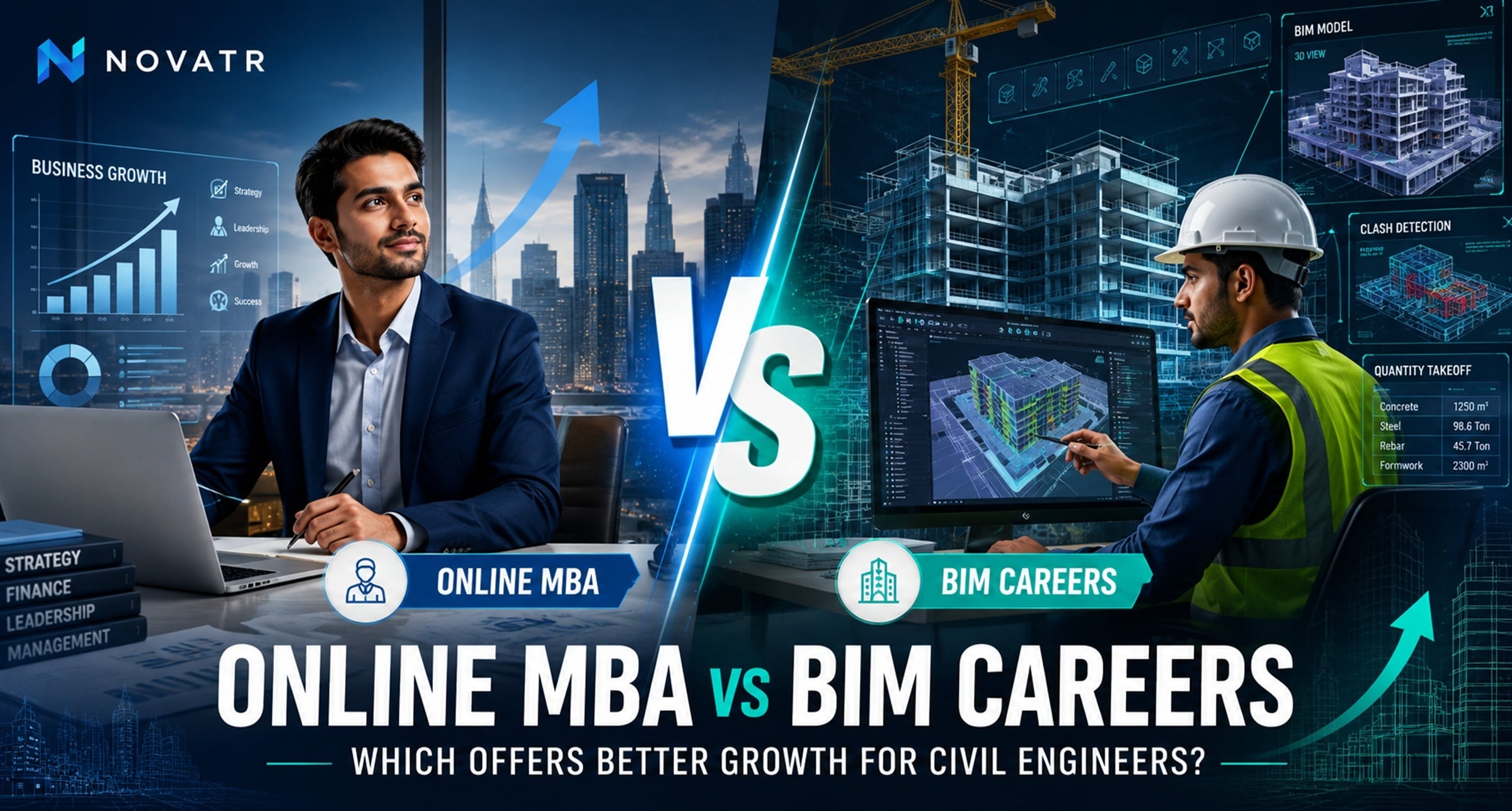 BIM Online MBA vs BIM Careers: Which Offer Better Growth For Civil Engineers? 19 June 2026 4 min read](https://blog.novatr.com/blog/online-mba-vs-bim-careers-which-offer-better-growth-for-civil-engineers) [ BIM Civil Future Ready Career Paths for Civil Engineers in 2026 11 June 2026 7 min read](https://blog.novatr.com/blog/future-ready-career-paths-for-civil-engineers) [ BIM Civil How Delhi-Mumbai Industrial Corridor Are Built using BIM? 5 June 2026 7 min read](https://blog.novatr.com/blog/how-delhi-mumbai-industrial-corridor-are-built-using-bim) [ BIM Civil What If You Don’t Crack ESE? Best Career Options for Engineers 11 June 2026 9 min read](https://blog.novatr.com/blog/what-if-you-dont-crack-ese-best-career-options-for-engineers)
Download Syllabus
## BIM Professional Program
Next Cohort
June 2026
Program Duration
7 Months
Premium Program benefits
8 Credentials from Autodesk, NSDC, Novatr
1 program. 10 career paths. Infinite Growth.
40+ ISO 19650 & RIBA real-world projects to practice
1-on-1 guidance. Access 400+ industry experts.
Access the biggest AEC-Tech community on the planet. 8500+ and counting
Curated for you by 100+ global BIM leaders.
Lifelong access to course content
Enter your details to download the program syllabus.
##### BIM Professional Program
June 2026, 7 Months
Your Name Invalid name.
Phone Number Enter a valid phone number
Email Please enter a valid email address.
Select years of experience\* Currently studying 0-1 years 1-2 years 2-4 years 4-8 years 8-10 years 10-12 years 12+ years Invalid selection.
Specialisation Select your background\* Architecture Civil Engineering Mechanical Engineering Electrical Engineering Invalid selection.
Are you professionally trained in interior design?
Yes
No
I agree to the [Terms of Use](https://www.novatr.com/terms-and-conditions) and [Privacy Policy](https://www.novatr.com/privacy-policy), and consent to be contacted by Email, Call, WhatsApp, or SMS.
Submit
Ready to skyrocket your career?
Begin your next chapter in AEC
with Novatr!
We are here to help you take the industry by storm with advanced, tech-first skills.
[Explore Courses](https://www.novatr.com/#courses)
Join our newsletter
Submit
Thank you for signing up.
We’ll send you a nice letter once per week. No spam.

Dare to Disrupt.
Join thousands of people who organise
work and life with Novatr.
Company
- [About Us](https://www.novatr.com/about)
- [BIM Professional Program v.2026](https://www.novatr.com/courses/bim-professional-program)
- [Masters Computational Design](https://www.novatr.com/courses/computational-design)
- [Become a Mentor](https://www.novatr.com/apply-as-mentor)
- [Hiring from Us](https://www.novatr.com/hire-from-us)
- [Careers at Novatr](https://www.novatr.com/career)
Resources
- [Blog](https://www.novatr.com/learning-hub)
- [Media Room](https://www.novatr.com/media-room-home-page)
- [Career Builder](https://www.novatr.com/career-navigator)
- [Events & Webinars](https://www.novatr.com/webinars)
- [FAQs & Support Center](https://www.novatr.com/contact-us)
- [Contact Us](https://www.novatr.com/contact-us)
- [Privacy Policy](https://www.novatr.com/privacy-policy)
- [Terms of Use](https://www.novatr.com/terms-and-conditions)
©2023 Oneistox Network Pvt. Ltd.
All Rights Reserved
```json
{
"@context" : "https://schema.org",
"@type" : "BlogPosting",
"author" : {
"@type" : "Person",
"name" : "Harshita Chaudhary",
"url" : "https://blog.novatr.com/blog/author/harshita-chaudhary"
},
"dateModified" : "2026-07-03T09:23:17.356Z",
"datePublished" : "2026-07-03T09:18:30.000Z",
"headline" : "MBA After Civil Engineering: Is It the Right Choice?",
"image" : [ "https://blog.novatr.com/hubfs/Is%20mba%20after%20civil%20engineering%20a%20right%20choice.jpg" ],
"mainEntityOfPage" : {
"@id" : "https://blog.novatr.com/blog/mba-after-civil-engineering-is-it-the-right-choice",
"@type" : "WebPage"
},
"publisher" : {
"@type" : "Organization",
"logo" : {
"@type" : "ImageObject",
"url" : "https://blog.novatr.com/hubfs/Novatr%20Prev%20OX-2.svg"
}
}
}
```