---
title: How BIM Adoption Changes Hiring Structure in Companies?2026
description: Discover how BIM is changing hiring processes, and skills required across AEC firms. Identify key roles that will merge in the future of work.
image: https://blog.novatr.com/hubfs/Screenshot%20Capture%20-%202026-08-31%20-%2015-44-22.png
---
[Blogs](https://www.novatr.com/learning-hub)
- [Architecture & Construction](https://www.novatr.com/learning-hub?category=Architecture+%26+Construction)
- [BIM](https://www.novatr.com/learning-hub?category=BIM)
- [Computational Design](https://www.novatr.com/learning-hub?category=Computational+Design)
- [Company News](https://www.novatr.com/learning-hub?category=Company+News)
- [Expert Talks](https://www.novatr.com/learning-hub?category=Expert+Talks)
Explore Courses
[Just Launched  BIM Professional Program v.2026 Take your career to the next level by mastering the real-world application of BIM. Know More](https://www.novatr.com/courses/bim-professional-program)
[ Master Computational Design Course Break into an advanced career by learning to apply the power of computation to the art of design. Know More](https://www.novatr.com/courses/computational-design)
[Blogs](https://www.novatr.com/learning-hub)
Explore Blogs
- [Architecture & Construction](https://www.novatr.com/learning-hub?category=Architecture+%26+Construction)
- [BIM](https://www.novatr.com/learning-hub?category=BIM)
- [Computational Design](https://www.novatr.com/learning-hub?category=Computational+Design)
- [Company News](https://www.novatr.com/learning-hub?category=Company+News)
- [Expert Talks](https://www.novatr.com/learning-hub?category=Expert+Talks)
Courses
- [BIM Professional Program v.2026](https://www.novatr.com/courses/bim-professional-program)
- [Master Computational Design](https://www.novatr.com/courses/computational-design)
- [BIM/](https://www.novatr.com/learning-hub?category=BIM)
Featured Article
# How BIM Impacts Hiring and Team Structure in Top AEC Firms?

Pragya Sharma
August 31, 2026
7 min read

When BIM was first introduced in the 1990s, it not only digitalised design and build processes but also created new career opportunities in the AEC industry. As larger firms began embracing BIM for their projects, it resulted in an increasing need for architects and engineers who could manage these computerised workflows.
Today, BIM adoption has moved beyond a handful of early adopters and has become highly common across the fraternity. This shift has challenged the traditional top-down structure of AEC teams, with BIM creating more specialised roles within the discipline. Thus, modern-day firms are also changing what they look for when hiring new talent.
A [report by Construction Placements](https://www.constructionplacements.com/bim-jobs-in-india/) states India’s active BIM job listings in 2026 are expected to be around 14,500+, representing an estimated 72% increase from 2024. This growth reflects how BIM is reshaping the demand for talent and the way AEC firms build their project teams.
## **Key Takeaways**
- BIM has expanded the AEC career landscape by innovating roles around coordination, construction management, and project delivery.
- AEC companies are placing more emphasis on technical skills, project experience, and multidisciplinary collaboration.
- BIM jobs include professionals such as Modellers, [Coordinators](https://www.novatr.com/blog/bim-coordination-workflow-explained-stages-tools-and-standards), Developers, as well as Managers alongside traditional architecture and engineering roles.
- Career progression in BIM requires a combination of software proficiency, BIM workflow knowledge, and problem-solving skills.
- Scaling BIM teams can be challenging due to talent shortages, upskilling needs, process standardisation, and resistance to a new construction technology.
Master BIM Before You Fall Behind
Join 8500+ AEC professionals building BIM careers.
Explore the Program
## **Why Does BIM Adoption Changes How AEC Firms Hire and Organise Teams?**
**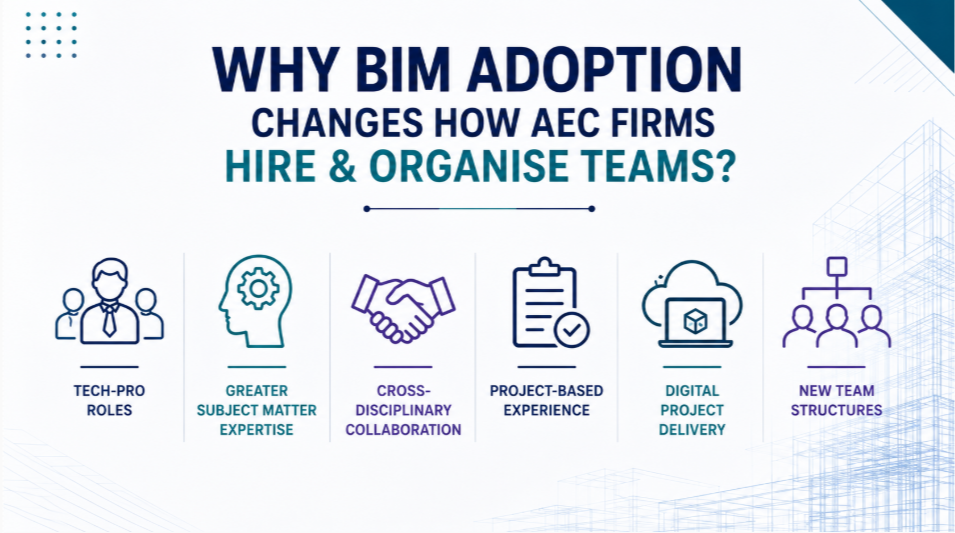**
BIM has introduced a different way of working, where project teams need a broader combination of technical expertise, BIM coordination skills, and digital capabilities. Here’s why:
**Tech-Pro Roles:** BIM workflows have created new positions such as BIM Coordinators, BIM Managers, [BIM Modellers](https://www.novatr.com/blog/how-to-become-a-bim-modeler), and Information Managers. These professionals take ownership of tasks that were previously distributed across traditional architecture, engineering, and project management roles.
**Greater Subject Matter Expertise:** Working on BIM-led projects requires more than knowing a modelling software. Professionals must understand model development, documentation, clash detection, coordination, and data exchange across various project stages.
**Cross-Disciplinary Collaboration:** BIM connects architectural, structural, MEP, and other project disciplines within a shared digital environment. This demands professionals who can communicate across teams and resolve issues rather than working in silos.
**Project-Based Experience:** Firms value candidates who can demonstrate how they have applied BIM skills to real projects. Experience with BIM standards and ISO 19650 protocol, model coordination, documentation, and delivery workflows can indicate whether a candidate is ready to contribute from day one.
**Digital Project Delivery:** BIM has shifted design and build workflows from manual processes towards connected digital workflows. Therefore, firms need professionals who can work with tools such as Revit, [Navisworks](https://www.novatr.com/blog/navisworks-type), ArchiCAD, Autodesk Construction Cloud, and Common Data Environments (CDEs).
**New Team Structures:** Traditional AEC teams often followed a straightforward hierarchy based on disciplines and seniority. However, BIM introduces new functions that create interconnected teams where experts work closely across different stages of delivery.
## **How Does BIM Adoption Influence Hiring Priorities and Team Structures?**
The changing nature of digital construction is pushing AEC firms to look beyond traditional roles when hiring and organising their teams. Here’s how this impacts BIM hiring across the domain:
**Hiring for BIM-Specific Roles:** Firms that once hired primarily around traditional architecture, engineering, and drafting positions now recruit for dedicated BIM roles. This has created positions such as BIM Coordinators, [BIM Managers](https://www.novatr.com/blog/guide-to-become-bim-manager), and Information Managers within larger teams.
**Prioritising Digital Competencies:** In workforce planning, the criteria have expanded beyond conventional design and engineering knowledge. Employers now assess candidates for their ability to work with BIM platforms, coordinate models, manage information, and navigate digital project environments.
**Valuing Practical Project Experience:** BIM proficiency on paper does not always indicate workplace readiness. Firms increasingly look for candidates who have applied their knowledge to live or simulated projects, handled coordination issues, followed project standards, and delivered BIM outputs.
**Moving Towards Multidisciplinary Teams:** Traditional teams were typically organised around separate disciplines, with coordination happening between them. BIM brings these disciplines into more connected workflows, increasing the need for professionals who can collaborate across architectural, structural, MEP, and other teams.
**Creating BIM-Specific Functions:** Larger AEC firms may establish BIM or digital delivery roles instead of distributing every BIM responsibility among existing staff. These teams can support multiple projects through coordination, standards, modelling, and technical assistance.
**Adding Coordination Layers:** BIM can introduce coordination functions between discipline teams and project leadership. This helps firms onboard professionals responsible for managing model integration, resolving conflicts, and keeping information aligned across teams.
**Bringing BIM Into Leadership:** At the senior level, the scope for BIM recruitment can advance into strategy and decision-making. BIM leaders may also oversee standards, [digital workflows](https://www.novatr.com/blog/top-revit-features-for-better-design-and-bim-workflows), technology implementation, and the organisation-wide use of BIM.
**Formalising Information Management:** The need to control project information has also created clearer responsibilities around data, CDEs, information requirements, and ISO 19650 processes. This gives information management a more defined place within modern AEC team structures.
## **Which New Roles, Skills, and Responsibilities Emerge as BIM Adoption Grows?**
The introduction of new [BIM careers](https://www.novatr.com/blog/bim-career-skills-guide) has expanded the range of roles within AEC teams. It has also increased expectations for candidates to possess holistic BIM skills. This includes:
| **Stages of BIM Adoption** | **Key Roles** | **Primary Responsibilities** | **Skills Needed** |
| --- | --- | --- | --- |
| Model Development | BIM Modeller, BIM Designer | Create and maintain discipline-specific models, develop drawings, and maintain model accuracy. | Revit, modelling standards, documentation, attention to detail |
| Model Coordination | BIM Coordinator, VDC Coordinator | Combine discipline models, identify clashes, coordinate design changes, and support multidisciplinary reviews. | Navisworks, BIM coordination, clash detection, communication |
| Project Delivery | BIM Manager, BIM Project Manager | Establish project workflows, manage deliverables, coordinate teams, and monitor BIM implementation. | ACC, CDE workflows, BIM execution plans (BEPs), project management |
| Information Management | Information Manager, BIM Information Specialist | Organise project information, manage data exchanges, maintain information requirements, and support structured documentation. | ISO 19650, BIM management, data management, information standards |
| BIM Leadership | BIM Lead, Digital Delivery Manager | Define BIM strategies, standardise processes, oversee digital delivery, and align BIM with business and project goals. | BIM strategy, leadership, automation, interoperability, process management |
## **What Challenges Do AEC Firms Face When Scaling BIM Teams?**
**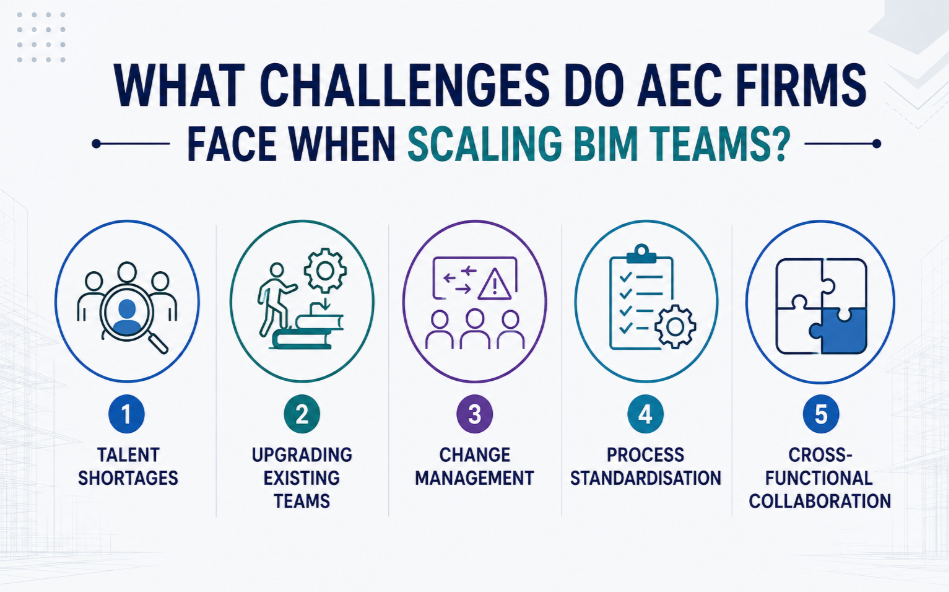**
A pressing need for BIM expertise also brings challenges for firms trying to build and manage larger, capable BIM teams. Let’s explore the key issues in BIM implementation:
**Talent Shortages:** The rising demand for [BIM professionals](https://www.novatr.com/blog/complete-bim-guide-for-aec-professionals) can make it difficult for firms to find candidates with the right skill set. Hiring someone who comprehends a BIM tool is often easier than finding someone who understands how to apply it within real project workflows.
**Upgrading Existing Teams:** Incorporating BIM across a set workforce needs professionals to learn new tools, processes, and responsibilities. Firms must invest in continuous training while helping employees apply these skills to active projects without disrupting ongoing work.
**Change Management:** Moving from familiar 2D or fragmented workflows to a connected BIM environment can meet resistance from teams accustomed to existing processes. Successful implementation needs proactive communication, leadership support, and adequate time for employees to adapt.
**Process Standardisation:** Larger teams need uniform modelling standards, naming conventions, and documentation practices. Without clearly defined processes, different teams may develop their own methods, making information more difficult to manage.
**Cross-Functional Collaboration:** BIM brings architects, engineers, contractors, and other specialists into close-knit collaboration. While this can improve project delivery, it also requires teams to communicate effectively, [resolve conflicts](https://www.novatr.com/blog/clash-detection-and-resolution-in-mep-projects), and understand how their work affects other disciplines.
BIM is Advancing. Are You?
Get BIM certified and open doors to a better career.
Join the Program
## **Conclusion**
The growing demand for BIM professionals signals a broader shift in the AEC industry, where digital transformation is becoming an important part of career growth. For professionals looking to strengthen their BIM knowledge and gain hands-on experience, structured learning can provide a strong foundation for entering this emerging field.
We suggest you explore the [BIM Professional Program](https://www.novatr.com/courses/bim-professional-program?utm_source=organic_search&utm_medium=blog&utm_campaign=) by [Novatr](https://www.novatr.com/). This comprehensive course teaches everything from BIM fundamentals and software to coordination and workflows. In this 7-month program, students also get the opportunity to work on capstone projects, learn from case studies, and receive one-on-one mentorship. Further, Novatr ensures career readiness of these learners by offering assistance for resume building, portfolio creation, and job placement.
For additional industry insights and learning resources, join us on our [WhatsApp channel](https://whatsapp.com/channel/0029Vb7Gy2LBFLgMx79j7B1b) or visit our [Resources Page](https://www.novatr.com/learning-hub) to learn about the latest trends in architecture and engineering.
## **FAQs**
### **1. Why are AEC firms hiring more BIM professionals?**
AEC companies are hiring BIM professionals because it helps them achieve cost reduction, timeline optimisation, and better stakeholder communication.
### **2. How does BIM adoption create new job roles?**
BIM adoption creates new job roles by introducing tech-first workflows, new software, and efficient project delivery.
### **3. Which BIM roles become important as firms adopt BIM?**
BIM roles such as BIM Modeller, BIM Coordinator, BIM Manager, and BIM Consultant have become more important as firms adopt BIM.
Was this content helpful to you
Like Yes
Dislike No

TABLE OF CONTENTS
BIM Is The New Standard. Are You Certified?
Get Certified in BIM
SHARE ON YOUR SOCIALS
Link Copied Successfully
Related articles
[ BIM Civil 8 Essential Tools Used by BIM Coordinators 30 April 2026 6 min read](https://blog.novatr.com/blog/8-essential-tools-used-by-bim-coordinators) [ BIM What Employers Look for When Hiring BIM Graduates: Top Skills and Qualifications 27 August 2026 6 min read](https://blog.novatr.com/blog/what-employers-look-for-in-bim-graduates) [ BIM What Do BIM Professionals Look for in an AEC Company? 26 August 2026 8 min read](https://blog.novatr.com/blog/what-do-bim-professionals-look-for-in-an-aec-company) [ BIM Top BIM Companies Hiring BIM Architects in 2026: Where to Build Your Career 24 July 2026 10 min read](https://blog.novatr.com/blog/top-bim-companies)
Download Syllabus
## BIM Professional Program
Next Cohort
June 2026
Program Duration
7 Months
Premium Program benefits
8 Credentials from Autodesk, NSDC, Novatr
1 program. 10 career paths. Infinite Growth.
40+ ISO 19650 & RIBA real-world projects to practice
1-on-1 guidance. Access 400+ industry experts.
Access the biggest AEC-Tech community on the planet. 8500+ and counting
Curated for you by 100+ global BIM leaders.
Lifelong access to course content
Enter your details to download the program syllabus.
##### BIM Professional Program
June 2026, 7 Months
Your Name Invalid name.
Phone Number Enter a valid phone number
Email Please enter a valid email address.
Select years of experience\* Currently studying 0-1 years 1-2 years 2-4 years 4-8 years 8-10 years 10-12 years 12+ years Invalid selection.
Specialisation Select your background\* Architecture Civil Engineering Mechanical Engineering Electrical Engineering Invalid selection.
Are you professionally trained in interior design?
Yes
No
I agree to the [Terms of Use](https://www.novatr.com/terms-and-conditions) and [Privacy Policy](https://www.novatr.com/privacy-policy), and consent to be contacted by Email, Call, WhatsApp, or SMS.
Submit
Ready to skyrocket your career?
Begin your next chapter in AEC
with Novatr!
We are here to help you take the industry by storm with advanced, tech-first skills.
[Explore Courses](https://www.novatr.com/#courses)
Join our newsletter
Submit
Thank you for signing up.
We’ll send you a nice letter once per week. No spam.

Dare to Disrupt.
Join thousands of people who organise
work and life with Novatr.
Company
- [About Us](https://www.novatr.com/about)
- [BIM Professional Program v.2026](https://www.novatr.com/courses/bim-professional-program)
- [Masters Computational Design](https://www.novatr.com/courses/computational-design)
- [Become a Mentor](https://www.novatr.com/apply-as-mentor)
- [Hiring from Us](https://www.novatr.com/hire-from-us)
- [Careers at Novatr](https://www.novatr.com/career)
Resources
- [Blog](https://www.novatr.com/learning-hub)
- [Media Room](https://www.novatr.com/media-room-home-page)
- [Career Builder](https://www.novatr.com/career-navigator)
- [Events & Webinars](https://www.novatr.com/webinars)
- [FAQs & Support Center](https://www.novatr.com/contact-us)
- [Contact Us](https://www.novatr.com/contact-us)
- [Privacy Policy](https://www.novatr.com/privacy-policy)
- [Terms of Use](https://www.novatr.com/terms-and-conditions)
©2023 Oneistox Network Pvt. Ltd.
All Rights Reserved
```json
{
"@context" : "https://schema.org",
"@type" : "BlogPosting",
"author" : {
"@type" : "Person",
"name" : "Pragya Sharma",
"url" : "https://blog.novatr.com/blog/author/pragya-sharma"
},
"dateModified" : "2026-09-01T06:44:28.003Z",
"datePublished" : "2026-08-31T10:16:46.000Z",
"headline" : "How BIM Adoption Changes Hiring Structure in Companies?{{year}}",
"image" : [ "https://blog.novatr.com/hubfs/Screenshot%20Capture%20-%202026-08-31%20-%2015-44-22.png" ],
"mainEntityOfPage" : {
"@id" : "https://blog.novatr.com/blog/how-bim-adoption-changes-hiring-structure-in-companies",
"@type" : "WebPage"
},
"publisher" : {
"@type" : "Organization",
"logo" : {
"@type" : "ImageObject",
"url" : "https://blog.novatr.com/hubfs/Novatr%20Prev%20OX-2.svg"
}
}
}
```