


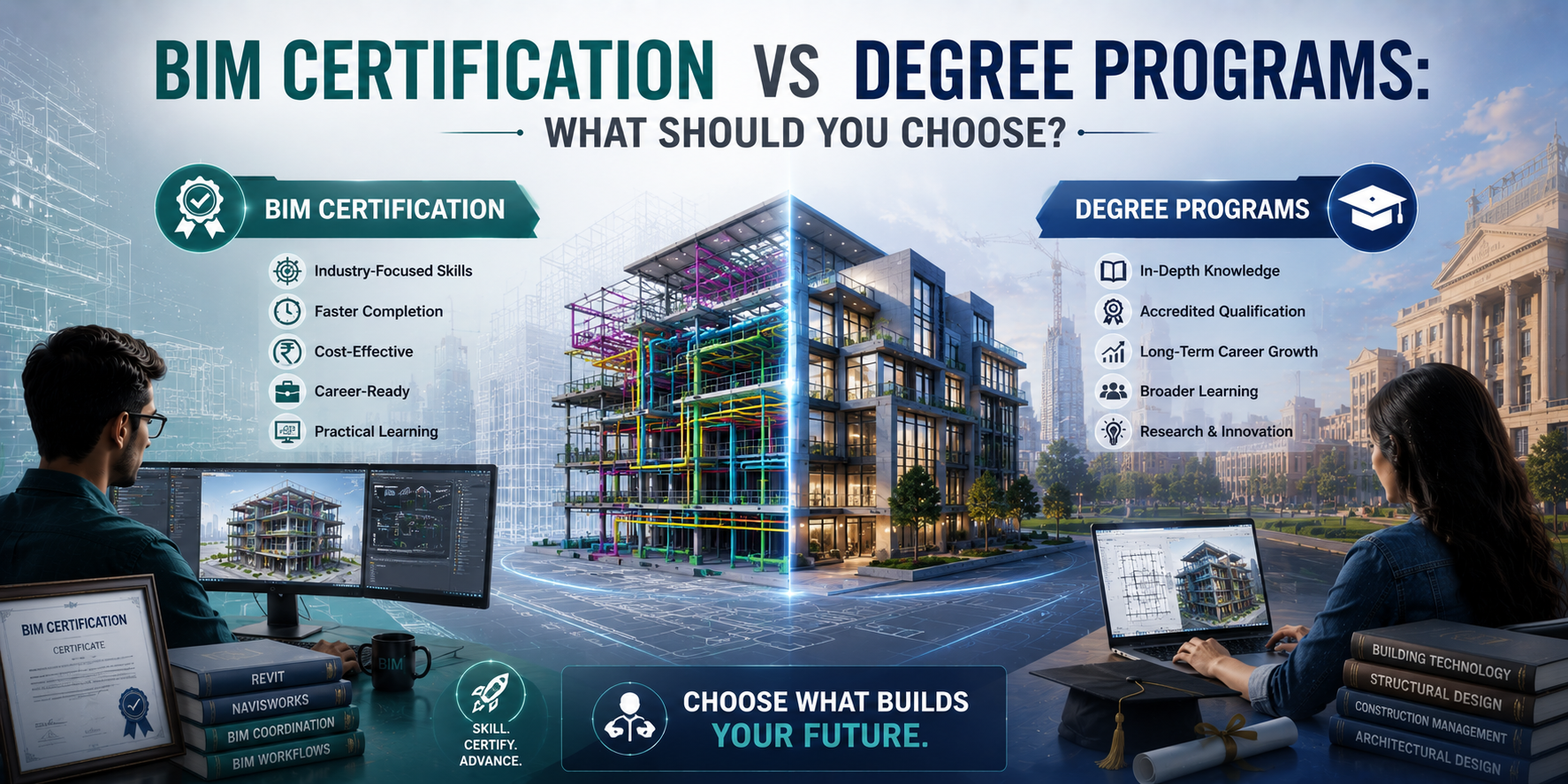

What’s the Difference Between BIM Certifications and Degree Programs?
Both BIM certifications and a BIM degree can help you build a career in the AEC industry, but they serve different purposes. While degree programmes provide a broad architecture education, BIM certification courses focus on developing practical, job-ready skills in a shorter period.
|
Aspect |
BIM Certification |
BIM Degree Program |
|
Focus |
Practical BIM skills and software training |
Broad architecture education with BIM as one subject |
|
Duration |
Typically 3 to 12 months |
Usually 3 to 5 years |
|
Learning Approach |
Hands-on projects and industry workflows |
Academic coursework with theoretical concepts |
|
Software Training |
Extensive training in industry-standard BIM tools |
Basic to moderate exposure, depending on the curriculum |
|
Career Outcome |
Prepares learners for entry-level BIM and senior digital construction roles |
Builds a foundation for architecture, engineering, and construction careers |
|
Best For |
Students and professionals looking to upskill quickly |
Learners seeking a full-time academic BIM degree or architecture qualification |
Which Option Builds More Practical BIM Skills?
Choosing the right BIM course depends on your career goals. Degree programmes provide academic foundations, while certification courses focus on software training, industry workflows, and real-life BIM projects that prepare learners for BIM roles.
|
Programme |
Type |
What You Learn |
Practical Exposure |
|
Novatr BIM Professional Program |
Professional Certification |
Learn BIM execution planning, interdisciplinary coordination, BIM documentation, automation with Dynamo, project collaboration, BIM standards, and portfolio development using tools such as Revit, Navisworks, Autodesk Construction Cloud, and Forma. |
High - Includes mentor-led learning, capstone projects, real-life projects, industry case studies, portfolio building, and career support. |
|
Autodesk Certified Professional (ACP) -Revit |
Software Certification |
Focuses on advanced Revit modelling, documentation, project setup, and validating software proficiency. |
Primarily software-focused with certification-based assessments. |
|
Bachelor of Architecture (B.Arch) |
Degree Programme |
Covers architectural design, building construction, structures, history of architecture, environmental planning, and introduces BIM concepts in some institutions. |
Studio projects with limited exposure to professional BIM workflows. |
|
Bachelor of Construction Technology |
Degree Programme |
Covers construction methods, surveying, building materials, quantity estimation, project planning, construction management, and digital construction fundamentals. |
Practical site training, but software-specific BIM exposure varies by university. |
|
RICS School of Built Environment / Similar BIM Certification Courses |
Professional Certification |
Covers BIM fundamentals, digital collaboration, model coordination, and BIM implementation aligned with industry practices. |
Includes assignments and software exposure but generally less project-intensive than immersive professional programmes. |
What Do Employers Value More in BIM Hiring?
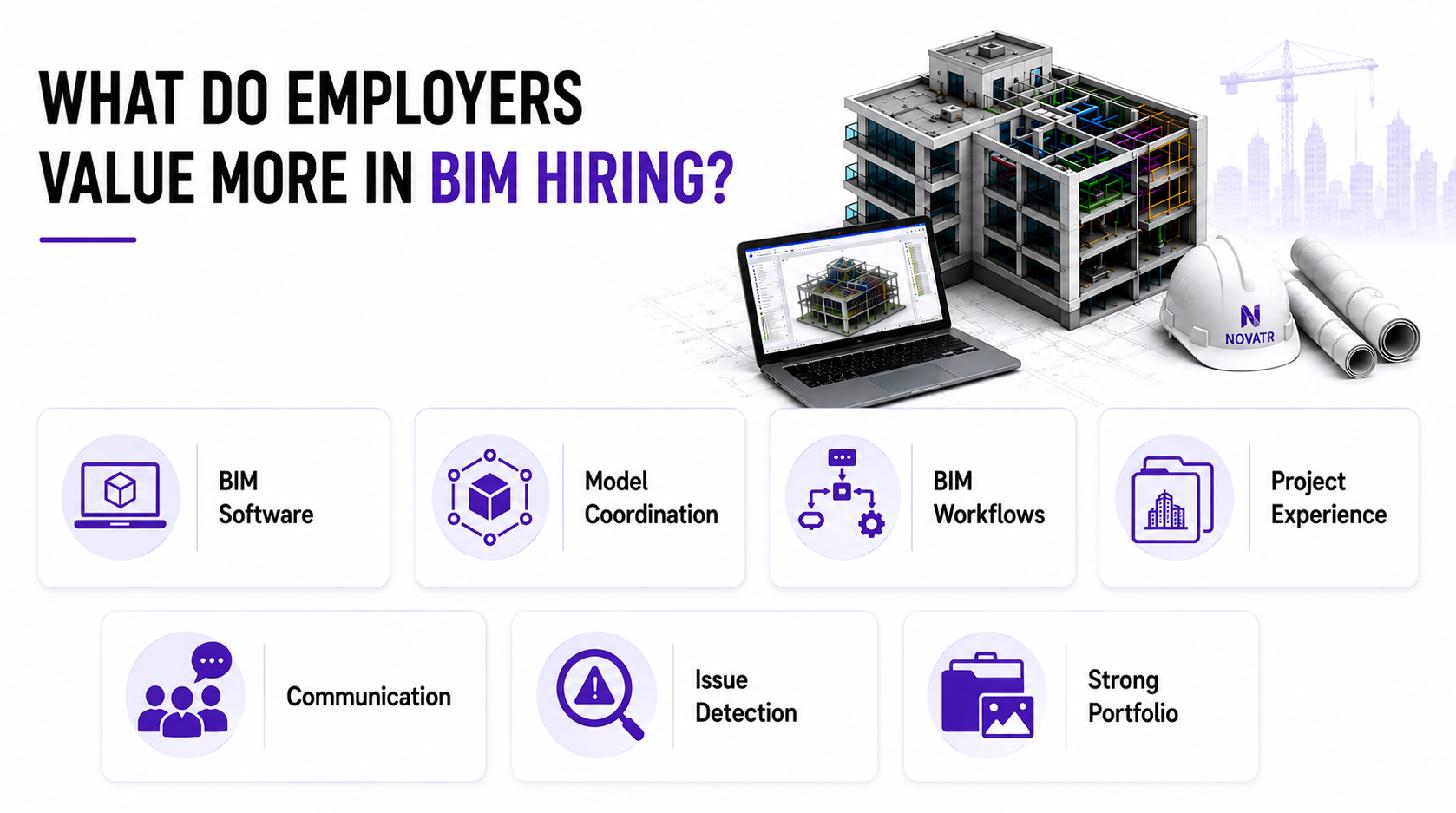
Employers look beyond qualifications when hiring BIM professionals. They prefer candidates who can apply their knowledge to real projects, work with industry-standard tools, and understand modern construction technology practices.
-
Hands-on experience with BIM software such as Revit, Navisworks SketchUp Studio, Autodesk Forma, Graphisoft Archicad and many more.
-
The ability to coordinate architectural, structural, and MEP models.
-
A strong understanding of BIM workflows and digital project delivery.
-
Experience working on practical or industry-based projects rather than only academic assignments.
-
Good communication and collaboration skills for working with multidisciplinary teams.
-
The ability to identify design issues early and support efficient project coordination.
-
A portfolio that demonstrates practical BIM skills and real project outcomes.
How Do Career Growth and Learning Outcomes Compare?
Choosing the right learning path can influence both your career progression and the practical skills you develop. While degree programmes provide academic knowledge, specialised BIM training helps learners build job-ready expertise with industry workflows and BIM software.
|
Learning Path |
Learning Outcomes |
Career Growth |
|
Novatr BIM Professional Program |
Develops practical skills in BIM execution planning, multidisciplinary coordination, documentation, BIM standards, Autodesk Construction Cloud, Dynamo, and portfolio development through mentor-led projects. |
Prepares learners for BIM Modeler, BIM Coordinator, and other digital construction roles with career support and industry exposure. |
|
Architecture or Engineering Degree |
Builds a strong academic foundation in design, engineering, and construction principles, with limited BIM exposure depending on the institution. |
Opens opportunities in architecture and engineering, with additional BIM skills often required for specialised digital roles. |
|
Postgraduate Construction Management Programmes |
Covers planning, project management, contracts, scheduling, and BIM-enabled construction practices. |
Supports progression into project management and senior construction roles while strengthening technical expertise. |
What Should Students and Professionals Choose Based on Their Goals?
The right learning path depends on your current experience, career aspirations, and the type of skills you want to build. Understanding your objectives can help you choose a programme that best supports your long-term growth.
-
For Students Starting Their Careers
Students aiming to enter BIM jobs should consider certification programmes that combine software training, practical assignments, and portfolio development. These courses help build industry-ready skills in a shorter time.
-
For Working Professionals
Professionals looking to switch roles or advance their careers can benefit from advanced BIM programmes that strengthen technical expertise and prepare them for specialised digital construction roles.
-
For Academic and Long-Term Learning
If your goal is to pursue higher education or build a strong theoretical foundation, a degree programme with BIM integrated into the curriculum can provide broader knowledge of architecture and construction.
.png)
.png)
.png)